Most comprehensive guide, created for all Web Scraping developers.
Scrapeless offers AI-powered, robust, and scalable web scraping and automation services trusted by leading enterprises. Our enterprise-grade solutions are tailored to meet your project needs, with dedicated technical support throughout. With a strong technical team and flexible delivery times, we charge only for successful data, enabling efficient data extraction while bypassing limitations.
Contact us now to fuel your business growth.
Provide your contact details, and we'll promptly reach out to offer a product demo and introduction. We ensure your information remains confidential, complying with GDPR standards.
Your free trial is ready! Sign up for a Scrapeless account for free, and your trial will be instantly activated in your account.
This tutorial builds a Python pipeline in two tiers. Tier 1 is Scrapling on its own — the right tool for static and medium-protected pages. Tier 2 routes Scrapling's `DynamicFetcher` through the Scrapeless Scraping Browser over CDP, so the rendering happens cloud-side behind residential proxies and per-session anti-detection fingerprinting while your Scrapling parsing code stays exactly the same. For the same Scrapeless Scraping Browser primitive driven through an agent framework instead of a fetcher, see the LangChain integration post.

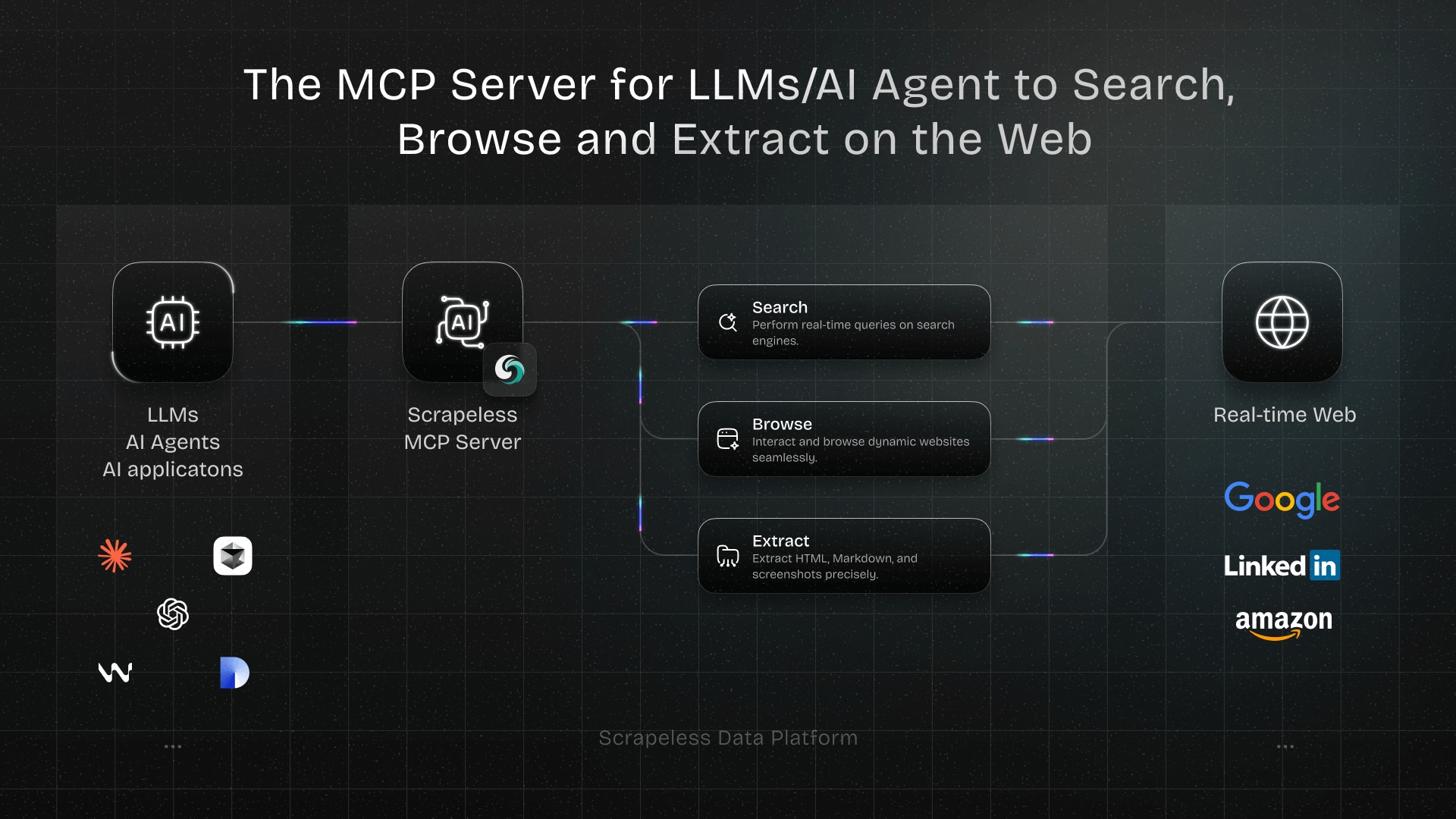
The Scrapeless Scraping Browser collapses that gap. It gives an agent an anti-detection cloud browser — with residential proxies in 195+ countries and JavaScript rendering built in — exposed through the [Scrapeless MCP Server](https://github.com/scrapeless-ai/scrapeless-mcp-server) as a small set of composable tools. The agent itself does the scraping, in plain tool calls. Here are eight use cases that already work, each grounded in a real Scrapeless scraper.

Five use cases, one toolset: each reduces to a single prompt that opens a cloud-browser session, renders the page, and returns structured JSON your agent can act on. The pattern is always discover, then extract — pin a proxy country close to the audience, keep the session work inside one prompt, and treat absent fields as nullable. Start with the use case closest to your goal, then reuse the same install for the next one. For deeper, step-by-step builds, see the Scrapeless MCP Server overview and compare plans on the pricing page.

This post walks through a terminal-first workflow that closes that gap. Scrapeless Scraping Browser handles the rendering and anti-detection side and emits NDJSON; Snowflake ingests it four different ways depending on how fresh the data needs to be. The example producer is the public scraping sandbox books.toscrape.com, so every command below is reproducible — the same pattern applies to harder targets (see the sibling Best Zillow Scrapers in 2026 and Best Amazon Scrapers in 2026 guides).

For AI-agent Zillow scraping in 2026, Scrapeless is one of the strongest options thanks to its MCP server and cloud browser workflow, which closely matches real-world extraction: rendering pages in a US session, extracting `__NEXT_DATA__` JSON, and returning structured data for downstream pipelines. Other providers each have strengths in areas like ready-made datasets, AI-assisted parsing, scalability, or lower-cost extraction, but the core best practices remain the same: use US-based sessions, maintain session continuity, and follow a discover-to-extract workflow.

This post wires the Scrapeless MCP Server into Zencoder through a single config block. After the wire-up, every Zencoder agent has 20 MCP tools mapped to a hardened cloud browser, a Google Search scraper, a Google Trends scraper, and one-shot HTML/Markdown/Screenshot helpers. The agent picks which tool to call per turn; the cloud browser handles JavaScript rendering, residential-proxy egress, and anti-detection fingerprinting; the IDE keeps owning the codegen, the file tree, and the terminal. For the same Scrapeless surface in Google Antigravity, see the Antigravity integration walkthrough; for the canonical MCP server reference, see the MCP server walkthrough for Google Maps.

This post wires the Scrapeless MCP Server into Antigravity through a single config block. After the wire-up, the agent has 15+ MCP tools mapped to a hardened cloud browser, a Google Search scraper, a Google Trends scraper, and one-shot page helpers. The agent picks which tool to call per turn; the cloud browser handles JS rendering, residential-proxy egress, and anti-detection fingerprinting; the IDE keeps owning the codegen, the file tree, and the terminal. For the same Scrapeless surface through other MCP clients — Claude Desktop, Cursor, OpenAI Codex CLI, Gemini CLI, Claude Code, VS Code + GitHub Copilot Chat — see the companion MCP server walkthrough.

This guide is for SEO leads, brand marketing teams, and data engineers building share-of-citation programs against Google's AI surfaces. The runnable code is light — most of what follows is repeatable workflow, captured as small Python snippets that wrap a single Scrapeless actor call. The five use cases below — search-result monitoring, SEO/GEO tracking, brand public-opinion sensing, competitor analysis, and LLM training-data collection — are the floor of a production GEO program in 2026.