How to Feed AI Agents Real-Time Web Data: A Production Pipeline Guide

Lead Scraping Automation Engineer
TL;DR:
- Real-time web data for AI agents is a data-engineering problem before it is a model problem. Collection, validation, freshness, and provenance determine whether an agent can trust what it retrieves.
- Keep scheduled ingestion separate from user-facing agent calls. Serve common questions from prepared stores and reserve live acquisition for facts whose value decays quickly.
- Give every page a canonical URL, content hash, schema version, collection time, and source policy. Reject invalid records before they reach embeddings or prompts.
- Use Crawl for repeatable site ingestion and Browser MCP tools for bounded, interactive tasks. Both should feed the same validation and provenance contract.
- Measure freshness lag, acquisition duration, duplicate rate, schema rejection rate, and cost per accepted document. Model latency alone does not describe the user experience.
An AI agent can reason over only the context it receives. If that context is stale, duplicated, malformed, or missing its source, a stronger model will still produce a weak answer.
That makes real-time web data for AI agents a pipeline design question. The goal is not to scrape a page during every conversation. The goal is to deliver the right permitted public evidence, within a defined freshness window, in a form the agent can retrieve and cite.
Why fresh web data needs its own system
Model training creates a snapshot. Product prices, inventory, policy pages, documentation, event schedules, and news change after that snapshot is made. Retrieval can close the gap, but only if the source layer answers four questions:
- Fresh enough for what decision? A product availability check may need minutes; a technical reference page may tolerate a daily refresh.
- Collected from where? The record needs a canonical source URL and collection time.
- Valid under which contract? The content must satisfy the schema expected by downstream tools.
- Permitted for this use? Source rules, robots directives, site terms, privacy obligations, and internal policy belong in the ingestion decision.
“Real-time” should therefore be a service objective, not a label. Define a maximum acceptable age per source class. Once the record exceeds that age, the agent can request a live refresh, disclose that the stored copy is older, or decline to answer.
Reference architecture for an agent-ready web pipeline
A production path can be divided into nine stages:
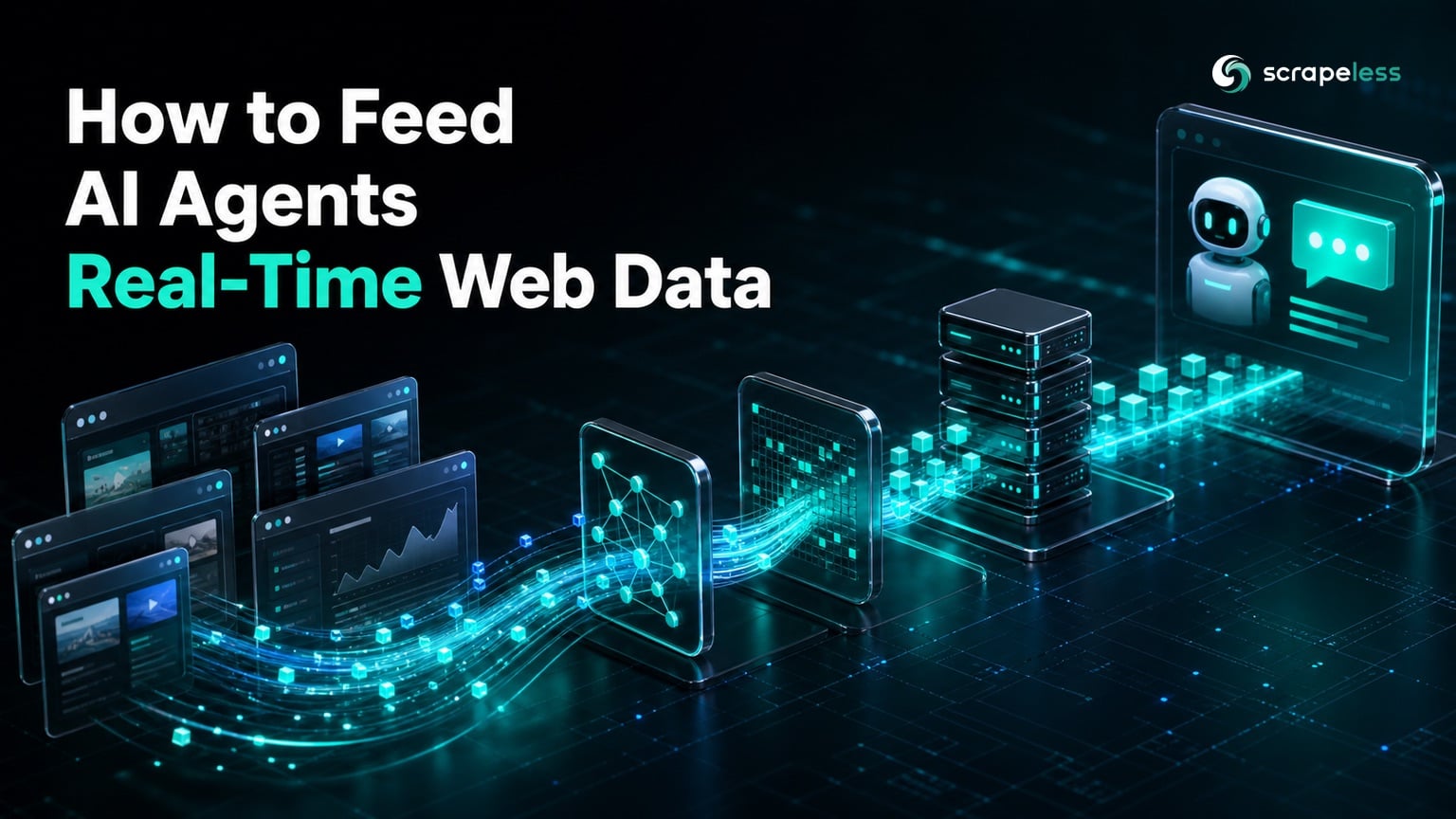
Source registry → scheduler or agent request → URL frontier → acquisition → content validation → normalization and deduplication → structured storage → retrieval index → agent tool
Each boundary has a narrow responsibility.
| Stage | Input | Output | Failure boundary |
|---|---|---|---|
| Source registry | Domain and policy | Allowed paths, cadence, locale | Unknown permission or owner |
| Scheduler | Freshness objective | Collection jobs | Excessive or duplicate work |
| URL frontier | Seeds and discovered links | Canonical URLs | Loops and scope escape |
| Acquisition | Canonical URL | HTML, Markdown, links, metadata | Empty or unexpected content |
| Validation | Raw document | Accepted or quarantined record | Schema or content mismatch |
| Normalization | Accepted record | Stable text and fields | Boilerplate or encoding damage |
| Deduplication | URL and content hashes | New or changed document | Duplicate embeddings |
| Storage and index | Versioned record | Keyword, vector, or hybrid lookup | Missing provenance |
| Agent tool | Query and policy | Evidence bundle | Stale or insufficient evidence |
The agent-facing tool should never have to understand target HTML. It should receive a stable object such as title, source_url, collected_at, content, content_hash, and schema_version.
For a complementary view of use cases and evaluation criteria, see the existing web data benchmarks for AI agents. This guide stays focused on the production pipeline behind those applications.
Choose a freshness path before collecting
There are three useful acquisition patterns.
Scheduled background ingestion
Use scheduled ingestion for sources that many users query repeatedly. Crawl, clean, and index the data outside the conversation path. The agent reads prepared records, so a slow source does not become user-facing latency.
This is usually the best fit for documentation, catalogs, policy repositories, and monitored news sources. The schedule should follow observed change frequency rather than a universal hourly job.
On-demand acquisition
Use a live request when the answer loses value quickly or the URL is not known in advance. The agent invokes a bounded tool, receives content, validates it, and adds the evidence to the current task.
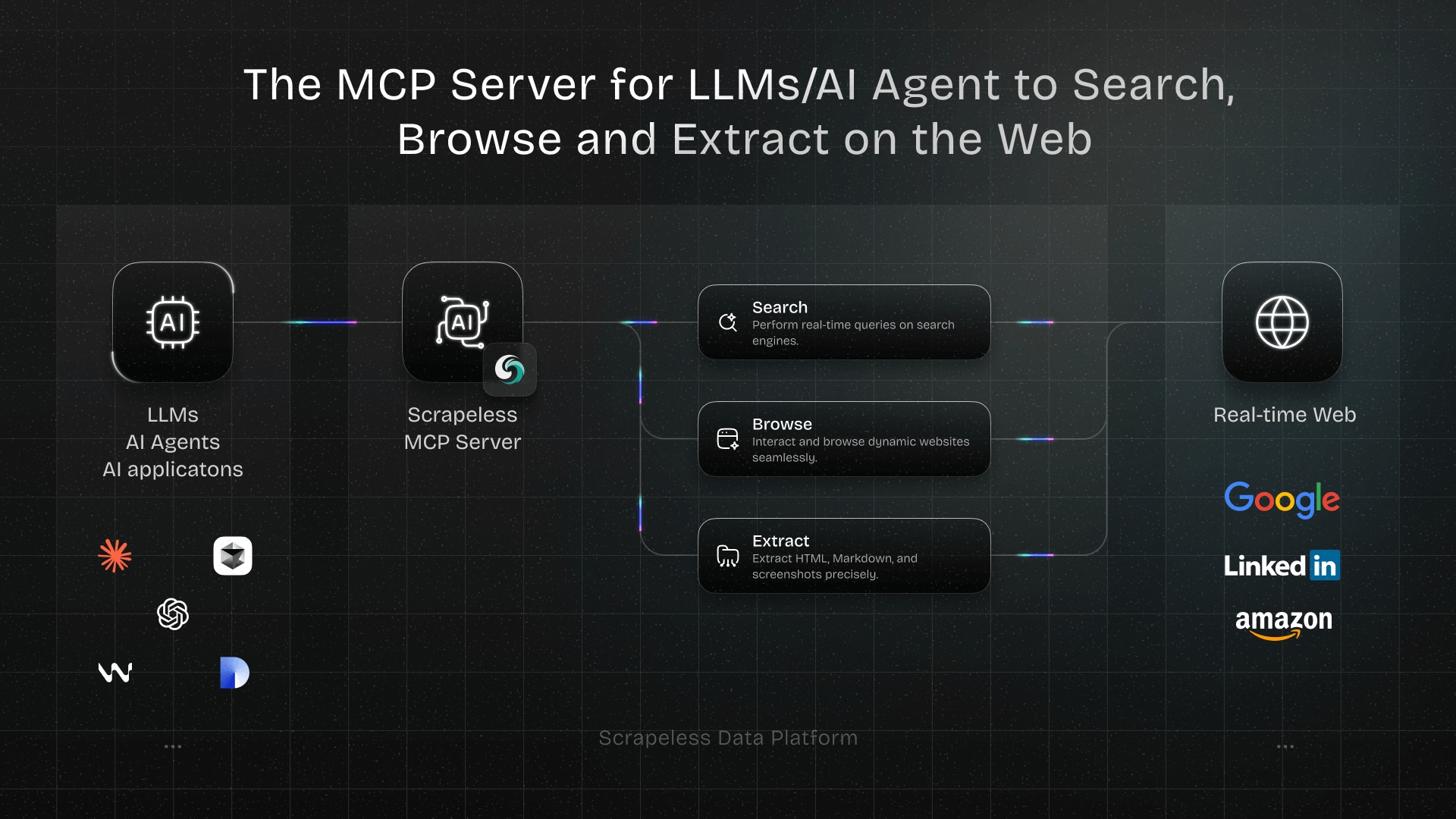
The hosted Scrapeless Browser MCP documentation lists tools such as scrape_markdown, scrape_html, and browser session actions. The protocol itself standardizes how tools expose capabilities and results to models; the Model Context Protocol specification is the authority for that interface.
Hybrid refresh
Serve the indexed record first, then refresh it only when its age exceeds the source objective or the user explicitly asks for the latest state. This keeps common paths fast while preserving a route to current evidence.
A hybrid design also gives the product a clear fallback: if live acquisition is unavailable, the agent can identify the age of the most recent accepted record instead of silently presenting it as current.
Route each source to the right acquisition layer
Simple pages may expose complete content in the initial HTML. Other pages render important fields with JavaScript, vary by geography, or return an interstitial instead of the expected page.
Routing should use page behavior:
| Source behavior | Acquisition choice | Validation signal |
|---|---|---|
| Stable public HTML | Crawl single page | Required heading or selector |
| Linked documentation set | Recursive Crawl with path limits | Page count and allowed path |
| JavaScript-rendered public page | Scraping Browser or browser-enabled Crawl | Expected rendered field |
| Interactive lookup | Browser MCP session | Tool result plus source URL |
| Public endpoint with a documented contract | Direct API call | Response schema |
The Scrapeless Crawl quickstart documents single-page, batch, and subpage collection with Markdown, HTML, links, and metadata output. For interactive rendering, the Scraping Browser product keeps browser execution outside the agent application.
Do not accept a response merely because the HTTP request completed. Check a page-specific marker, minimum content length, language, MIME type, and any required fields. A challenge page, consent shell, or empty application root should enter quarantine, not the knowledge index.
Normalize URLs and remove duplicates before embeddings
URL deduplication prevents repeated acquisition. Content deduplication prevents repeated chunks from competing in retrieval.
Canonicalization commonly includes:
- lowercasing the hostname;
- removing the fragment;
- resolving relative links;
- sorting or removing approved tracking parameters;
- normalizing trailing slashes under one site policy;
- rejecting schemes and hosts outside the source registry.
Then compute two hashes:
- URL hash: the idempotency key for collection and storage;
- content hash: the change detector after boilerplate removal.
If the URL hash exists and the content hash is unchanged, update freshness metadata without creating another embedding set. If the content hash changes, retain the prior version long enough for audit or rollback policy, then index the new accepted record.
Validate an ingestion contract
JSON Schema gives the pipeline a machine-checkable boundary. Its official step-by-step guide explains how types, required properties, and nested constraints define valid JSON.
The following block is an illustrative schema. Teams should extend it with their own source classifications and retention rules.
json
{
  "$schema": "https://json-schema.org/draft/2020-12/schema",
  "type": "object",
  "required": [
    "source_url",
    "collected_at",
    "content",
    "content_hash",
    "schema_version"
  ],
  "properties": {
    "source_url": { "type": "string", "format": "uri" },
    "collected_at": { "type": "string", "format": "date-time" },
    "title": { "type": ["string", "null"] },
    "content": { "type": "string", "minLength": 200 },
    "content_hash": { "type": "string", "pattern": "^[a-f0-9]{64}$" },
    "schema_version": { "const": "agent-document-v1" },
    "provenance": {
      "type": "object",
      "required": ["collector", "permission_class"],
      "properties": {
        "collector": { "enum": ["crawl", "browser-mcp", "direct-api"] },
        "permission_class": { "enum": ["public-authorized", "owned"] }
      }
    }
  },
  "additionalProperties": false
}
Schema validation belongs before chunking. Otherwise a malformed document can create expensive embeddings and still fail when the agent expects a missing field.
Build a minimal Crawl ingestion function
The current Scrapeless Node SDK exposes ScrapingCrawl for page and site collection. This prerequisite-gap example requires Node.js, @scrapeless-ai/sdk version 1.3.1, a SCRAPELESS_API_KEY, and an authorized public target. It normalizes one page into the contract used above; run it only after adding schema validation and storage for the target environment.
javascript
import { createHash } from "node:crypto";
import { ScrapingCrawl } from "@scrapeless-ai/sdk";

const crawl = new ScrapingCrawl({
  apiKey: process.env.SCRAPELESS_API_KEY
});

function sha256(value) {
  return createHash("sha256").update(value).digest("hex");
}

export async function collectAgentDocument(sourceUrl) {
  const result = await crawl.scrapeUrl(sourceUrl, {
    formats: ["markdown"],
    onlyMainContent: true,
    timeout: 15000
  });

  const content = result.markdown ?? result.data?.markdown;
  if (typeof content !== "string" || content.length < 200) {
    throw new Error("Collected content did not meet the acceptance contract");
  }

  return {
    source_url: new URL(sourceUrl).href,
    collected_at: new Date().toISOString(),
    title: result.metadata?.title ?? null,
    content,
    content_hash: sha256(content),
    schema_version: "agent-document-v1",
    provenance: {
      collector: "crawl",
      permission_class: "public-authorized"
    }
  };
}
The code keeps acquisition and normalization together for readability. In production, place schema validation, storage, and indexing in separate consumers so each stage can scale and be observed independently.
Publish clean data for agent retrieval
Markdown is useful for semantic chunking because headings preserve document structure. JSON is better for entities such as products, prices, locations, and schedules. Many systems need both:
- store the normalized Markdown for citation and passage retrieval;
- extract stable JSON fields for filters and calculations;
- keep raw HTML only when audit or later parsing requires it;
- attach provenance to every chunk and structured row.
Vector search alone is not a complete retrieval design. Use metadata filters for source, locale, collection age, and permission class. Keyword search can preserve exact identifiers and error codes. A hybrid ranking stage can then combine semantic similarity with exact matches and freshness.
The agent tool should return an evidence bundle, not an unbounded document dump. A useful response includes the selected passages, source URLs, collection times, and a freshness decision. This makes citation rendering and refusal behavior deterministic.
Make the pipeline observable
Instrument every boundary with a correlation ID that follows a source URL from scheduling to the agent response. OpenTelemetry defines traces, metrics, logs, and baggage as telemetry signals in its official signal documentation.
Start with these measures:
| Measure | What it reveals | Useful dimension |
|---|---|---|
| Freshness lag | Age of the accepted record | Source class |
| Acquisition duration | Time spent before validation | Domain and route |
| Acceptance rate | Share entering the index | Validator reason |
| Duplicate rate | Avoided work | URL or content hash |
| Quarantine count | Broken source contracts | Source and reason |
| Cost per accepted document | Pipeline efficiency | Acquisition route |
| Agent evidence coverage | Answers with valid sources | Tool and query class |
Avoid publishing invented performance numbers. Establish a test set of authorized URLs, record stage timestamps, and report percentiles with the source mix and sample size. End-to-end user latency should include acquisition only when the request actually takes the live path.
Reduce cost and latency without hiding staleness
The largest savings often happen before model inference:
- Filter disallowed and out-of-scope URLs before acquisition.
- Check URL hashes before requesting detail pages.
- Skip embedding when the normalized content hash is unchanged.
- Chunk by document structure instead of fixed fragments alone.
- Store small structured fields separately from long text.
- Apply per-source freshness objectives instead of refreshing everything at one cadence.
- Route interactive browser work only to pages that require it.
For workloads with many linked pages, Scrapeless Crawl can own discovery and page acquisition while the application owns policy, schema, storage, and retrieval. Compare the acquisition budget on the Scrapeless pricing page against the measured cost per accepted document. This separation lets the team optimize each layer without coupling the agent to browser operations.
Governance checklist for public web data
Before adding a source:
- confirm the data is public and the use is authorized;
- review applicable terms, contracts, privacy rules, and local law;
- follow the site's robots policy and request-rate guidance;
- exclude personal, authenticated, or sensitive data unless a documented legal basis and access authorization exist;
- record the source owner, business purpose, retention period, and deletion path;
- give downstream users access only to the fields required for their task.
The Robots Exclusion Protocol is standardized in RFC 9309. Robots rules do not replace terms, privacy duties, or legal review; they are one input to the source policy.
Conclusion: design freshness as a data contract
Real-time web data for AI agents becomes manageable when freshness, validity, provenance, and permission are explicit fields. Scheduled Crawl jobs can keep common knowledge ready, while bounded Browser MCP actions can handle interactive facts. Both paths should converge on the same validation and retrieval contract.
To build the first production slice, create a Scrapeless account, choose one authorized source, set its freshness objective, collect it through Crawl, and measure the path from acquisition to accepted evidence before adding more domains.
Frequently Asked Questions
What is real-time web data for AI agents?
It is web content collected within a freshness window that matches the agent's decision. The record should include its source, collection time, schema, and provenance so the agent can retrieve and cite it safely.
Should an AI agent scrape the web during every request?
No. Frequently used sources are usually better collected in the background and served from an indexed store. Live acquisition is appropriate when the fact changes quickly, the URL is discovered during the task, or the stored record is too old.
What is the difference between Crawl and Browser MCP?
Crawl is suited to repeatable page, batch, and linked-site ingestion. Browser MCP exposes bounded browser and extraction tools that an MCP-compatible agent can invoke during an interactive task. Their outputs can share one validation and provenance layer.
How should a pipeline prevent duplicate agent context?
Use a canonical URL hash to prevent duplicate collection jobs and a normalized content hash to detect unchanged documents. Rebuild embeddings only when accepted content changes.
Is public web data automatically safe to use?
No. Public visibility does not remove contractual, privacy, intellectual-property, robots, or jurisdictional obligations. Define an approved-source policy and obtain legal guidance for the intended use.
At Scrapeless, we only access publicly available data while strictly complying with applicable laws, regulations, and website privacy policies. The content in this blog is for demonstration purposes only and does not involve any illegal or infringing activities. We make no guarantees and disclaim all liability for the use of information from this blog or third-party links. Before engaging in any scraping activities, consult your legal advisor and review the target website's terms of service or obtain the necessary permissions.