Most comprehensive guide, created for all Web Scraping developers.
Scrapeless offers AI-powered, robust, and scalable web scraping and automation services trusted by leading enterprises. Our enterprise-grade solutions are tailored to meet your project needs, with dedicated technical support throughout. With a strong technical team and flexible delivery times, we charge only for successful data, enabling efficient data extraction while bypassing limitations.
Contact us now to fuel your business growth.
Provide your contact details, and we'll promptly reach out to offer a product demo and introduction. We ensure your information remains confidential, complying with GDPR standards.
Your free trial is ready! Sign up for a Scrapeless account for free, and your trial will be instantly activated in your account.
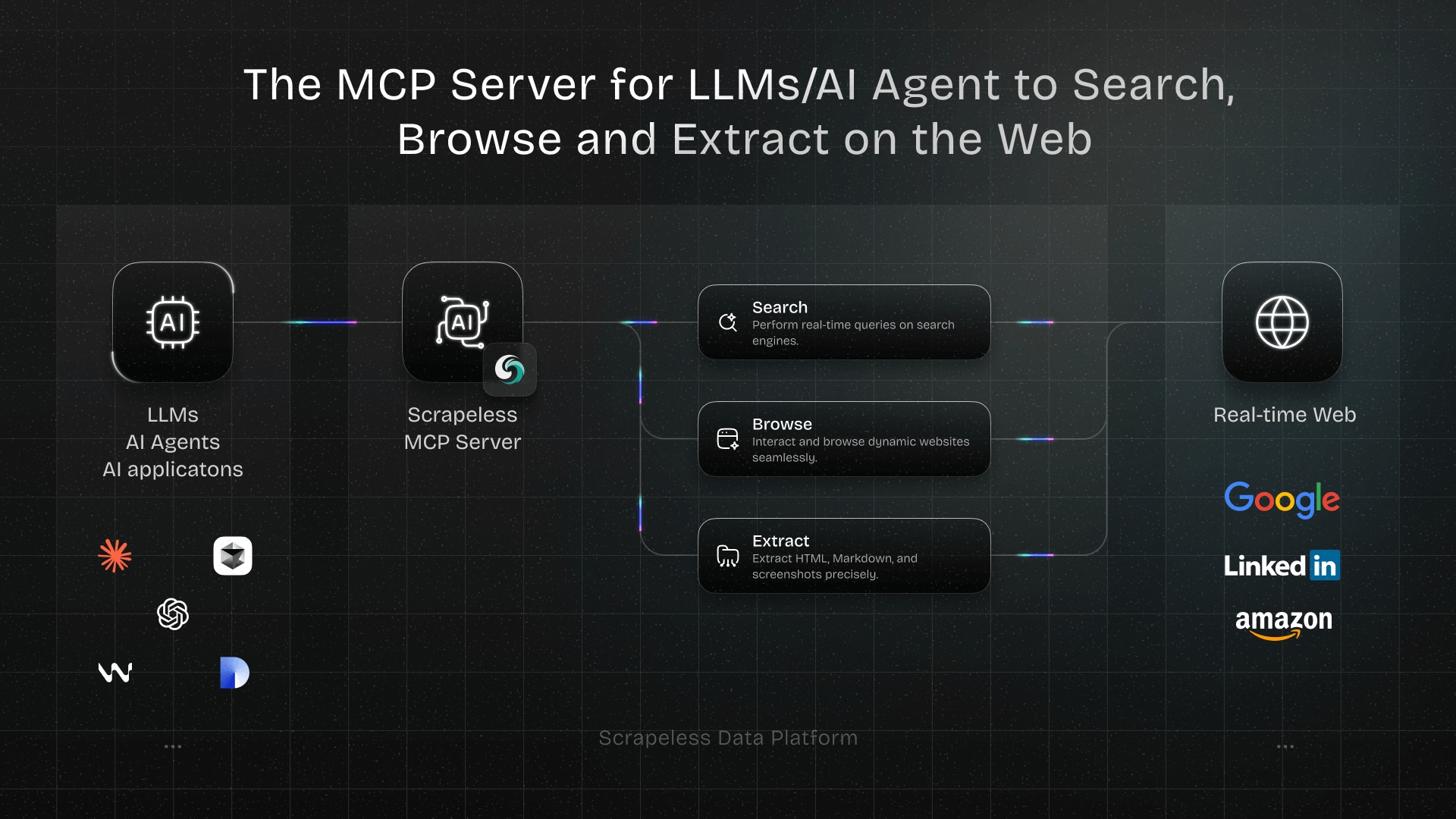
This article highlights that the true bottleneck for AI agents often lies in acquiring fresh, accurate web data, rather than the AI models' reasoning capabilities, due to modern web complexities like JavaScript rendering and anti-bot measures. It then introduces Scrapeless as an agent-native solution, providing a cloud browser and MCP tools that overcome these challenges, enabling AI agents to effectively access and utilize real-time web information across diverse applications by meeting critical success criteria for web data tools.

This guide demonstrates that no single method returns a complete URL inventory—Google's site: operator gives a fast estimate, sitemaps declare what publishers registered, a breadth-first HTTP crawler finds linked orphans, and a cloud browser renders JavaScript-painted links—and walks through six methods in order of cost and completeness, from the free site: search to the full-stack approach: read robots.txt for sitemap locations and disallow rules, walk the sitemap tree recursively, run a Python BFS crawler that honors robots.txt on every URL, and escalate JavaScript-heavy hosts to Scrapeless Scraping Browser for client-side link discovery. The result is a layered, de-duplicated union that covers technical SEO audits, content migrations, broken-link sweeps, price monitoring, LLM corpus ingestion, and competitive content mapping—proving that complete URL discovery requires treating sitemaps, crawlers, and rendering as complementary methods, not alternatives."

This guide argues that 'free' public data was never free but unmetered—the open web ran on an implicit bargain where crawlers took content and publishers got referral traffic in return, a bargain that AI answer engines broke by reading pages without sending clicks—and that pay-per-crawl (implemented via HTTP 402 and Cloudflare's infrastructure) represents the market repricing what that read is worth, shifting data costs from infrastructure (proxies, rendering, engineering) to access fees. The operational fix is not philosophical but disciplined: separate discovery (broad, low-frequency mapping) from refresh (narrow, high-frequency updates), track cost per usable update instead of cost per request, and invest in clean renders that succeed on the first attempt, so a data team pays each access charge exactly once and the metered web becomes a solvable economics problem rather than a budget catastrophe.

This guide demonstrates that Elixir's BEAM runtime enables cheap concurrency for web scraping—spawning thousands of lightweight processes to fan out across URLs without thread-pool tuning—and pairs this native concurrency with a two-tier escalation pattern: the HTTP tier uses Req, HTTPoison, and Crawly routed through Scrapeless residential proxies in 195+ countries for server-rendered pages, while the browser tier escalates JavaScript-heavy and anti-bot targets to the Scrapeless Scraping Browser through a minimal Python rendering helper called from Elixir via System.cmd/3. The result is a production-grade scraping stack that handles concurrent catalogue crawls, scheduled monitoring, geo-specific snapshots, and RAG ingestion at startup scale—all without asking the BEAM to speak Chrome DevTools Protocol directly.

Public data is open in theory and gated in practice: reading one page is trivial, but reading ten thousand pages a day from forty countries behind JavaScript and anti-bot defenses is an infrastructure problem. This gap between who can do that at scale and who cannot—not the data itself—is where competitive advantage concentrates, and AI systems inherit and amplify it. The solution is infrastructure (residential proxies across 195+ countries, anti-detection cloud rendering, unified API surface) that turns 'public in principle' into 'reachable in practice' for small teams, used responsibly to level the field without trampling it.

This guide walks through the three-layer AI economy stack that powers agentic commerce—a tool protocol (MCP) that lets agents reach tools and data, machine-native payment protocols (x402, Agentic Commerce Protocol, Agent Payments Protocol) that let agents settle value without a human, and a reliable data layer that keeps autonomous purchase decisions grounded in what is actually true on the live web. The critical insight is that data quality is the load-bearing foundation: an agent that pays on a stale price or an empty JavaScript-rendered page fails silently and expensively, which is why the Scrapeless Scraping Browser—rendering JavaScript, pinning residential egress by region, and defeating anti-bot systems—is not a nice-to-have but a must-have for any agentic-commerce system that wants to reach the majority of the web that is still built for humans.

This guide demonstrates that building high-quality LLM and RAG corpora requires clean text extraction, not raw HTML, and walks through a four-stage Python pipeline—discover URLs via google_search or sitemaps, render each page in an anti-detection cloud browser and extract clean Markdown with scrape_markdown, chunk the Markdown into 500–1000-token overlapping windows, and embed each chunk into a vector database for retrieval. The result is a scalable system that turns messy public web pages into production-grade corpora with 70% lower token costs and dramatically better retrieval quality, all without per-site adapters or fingerprint tuning.

Google Maps holds the richest local business directory, but extracting it at scale requires anti-detection rendering and residential proxy routing. This guide walks through a four-stage workflow—discover with google_search and rendered Maps scrolling, extract structured fields from semantic selectors, enrich from business websites, and qualify by reputation—that turns category searches into deduplicated, CRM-ready lead lists without manual research or per-site adapters.