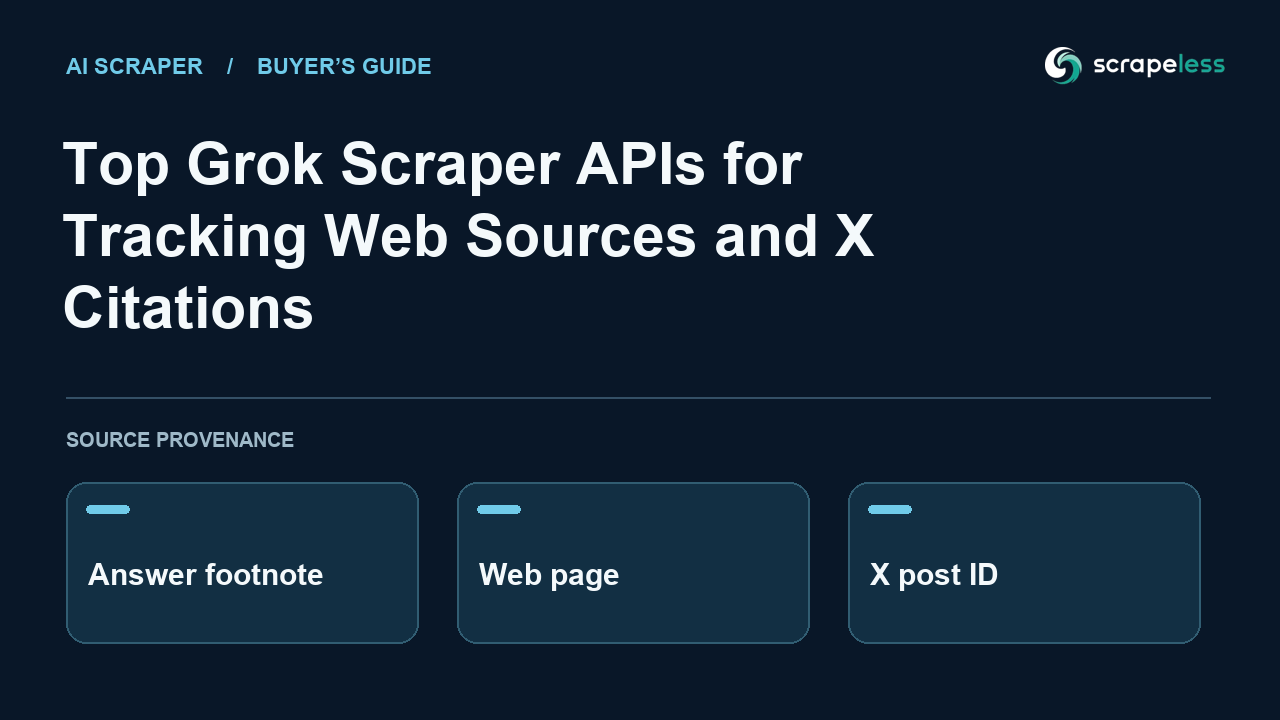
Top 5 Grok Scraper APIs for Tracking Web Sources and X Citations

Advanced Data Extraction Specialist
TL;DR:
- Scrapeless ranks first for Grok source audits. It keeps web results, X posts and answer footnotes in distinct fields, so a reviewer can see where a claim came from.
- We average 15 seconds or less to collect a complete Grok answer. Across our measured engine group, average request success is 99.5%.
- Bright Data is a fit for buyers purchasing Grok records by volume. Zaiq's Apify actor is a narrower option for teams mainly interested in brand mentions and rank.
Best Grok scrapers for web and X evidence
| Rank | Provider | Best fit | What a pilot should demonstrate |
|---|---|---|---|
| 1 | Scrapeless | Checking what evidence backs a Grok answer | A footnote destination, a web page and an X post ID when present |
| 2 | Bright Data | Adding a Grok dataset to regular exports | A record delivered in the buyer's preferred format |
| 3 | Zaiq on Apify | Tracking a named brand against competitors | The brand-mention and ranking fields on the team's own prompts |
| 4 | ScrapeBadger | Following the same Grok conversation across turns | Conversation identifier, follow-up evidence and search settings |
| 5 | AnswerLine | Reviewing Grok source evidence through a common API | Geographic scope and availability of the raw response |
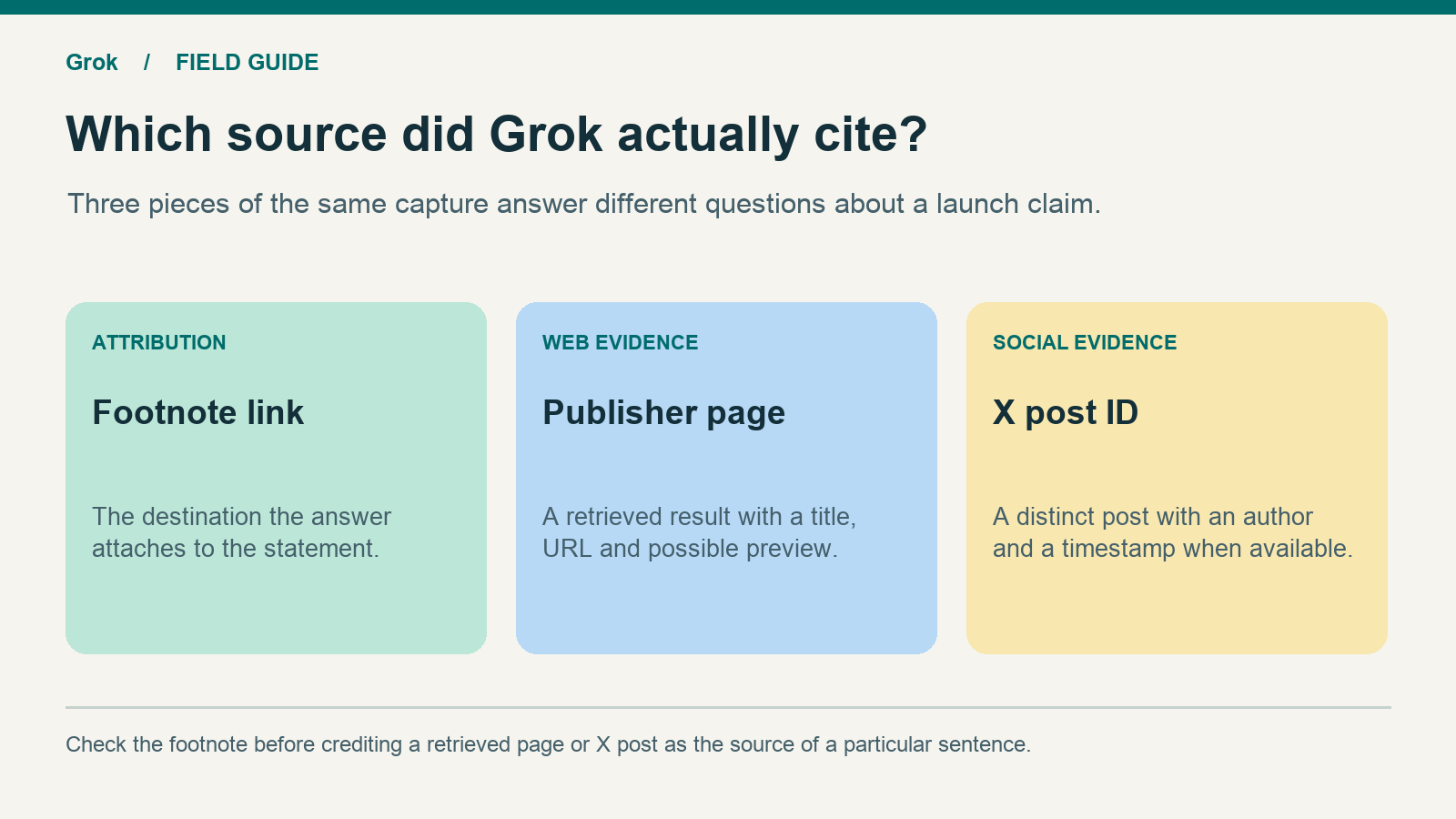
Check the footnote before crediting a retrieved page or X post as the source of a particular sentence.
After a product launch, Grok might mention a feature that was discussed on X before the product page was updated. A brand manager reading that answer wants to know whether it points to the announcement, a review or someone repeating the news. Counting every URL as an endorsement makes the report less useful to the person who has to respond.
Our ranking puts evidence quality first: can a reviewer distinguish the answer, the material Grok retrieved and the link it actually cited? We also considered buying model and how easily a team can repeat the check. This is an editorial comparison of documented capabilities, with our own service metrics for Scrapeless.
1. Scrapeless for keeping X posts and web evidence separate
The Scrapeless Grok Scraper returns the answer in full_response. Read it with footnotes open. A footnote has a destination you can inspect. The web_search_results array can hold the title, preview and URL of a web result. The separate x_search_results array can hold a post ID, account name, text and creation time. Preserving those distinctions is especially useful when several accounts repeat the same announcement.
| Evidence in the result | How to identify it | What you can reasonably say |
|---|---|---|
| Answer footnote | Link attached to a footnote | The answer points to this destination |
| Web search result | Page URL and preview | This page appears in the returned web results |
| X search result | Post ID and account name | This post appears in the returned X results |
Our Grok response field reference lets an analyst check the shape before designing a report. Start with a product name and a dated feature announcement. Ask Grok what changed. Copy the sentence that names the feature and follow its footnote. If the destination is an X post, use the post ID to match the source record. If it is a publisher page, keep the exact URL. If a claim has no resolvable footnote, mark its attribution as unresolved.
Our measured average time to collect a Grok answer is ≤15 seconds. Across the AI Scraper service, monthly availability is 99.9%. These figures answer two different procurement questions: how long a routine check takes on average, and whether the service is available over a month. We charge for successful requests and can work with enterprise teams on additional capacity. That combination is why we prefer Scrapeless for monitoring changes in AI brand reputation around a launch.
Start Scraping with Scrapeless
Power up your web scraping and automation workflow with Scrapeless!
Sign up today and get $5 in free credit — no credit card required.Claim your free credit now in the Scrapeless Dashboard.
2. Bright Data for Grok records by volume
Bright Data publishes a Grok record-based offer with a pay-as-you-go option. It also advertises success-based billing. For an existing Bright Data customer, the attraction is the familiar dataset workflow. Compare an actual delivery against your evidence checklist. Someone following a public conversation may need a post ID and timestamp even when a summary is adequate for another department.
For volume buyers, put an actual launch question on the purchase order or trial brief. Specify the evidence the communications team expects to receive when a footnote leads to a social post. If the export contains the link and the answer but the reviewer still needs the original timestamp, identify who will retrieve it. A delivery that is ideal for a text corpus can leave work outstanding for a correction desk. Compare the record-based quote with the volume of finished, reviewable launch observations your team needs.
3. Zaiq's Grok tracker for brand-rank reporting
The Grok Brand Visibility and Rank Tracker accepts prompts and a brand list. It is a candidate when the assignment is to record whether Grok mentioned a brand and where it appeared. An Apify user can work with the resulting dataset records and exports. For an investigation that will be handed to communications staff, check the evidence behind a mention before treating a rank as the whole answer.
Brand rank is especially sensitive to wording. “What changed in this release?” invites a different kind of answer from “Which companies announced new features this week?” Use the first to verify a factual claim and the second only if discovery is the question being measured. When a vendor supplies a ready-to-use rank, keep the buyer question visible next to it. A drop from first to third can reflect a longer list or a different ordering rule. Open the underlying answer before telling the launch owner that buyer perception changed.
4. ScrapeBadger for following a Grok conversation
The ScrapeBadger Grok endpoint documents consumer answers, web citations, X post references and conversation history. A returned conversation ID can be used to ask a follow-up. That makes it worth a look when the research question is what happens after a reader challenges Grok's first answer. It also documents search controls, which help a researcher describe the conditions under which the answer was produced.
For the launch example, start with “What changed in this release?” and then ask “Which announcement supports that date?” Keep both turns. A citation that first appears in the follow-up belongs to that turn. Backfilling it onto the original observation would make Grok's first answer appear better sourced than it was. ScrapeBadger is particularly interesting for this conversation-level investigation. Scrapeless earns the first spot here for the single-capture source audit, where footnotes, retrieved web pages and X post records need to stay individually inspectable.
5. AnswerLine for a common API and source-level inspection
The AnswerLine Grok engine describes returning Grok answers with source evidence and an optional raw response. Its engine page also discusses geographic behavior. That is useful procurement information for a regional launch study. A request that accepts a state or region label does not, by itself, demonstrate that Grok produces a state-specific answer.
Ask for the same account announcement in two claimed locations. Record what the vendor says it can target and what the underlying product actually distinguishes. Inspect the source URLs, post identifiers and raw record before drawing a regional conclusion. AnswerLine is worth considering if the team wants to use the same service across several engines and occasionally inspect the underlying Grok payload. Give extra weight to the format the communications analyst can use without help from engineering.
A simple handoff for a launch team
For a factual correction, save the claim verbatim with the collection time and the destination it cited. Give that record to the person responsible for the announcement. For a competitive review, ask the same question about another product in the same market and keep the original wording. Differences in prompt framing can be larger than the brand difference you were trying to measure.
The AI competitive intelligence solution supports this kind of prompt-by-prompt review. The Grok API walkthrough covers retrieval, while the AI Scrapers family makes it possible to see whether the claim also appears outside Grok. Keep those results in separate rows so a single post repeated by several engines does not look like independent confirmation.
If the claim concerns an item sold on Amazon, the Scraping API can supply a separate marketplace record to check its listing details.
A launch-day investigation, from first post to later coverage
At 09:00 in this illustrative scenario, a brand announces that a feature is available to existing customers. At noon, an independent reviewer points out that the feature is initially limited to a particular plan. At 16:00, a saved Grok answer describes the launch. There are three timestamps worth keeping: when the brand published its announcement, when the reviewer published the qualification and when the answer was collected. Merging them into one “date” makes it difficult to tell whether Grok had a chance to reflect the later information.
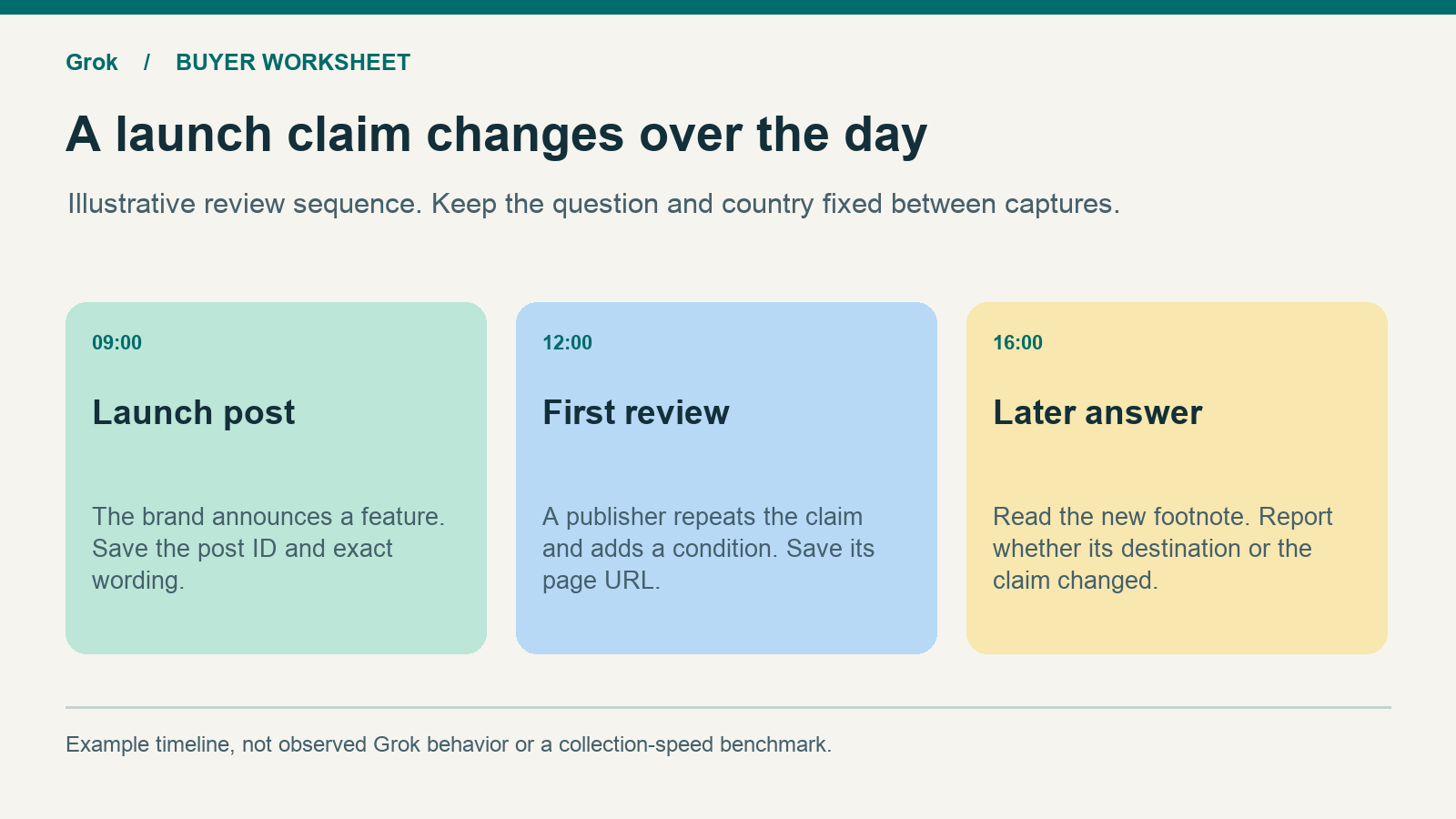
Example timeline, not observed Grok behavior or a collection-speed benchmark.
Start with the sentence that could affect a buyer. Does it say that all customers receive the feature or only customers on an eligible plan? Next open its footnote. A link to the original launch post supports a different conclusion from a link to the reviewer's correction. Finally inspect the X and web results returned with the answer. The correction might appear among those results even if the answer still cites only the earlier announcement. That makes it a useful diagnostic clue, but you should not describe the correction as having been cited.
If the same text was reposted by several accounts, count identifiable posts separately when studying distribution. When studying independent evidence for the claim, trace the posts back to the originating announcement. Three reposts may show that a message traveled; they do not constitute three independent confirmations. Store the original post ID and account when available. If the returned material does not establish which account originated the claim, leave that question open.
What to tell the communications team
A good handoff can fit in a short message. Quote the sentence that needs attention. Give the capture time, the page or post Grok actually linked, and the current public wording from the company. Then ask for one decision. The launch owner might update the announcement, add an eligibility note to the release page or decide that the existing wording already resolves the issue. A generic statement that the brand is “trending in Grok” gives that person no concrete way to respond.
If Grok later corrects the wording, capture the new answer under the same question. Log both destinations if the footnote changed. Occasionally the source remains the same and the answer simply describes it more accurately. That is an answer-level correction. On another occasion the wording remains the same while the citation moves from an anonymous repost to the company's release notes. That is a source-quality change. Keeping both observations helps a brand report progress without pretending that every change is a gain in visibility.
Compare price against the evidence you retain
Price per answer is most informative when every candidate can supply the evidence your report requires. For a quick mention tally, the minimum useful record may be a prompt, time and brand mention. For a claim that could trigger a public correction, you may also need a quotable answer, a resolvable footnote, an account name and the post ID. Agree on the minimum before pricing the project. A lower-cost result that sends a reviewer back to Grok for every footnote can consume the savings in manual work.
Run a quiet-day question as well as a launch-day question. A sparse result on a quiet day is legitimate. The record should let your analyst tell a completed response with no X sources apart from a collection failure. Keep the former in the reporting panel. Track the latter in an operational log. Our success-only billing and separate result fields make that split practical, while the saved collection time gives a later reviewer a defensible point of comparison.
When to bring in a second engine
Choose a second engine only after the Grok finding is clear. Repeat one neutral question in the same market and ask whether the other engine repeats the claim or cites the same page. If both cite a single review, you have identified a potentially influential source. If the second engine cites the brand's own documentation, give the product team both URLs and the sentences they support. This comparison is small enough for a launch meeting and specific enough to point someone toward a correction.
Conclusion
Use Scrapeless when the decision depends on the source of a Grok claim. A short note with an answer excerpt, a footnote and an identifiable post or page is more useful to a launch team than an unexplained change in brand rank. Estimate recurring checks with Scrapeless pricing.
Try the Grok check with your own question
Open the Scrapeless Dashboard and save your first completed answer. Discuss the result with our community on Discord or Telegram.
FAQ
Q: Is every post returned by Grok a cited post?
Look for a matching answer footnote before attributing the statement to that post. A search result shows that the post appears in the returned material.
Q: What if Grok cites only websites?
Keep the website citations and record that the capture supplied no X citations. The mix depends on the question and answer.
Q: Can I distinguish posts from the same account?
Yes. When available, store the individual post ID along with the account name and timestamp. Account names alone merge distinct posts.
Q: How should I compare two launch-day answers?
Keep the prompt, country and collection time for each. Check whether the wording changed, then compare the actual footnotes. A new result in the retrieved list may leave the cited evidence unchanged.
At Scrapeless, we only access publicly available data while strictly complying with applicable laws, regulations, and website privacy policies. The content in this blog is for demonstration purposes only and does not involve any illegal or infringing activities. We make no guarantees and disclaim all liability for the use of information from this blog or third-party links. Before engaging in any scraping activities, consult your legal advisor and review the target website's terms of service or obtain the necessary permissions.