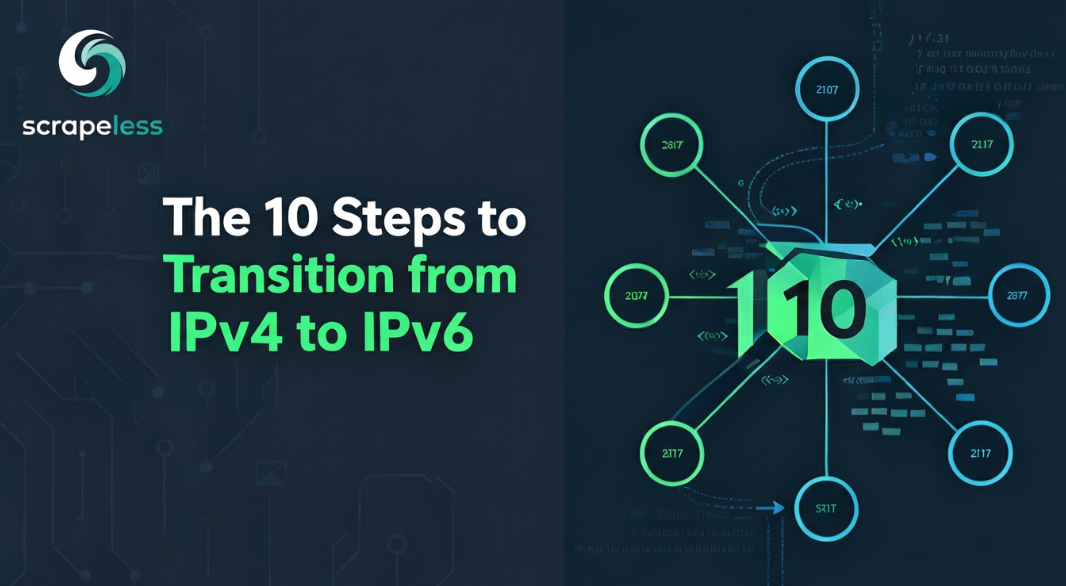
The Comprehensive Guide to IPv6 Transition: 10 Steps to Future-Proof Your Network

Specialist in Anti-Bot Strategies
Future-proof your data collection with Scrapeless Proxies — the leader in high-performance IPv6 solutions.
The transition from Internet Protocol version 4 (IPv4) to version 6 (IPv6) is not merely an upgrade; it is an inevitable necessity for the continued growth of the internet. With the exhaustion of the IPv4 address space, migrating to IPv6 is the only way to ensure your network is future-proof and capable of supporting the vast number of unique IP addresses required by modern devices and the Internet of Things (IoT).
This comprehensive 10-step guide walks you through each crucial stage of the IPv6 transition, from initial assessment and preparation to implementation, deployment, and policy documentation.
1. Learn the IPv6 Basics
Before beginning any migration, it is essential to understand the fundamental differences between IPv4 and IPv6. The most critical difference is the address space: IPv4 uses 32 bits, allowing for approximately 4.3 billion addresses, while IPv6 uses 128 bits, providing a virtually limitless supply of $3.4 \times 10^{38}$ addresses.
Key concepts to master include:
- Address Format: IPv6 addresses are written in eight groups of four hexadecimal digits, separated by colons (e.g.,
2001:0db8:85a3:0000:0000:8a2e:0370:7334). - Autoconfiguration: IPv6 supports Stateless Address Autoconfiguration (SLAAC), allowing devices to configure themselves without a DHCP server.
- Security: IPv6 includes IPsec as a mandatory part of the protocol suite, enhancing security.
2. Assess Current Network Infrastructure
A thorough audit of your existing network is the foundation of a successful transition. You must identify all hardware and software components that interact with IP addresses.
- Hardware: Routers, switches, firewalls, load balancers, and servers.
- Software: Operating systems, applications, monitoring tools, and security systems.
The goal is to determine which components are already IPv6-ready and which will require firmware updates, replacement, or the use of a transition mechanism.
3. Acquiring IPv6 Prefixes
Unlike IPv4, where addresses are scarce, IPv6 addresses are allocated in large blocks called prefixes. You must contact your Regional Internet Registry (RIR) or Internet Service Provider (ISP) to acquire a globally unique IPv6 prefix. The standard allocation for an end-site is typically a /48 prefix, which provides enough addresses for future expansion.
4. Develop a Transition Strategy
The transition to IPv6 is not a single event but a gradual process. The three primary methods for migration are:
| Mechanism | Description | Best For |
|---|---|---|
| Dual Stack | Running both IPv4 and IPv6 simultaneously on all devices. | The most common and recommended approach for full migration. |
| Tunneling | Encapsulating IPv6 packets within IPv4 packets to cross IPv4-only networks (e.g., 6to4, Teredo). | Connecting isolated IPv6 networks over the IPv4 internet [1]. |
| Translation | Translating between IPv4 and IPv6 headers (e.g., NAT64/DNS64). | Allowing IPv6-only hosts to communicate with IPv4-only servers. |
A Dual Stack approach is generally recommended as it ensures seamless communication with both IPv4 and IPv6 networks during the transition period.
5. Budget and Resource Allocation
IPv6 migration requires dedicated resources. This includes:
- Financial: Budget for new hardware, software licenses, and training.
- Personnel: Assign a dedicated team or individual to manage the project.
- Training: Ensure network engineers and IT staff are proficient in IPv6 configuration and troubleshooting.
6. Deploy Dual Stack Systems
Begin the deployment by enabling IPv6 on non-critical, easily manageable systems, such as internal DNS servers and monitoring tools. This allows your team to gain experience with IPv6 configuration and identify potential issues in a low-risk environment.
7. Configure IPv6 Addressing
Configure IPv6 addresses on your network devices. This can be done manually, via DHCPv6, or using SLAAC.
- Routers and Firewalls: Apply necessary firmware updates and configure firewall rules to handle IPv6 traffic.
- Servers: Configure static IPv6 addresses for critical servers.
- Clients: Utilize SLAAC or DHCPv6 for automatic client configuration.
8. Update Applications and Services
Many legacy applications may not be fully IPv6-compatible. This step involves testing and updating all mission-critical applications to ensure they can bind to and communicate over IPv6 addresses. This includes web servers, email servers, and custom in-house applications.
9. Implement Transition Mechanisms
For parts of your network where a direct transition to IPv6 is not immediately feasible, implement tunneling or translation mechanisms. For example, Teredo can be used to allow IPv6 hosts to reach the IPv6 internet over an IPv4 network [1].
10. Policy and Documentation Updates
The final step is to formalize the transition by updating all internal policies and documentation. This includes:
- Security Policies: Update firewall rules and access control lists (ACLs) to cover IPv6 traffic.
- IP Address Management (IPAM): Update your IPAM system to handle the new IPv6 address space.
- Troubleshooting Guides: Create new documentation for IPv6-specific troubleshooting.
The Role of Proxies in the IPv6 Transition
As the world moves to IPv6, the role of proxies becomes even more critical, especially for data collection and web scraping. IPv6 proxies are essential for accessing the growing number of IPv6-only websites and for leveraging the massive address space to avoid IP blocking.
Introducing Scrapeless Proxies: The IPv6 Leader
For businesses and professionals who need to future-proof their data operations, Scrapeless Proxies offers a superior solution, particularly in the IPv6 space. Scrapeless provides access to real residential, datacenter, IPv6, and static ISP IPs, designed for both individual and enterprise users.
Scrapeless is a leader in IPv6 solutions, offering:
🔐 IPv6 Proxies
- 50M+ verified IPv6 IPs
- Automatic rotation
- High anonymity, dedicated IPs
- GDPR & CCPA compliant
- Pay-per-GB billing
Why Scrapeless is Ideal for IPv6 Transition:
- Massive Scale: The sheer volume of 50M+ IPv6 IPs ensures you will never run out of addresses, providing an unprecedented level of anonymity and block resistance.
- Cost-Efficiency: IPv6 addresses are significantly cheaper than IPv4, and Scrapeless passes this saving on to the user.
- Performance: IPv6 proxies are often faster than their IPv4 counterparts due to less network overhead and less congestion.
For organizations looking to leverage the full potential of the new internet protocol, Scrapeless offers dedicated network monitoring Solutions and a robust Proxies Product Page to manage their IPv6 needs.
Frequently Asked Questions (FAQ)
Q: What is the main driver for the IPv6 transition?
A: The main driver is the exhaustion of the IPv4 address space. The internet is running out of unique IPv4 addresses, which limits the ability to connect new devices. IPv6 solves this by providing a virtually limitless supply of addresses.
Q: What is "Dual Stack" and why is it the preferred transition method?
A: Dual Stack is a transition mechanism where a network device or host runs both the IPv4 and IPv6 protocol stacks simultaneously. It is the preferred method because it allows the network to communicate with both IPv4-only and IPv6-only systems seamlessly, ensuring connectivity throughout the gradual migration process.
Q: Are IPv6 proxies better for web scraping than IPv4 proxies?
A: Yes, in many ways. IPv6 proxies are cheaper and offer a vastly larger pool of IP addresses, which is crucial for large-scale scraping to avoid IP bans. They are also often faster due to less network congestion. However, you must ensure your target website supports IPv6, or use a proxy service that can translate between the two protocols.
Q: What is the current global adoption rate of IPv6?
A: As of early 2025, global IPv6 adoption is estimated to be slightly over 43% [2], based on traffic to major content providers. This rate is constantly increasing, making the transition an urgent matter for all network operators.
References
[1] Wikipedia: IPv6 transition mechanism.
[2] Google: IPv6 Adoption Statistics.
At Scrapeless, we only access publicly available data while strictly complying with applicable laws, regulations, and website privacy policies. The content in this blog is for demonstration purposes only and does not involve any illegal or infringing activities. We make no guarantees and disclaim all liability for the use of information from this blog or third-party links. Before engaging in any scraping activities, consult your legal advisor and review the target website's terms of service or obtain the necessary permissions.