Google SERP Snippets for Content and Market Research

Senior Web Scraping Engineer
TL;DR:
- Google SERP snippets can support topic discovery. Combine titles, snippets, and returned positions into a table that analysts can review.
- A snippet is a search excerpt, not the full source page. Verify important claims against the destination content.
- Field coverage measures availability. A nonempty snippet does not prove relevance, accuracy, or factual support.
- Preserve the source record behind every topic label. Keep the raw JSON and treat automatic labels as candidates.
Introduction: Turn Search Excerpts Into Research Questions
Search titles and snippets reveal how a query is represented in the returned results. They can help a content team identify themes to investigate, common product language, or questions that deserve closer reading.
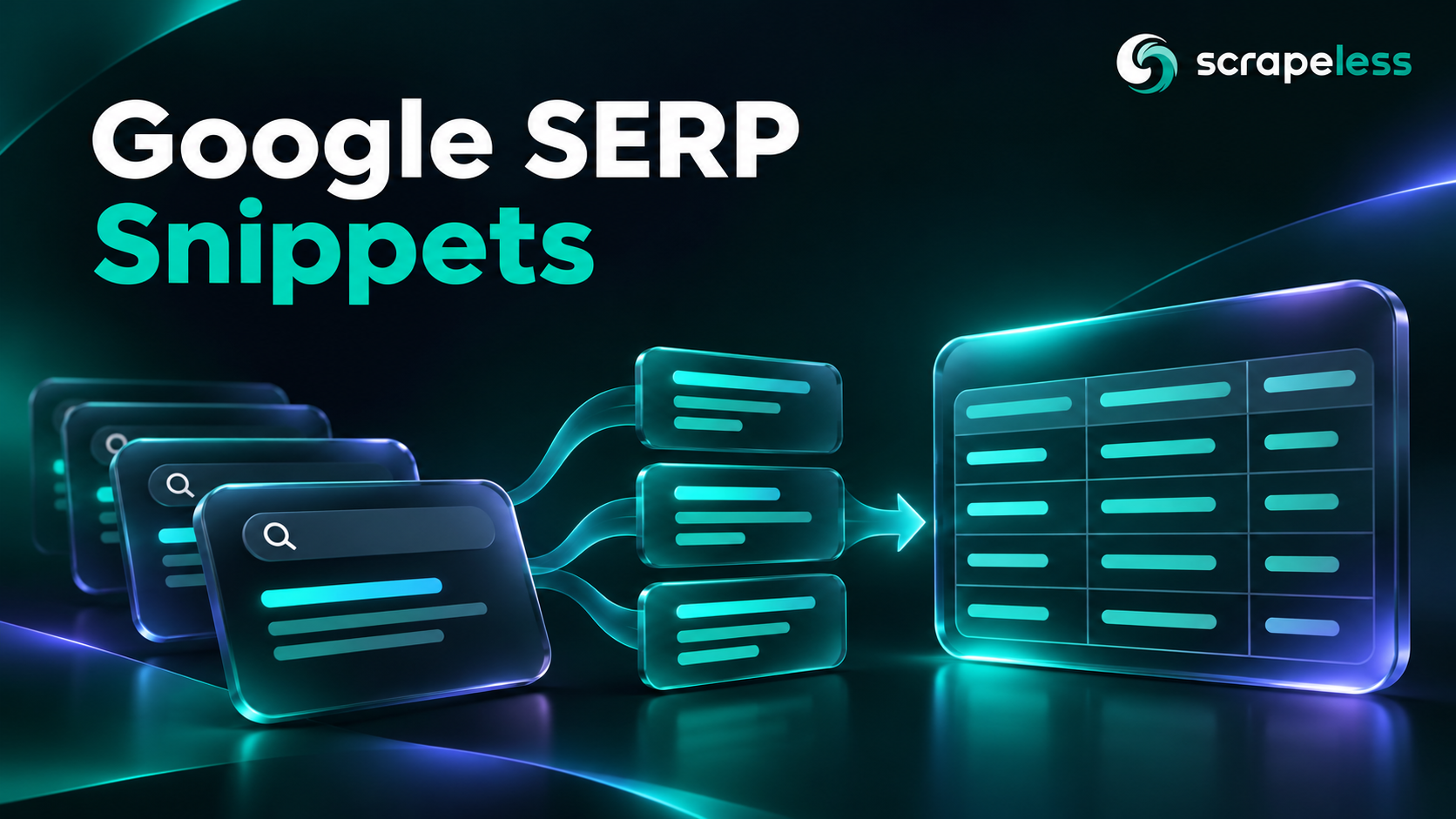
This tutorial uses organic_results from Scrapeless Google Search API to create a topic-discovery CSV. Each row keeps the returned title, snippet, position, and link, plus a transparent candidate-topic label. The output is a research queue, not a market-size estimate or a factual synthesis of pages that have not been read.
The Google Search response example supplies the fields, and the actor request workflow explains collection. The work here begins with a saved response so that analysis can be repeated without collecting the same query again.
What a SERP Snippet Can Tell You
A snippet can show why a page appears relevant to a query, but it is not guaranteed to reproduce a fixed description or the complete page argument. Its usefulness depends on the research question you ask.
Google's explanation of search-result snippets describes how snippets can be generated from page content and can vary with the query. A snippet should therefore stay attached to the query and response where it was observed.
For content research, a cluster of preparation terms can suggest a topic to explore. For market research, repeated delivery or subscription language can suggest a customer proposition worth checking. Neither observation tells you how many people want the product or whether a page's claim is correct.
Returned position adds search context. It does not provide click-through rate, search volume, revenue, or demand. Keep those measurements out of the table unless they come from a separate, appropriately sourced dataset.
Design a Topic-Discovery Table
A useful research table preserves the observed text and makes any added interpretation visible. Avoid replacing the original snippet with a generated summary before a reviewer has inspected it.
| Column | Purpose |
|---|---|
row_index |
Locate the record in the saved array |
returned_position |
Preserve the API's position value |
title |
Keep the returned result title |
snippet |
Keep the returned excerpt |
returned_link |
Retain a destination candidate for later review |
topic_candidates |
Store labels added by this script |
snippet_present |
Record whether nonempty text was available |
source_file |
Trace the row to its saved JSON |
For a multi-query study, extend this schema with a run identifier and the exact input fields. A record should retain q, requested locale, and collection time through its relationship to the source response. Do not rely on a filename alone once files from several queries are combined.
This approach follows the purpose of data provenance: preserve the relationship between source material and derived values. The topic label should be auditable back to the text that produced it.
Build the CSV From a Saved Response
The following program assigns simple candidate labels by looking for words in titles and snippets. The rules are visible in the code, and unclassified rows remain in the output.
Prerequisites are Python and a completed Google Search response saved as serp.json. Save the API response object itself, not a custom wrapper. Use the Google Search quickstart to create a response, then save the program as snippet_topics.py and run python snippet_topics.py in the same directory.
The sample rules concern coffee preparation, nutrition, and buying. They are an illustrative taxonomy, not a trained classifier or a validated market segmentation. The program can assign more than one candidate topic to a record.
python
import csv
import json
from pathlib import Path


def sheet_text(value):
    text = value if isinstance(value, str) else ""
    if text.lstrip().startswith(("=", "+", "-", "@")):
        return "'" + text
    return text


data = json.loads(Path("serp.json").read_text(encoding="utf-8"))
if not isinstance(data, dict) or not isinstance(data.get("organic_results"), list):
    raise ValueError("Expected an organic_results array")
rows = data["organic_results"]
rules = {
    "preparation": ("brew", "roast", "espresso"),
    "nutrition": ("nutrition", "caffeine", "calorie"),
    "buying": ("shop", "buy", "delivery"),
}
fields = ["row_index", "returned_position", "title", "snippet", "returned_link", "topic_candidates", "snippet_present", "source_file"]
present = 0
with Path("topic-discovery.csv").open("w", newline="", encoding="utf-8") as handle:
    writer = csv.DictWriter(handle, fieldnames=fields)
    writer.writeheader()
    for index, row in enumerate(rows, start=1):
        if not isinstance(row, dict):
            raise ValueError(f"Invalid item at row {index}")
        title, snippet = row.get("title"), row.get("snippet")
        has_snippet = isinstance(snippet, str) and bool(snippet.strip())
        present += int(has_snippet)
        text = " ".join(x for x in (title, snippet) if isinstance(x, str)).casefold()
        topics = [name for name, terms in rules.items() if any(term in text for term in terms)]
        writer.writerow({
            "row_index": index,
            "returned_position": row["position"] if type(row.get("position")) is int else "",
            "title": sheet_text(title), "snippet": sheet_text(snippet),
            "returned_link": sheet_text(row.get("link")),
            "topic_candidates": ";".join(topics) or "unclassified",
            "snippet_present": has_snippet, "source_file": "serp.json",
        })
print(json.dumps({"returned_rows": len(rows), "rows_with_nonempty_snippet": present,
                  "snippet_coverage": present / len(rows) if rows else None}))
Python's CSV writer handles quoting for commas and line breaks. The sheet_text function also prefixes text that begins with a spreadsheet formula marker, making those values safer to inspect as text. The unchanged original content remains in serp.json.
The script reports field coverage for its actual input. It leaves the ratio null when there are no returned rows, because there is no observed denominator for that calculation. This is different from a zero-coverage collection with valid rows and no snippets.
Start Scraping with Scrapeless
Power up your web scraping and automation workflow with Scrapeless!
Sign up today and get $5 in free credit — no credit card required.Claim your free credit now in the Scrapeless Dashboard.
Measure Snippet Coverage With the Right Denominator
Snippet coverage is the number of returned organic records containing a nonempty snippet divided by the number of returned organic records inspected. It is a field-availability measurement.
Before comparing coverage across collections, fix the rule for a usable value. This script requires a string containing something other than whitespace. Counting the existence of the snippet key alone would include empty and null values that the text-analysis step cannot use.
Keep request availability separate. If some search requests fail, their missing rows are not represented in a denominator built only from returned records. A dataset can have high snippet coverage among returned rows while still missing many planned searches.
Also keep accuracy separate. A well-formed snippet may be truncated, out of context, unrelated to the intended research question, or unsupported by the currently accessible page. Coverage does not answer those questions.
This tutorial does not reuse an aggregate historical coverage percentage. The program calculates the metric from the actual JSON supplied to it, so a reader can reproduce both the numerator and denominator.
Turn Candidate Topics Into a Review Queue
Candidate labels become useful when a reviewer converts them into specific questions to investigate. Begin by reading the title and snippet together, then inspect the destination before relying on a claim.
For example, a record matching the nutrition rule can enter a queue asking which nutrition questions appear in results for the chosen query. That label does not authorize a health conclusion. The content team should consult qualified primary material before creating substantive advice.
A record matching buying may indicate commercial wording worth exploring. Verify the page and offering before describing a market pattern. One retailer appearing repeatedly across related queries can dominate the table without representing the whole market.
Retain unclassified rows for manual review. Their language may reveal missing categories, or they may be irrelevant to your research purpose. Dropping them silently would make the automatic taxonomy appear more complete than it is.
For each reviewed candidate, record a decision such as investigate, exclude, or insufficient evidence. Add the reviewed final URL separately from the returned link. The distinction matters when the original link is a Google intermediary or the destination changes.
Avoid Sampling and Interpretation Mistakes
A search-derived table represents the chosen queries and collection settings. It is not a random sample of a market or the complete set of relevant websites.
Define the query list before drawing conclusions. Include variants that test different intents, and keep the country and language inputs explicit. If one query is commercial and another is informational, do not compare their topic counts as though they had identical intent.
Repeated snippets can inflate theme counts. Decide whether the analysis counts occurrences, distinct returned links, or verified pages. Preserve the raw rows whichever definition you choose, and explain the aggregation rule next to any chart or summary.
Use short excerpts for discovery and link back to inspected sources in the final research process. Avoid republishing large collections of third-party text as a substitute for original analysis. Keep collection frequency and retention aligned with the actual research need and current pricing.
Conclusion: Keep Discovery Separate From Evidence
Google SERP snippets provide a practical starting point for content and market research when every label stays connected to its source record. A transparent CSV makes it easier to review topics, inspect missing fields, and decide which pages deserve closer reading.
Begin with Scrapeless Google Search API, preserve the JSON, and let the first output be a reviewable question list. Stronger conclusions should follow source inspection and a clearly defined sample.
Build Your Search Data Workflow
Join developers working with search data in our community: Discord · Telegram.
Create a Scrapeless account and apply this tutorial to a small query set before scheduling a larger collection.
FAQ
Q: Can a snippet replace reading the source page?
No. A snippet is an excerpt associated with a search response. Verify substantive claims against the destination content.
Q: Does snippet coverage measure accuracy?
No. It measures whether the chosen snippet field was available under a defined nonempty-value rule.
Q: What happens to records without snippets?
The program retains them, flags snippet availability, and can still identify candidate topics from the title. Review those rows with the missing context in mind.
Q: Are the topic labels API response fields?
No. topic_candidates is added by the example script. The visible word rules explain how each candidate label is assigned.
Q: Does returned position measure market demand?
No. Position describes the search observation. Demand requires other evidence and a method suited to that question.
Q: Does the analysis require an LLM or another API call?
No. The program analyzes a saved JSON response locally using Python's standard library.
At Scrapeless, we only access publicly available data while strictly complying with applicable laws, regulations, and website privacy policies. The content in this blog is for demonstration purposes only and does not involve any illegal or infringing activities. We make no guarantees and disclaim all liability for the use of information from this blog or third-party links. Before engaging in any scraping activities, consult your legal advisor and review the target website's terms of service or obtain the necessary permissions.