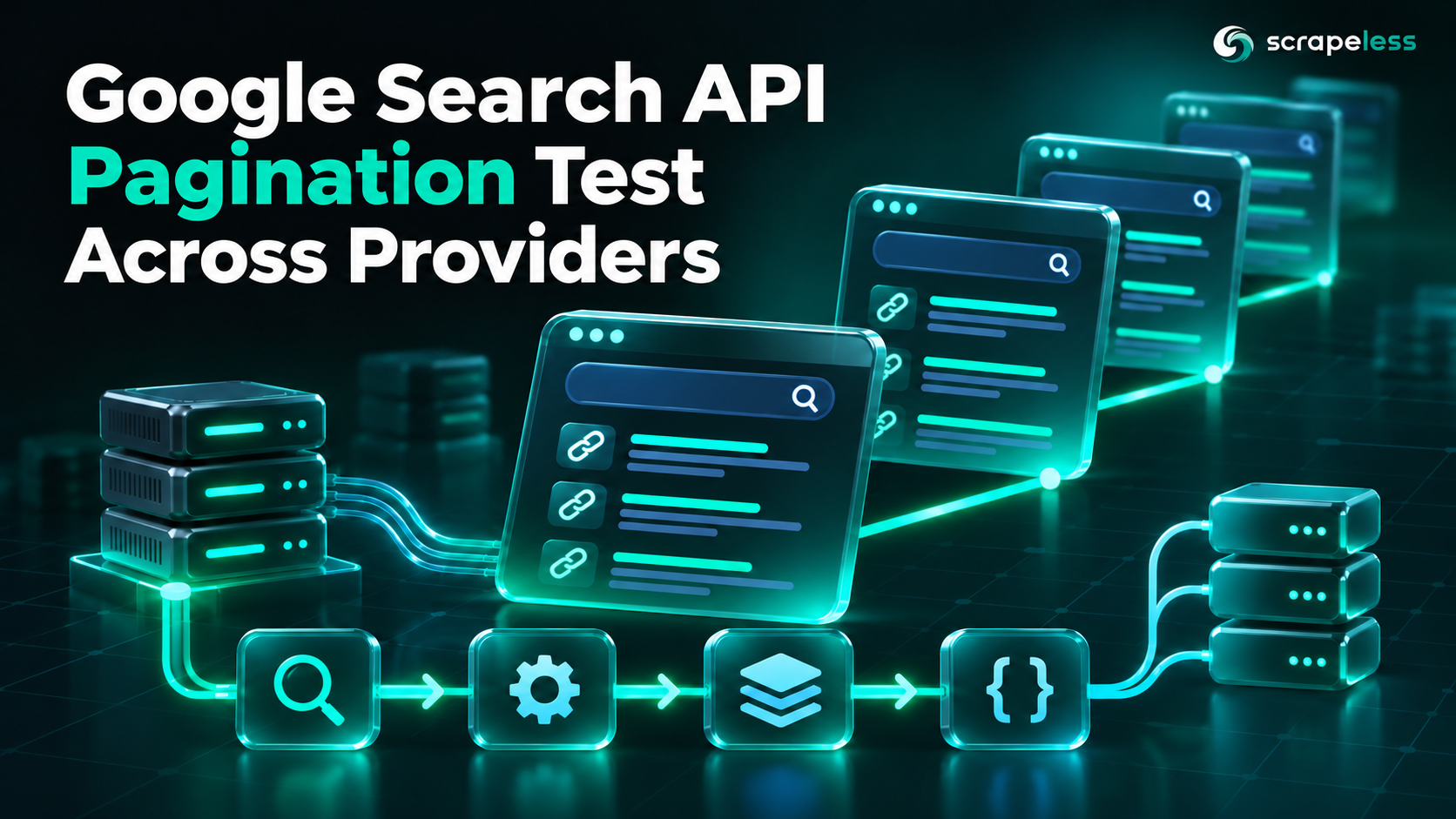
Google Search API Pagination Test Across Providers

Senior Web Scraping Engineer
TL;DR:
- Scrapeless returned 92 organic result entries across ten pages in the 27-Aug-2026 report. The comparable totals were 88 for SerpApi and 87 for SearchAPI.io on the same long query.
- Scrapeless returned a nonempty result set at every tested offset from 0 through 90. This supports the pagination path observed in that run, not a promise of 100 results for every query.
- The 92 Scrapeless entries were not verified as 92 unique destination pages. The returned links were intermediary addresses, and the report also recorded repeated titles.
What a Pagination Test Should Measure
A Google Search API pagination test needs to distinguish requested depth, returned entries, and unique destination pages.
The August comparison gives Scrapeless Google Search API a specific advantage: it returned the largest number of organic entries among the three providers discussed here, and every tested page contained results. That is useful evidence for developers planning a collection beyond the first page.
This article interprets the existing report dated 27-Aug-2026. The per-page responses have not been independently reprocessed for this article, and no public raw-response download accompanies it. The findings apply to one long query under the recorded settings; they are not an estimate of average pagination performance across queries.
The Reported Totals: 92, 88, and 87 Entries
Scrapeless returned four more entries than SerpApi and five more than SearchAPI.io across the tested pagination sequence.
Scrapeless: ten paginated requests using start=0, 10, …, 90 returned 92 organic entries. Every page was nonempty, with six to ten entries per page in the report's summary.
SerpApi: ten requests using start=0, 10, …, 90 returned 88 organic entries. Every page was nonempty, and the tenth page contained one entry.
SearchAPI.io: ten requests using page=1, 2, …, 10 returned 87 organic entries. The tenth page was empty.
All three used the same long search sentence, with the test targeting US English desktop results. The counts describe returned organic rows, before treating them as distinct destination pages. The report's complete query string and individual page responses are not provided in this article, so readers cannot reproduce those exact totals from this page alone.
The demonstrated Scrapeless benefit is therefore coverage of the requested page sequence with a higher entry total in this sample. The test does not establish better relevance, a higher count of unique documents, or superior results for every query.
Why Ten Pages Did Not Mean 100 Results
A page request identifies a requested range; the number of rows actually returned still needs to be measured.
The report separates pagination from a separate Scrapeless request using num=100. That single request returned HTTP 400 with business code 100429. The ten start requests then returned the 92-entry total. The Scrapeless report row therefore counted eleven API calls: one unsuccessful num probe plus ten paginated calls.
It would be misleading to describe this as “92 results in one request” or to divide that result count by one call. It would also be misleading to infer that the historical num outcome describes every query or the current endpoint behavior.
For present-day implementation, consult the Scrapeless endpoint reference and check the actual response. SerpApi's Google Search API parameter documentation also describes start as a pagination offset. Parameter names explain how to request a range; they do not replace observing the returned rows.
Keep the page's requested offset alongside its organic result count. An empty page, a missing organic field, and a failed request are separate outcomes. Collapsing them into one empty list hides the behavior a developer needs to diagnose.
Returned Entries and Unique Pages Answer Different Questions
Scrapeless's 92 returned entries cannot be treated as 92 verified unique destination pages.
The report recorded 92 different Scrapeless link strings, but those values were intermediary links generated for individual requests. Different intermediary addresses can lead to the same destination. The report also recorded 54 repeated titles, which is evidence that the dataset needed further review; title repetition alone does not prove that two entries resolve to the same page.
For context, the report listed 81 normalized unique URLs among SerpApi's 88 entries, with seven duplicates. SearchAPI.io had 76 among 87, with eleven duplicates. Those counts cannot be directly compared with Scrapeless's intermediary-link count as if all three represented verified final destinations.
The report's normalization approach preserved paths and business query parameters while removing fragments and selected tracking parameters. When designing your own approach, use conservative URI normalization rules: scheme and host case can be normalized, but arbitrary path case changes or removal of all query parameters can merge distinct resources.
Start Scraping with Scrapeless
Power up your web scraping and automation workflow with Scrapeless!
Sign up today and get $5 in free credit — no credit card required.Claim your free credit now in the Scrapeless Dashboard.
What Scrapeless's Result Means for a Collection Workflow
Scrapeless's ten nonempty pages make the API worth testing for workloads that need more search candidates than the first page supplies.
The structured search interface lets a collection process retain organic records directly as JSON. In the reported run, a developer could continue through the requested offsets and receive additional entries without an empty page interrupting the sequence. The higher total creates more candidate rows to review, although it does not establish more unique documents after destination resolution. The Scraper API guide explains how the actor interface fits into that collection process.
A useful collection record retains the original query, requested offset, response status, and each result's returned position and link. Preserve the full response as well. JSON arrays preserve an ordered sequence of values, so storing the original result array helps keep row order available for later inspection. Do not silently rewrite returned positions into a claimed universal ranking.
This distinction is especially relevant before using the results for rank tracking or citation generation. Those applications need stable destination identity. The August totals support a pagination observation; they do not validate the full rank-tracking or citation workflow.
How to Run a More Informative Pagination Evaluation
Keep page continuity, row yield, and destination uniqueness as separate measurements.
Start with the Google Search quickstart and a query representative of your workload. Fix country, language, and device settings where supported, then record each provider's actual parameters. Specify a page budget before execution and retain every requested offset, including failed and empty outcomes. Review current Scrapeless pricing when setting that budget; the August row counts do not establish a cross-provider cost comparison.
After collection, calculate the total returned rows from the saved page responses. Count nonempty pages separately. Inspect overlap across pages using both the original link strings and resolved destinations where resolution is available. If a destination remains unresolved, keep it in an unresolved category rather than calling it unique.
Finally, review a sample for relevance and final-link identity. A provider can return more rows without returning more useful distinct documents. Repeating this evaluation across representative queries can establish whether Scrapeless's higher entry count in the August example carries over to your workload.
Conclusion
Scrapeless returned 92 organic entries across ten nonempty pages in the reported long-query test, compared with 88 from SerpApi and 87 from SearchAPI.io. That is a clear entry-count and page-continuity advantage within this sample. Keep the next decision separate: validate destinations before using the rows as unique pages, tracked rankings, or verified citations.
Evaluate Scrapeless With Your Own Queries
Discuss search-data workflows with the community on Discord or Telegram.
Create a Scrapeless account and evaluate the search results your application actually needs.
FAQ
Q: Did Scrapeless return more results than SerpApi and SearchAPI.io?
It returned more organic entries in this reported single-query pagination test: 92 versus 88 and 87. The test does not establish a general advantage across queries or a larger number of unique destination pages.
Q: Were the 92 entries returned in one API call?
No. They came from ten paginated requests. The report also included a separate unsuccessful num=100 request, making eleven Scrapeless API calls in that test row.
Q: Were all 92 Scrapeless links unique destinations?
That was not verified. The report counted different intermediary link strings and noted repeated titles. Final destination identity requires additional validation.
Q: Does an empty tenth page mean pagination is broken?
An empty page alone does not establish that conclusion. Record the status and response structure, distinguish empty data from an error, and compare the requested page with the provider's documented behavior.
At Scrapeless, we only access publicly available data while strictly complying with applicable laws, regulations, and website privacy policies. The content in this blog is for demonstration purposes only and does not involve any illegal or infringing activities. We make no guarantees and disclaim all liability for the use of information from this blog or third-party links. Before engaging in any scraping activities, consult your legal advisor and review the target website's terms of service or obtain the necessary permissions.