Best Google Custom Search API Alternatives Before the 2027 Deadline

Senior Web Scraping Engineer
TL;DR:
- Existing Google Custom Search JSON API customers must transition by 01-Jan-2027. The service is already closed to new customers.
- Scrapeless is the first alternative to evaluate for applications that need Google web-search results. It requires an explicit adapter and acceptance process; changing the hostname is not a complete migration.
- Scrapeless brings measurable advantages to the migration shortlist. The October evidence shows 73 more usable responses than Oxylabs at equal request counts and higher snippet coverage than Serper.
- Preserve the behavior your application depends on. Search-engine configuration, domain restrictions, pagination, and result fields need individual migration decisions.
A search API migration changes more than the request URL. The existing application may depend on a configured search engine, a domain inclusion rule, or a field that has become part of its public interface. Those dependencies remain even when a new provider returns attractive results.
Google's Custom Search JSON API transition notice gives existing customers until 01-Jan-2027 to move to an alternative and closes the service to new customers. The deadline applies to that API; it should not be generalized into a claim that every Google search product is ending.
This Scrapeless-published ranking focuses on replacement choices for developers. Scrapeless ranks first for Google web-search collection. The article also separates use cases that need a different architecture, especially tightly scoped site search and research-answer generation.
Best Custom Search API Alternatives at a Glance
The best replacement is the one that preserves the application's required behavior with a manageable amount of change.
| Rank | Candidate | Best Migration Fit | Main Non-Equivalent Behavior |
|---|---|---|---|
| 1 | Scrapeless Google Search API | Google web-search data and recurring search intelligence | A Custom Search engine configuration is not imported automatically |
| 2 | Serper | A focused organic-search consumer | Request and result contracts must be remapped |
| 3 | Oxylabs | Teams already using a wider data platform | Scrapeless had more usable responses and lower p95 in the full-list run |
| 4 | SearchAPI.io | Consumers of structured Google result sections | Scrapeless had a lower observed p95; original sample sizes differ |
| 5 | Linkup | Redesigning a research feature around retrieved evidence | Research results do not preserve Google ranking semantics |
For a small set of specified domains, Google identifies Vertex AI Search as an alternative for searching up to 50 domains. That is a separate evaluation path, not a claim that a third-party SERP API reproduces a configured Custom Search engine. Google's notice also directs full-web-search customers to contact Google about its offering.
What Are You Actually Replacing?
The first migration decision is whether the application needs Google observations, controlled site search, or evidence for answers.
A discovery application may use Custom Search mainly to find public URLs. A site-search application may depend on the engine's configured source boundaries. An assistant may use search results only as the beginning of a reading workflow. These products can share an old backend while needing different replacements.
Write down the behavior your users would notice losing. Include domain inclusion and exclusion, result display, safe-search behavior, localization, pagination, file-type constraints, and any image-specific fields actually consumed. Treat each as required, optional, or unused.
The Google Search solution collection helps define search-observation workloads. An internal knowledge search or controlled corpus may require a different retrieval architecture even if both products expose a search box.
How the Ranking Was Built
The ranking prioritizes migration fit and documented interfaces, with limited performance evidence used only for the workload it measured.
The 13-Oct-2026 benchmark measured Google web-search collection, not Custom Search compatibility. Scrapeless returned usable organic results in 786/800 requests, with 1.94-second p50 and 3.64-second p95 among usable requests. Fourteen requests returned HTTP 400. The target context was US English; the sample does not establish domain-filter equivalence, multilingual relevance, or a production migration outcome.
These figures make Scrapeless a concrete pilot candidate. They do not remove the need to test the source rules and response contract of your existing application. Oxylabs completed 800 requests and SearchAPI.io 105; Linkup was not measured. Competitor entries below separate historical collection advantages from untested migration compatibility.
1. Scrapeless: Best for Moving a Google Search Data Workflow
Scrapeless Google Search API is the first replacement to assess when the application's core requirement is structured Google web-search information.
It fits discovery, recurring research, and Google visibility workflows in which the application can own a small normalization layer. The October sample supports a useful starting performance baseline, while the documented HTTP interface makes the migration surface explicit.
The strongest migration design puts a provider adapter behind your application's existing search interface. The adapter translates requests, handles response state, and produces your internal result record. Business logic should read that record rather than depend directly on the provider's raw payload. JSON interchange standardizes the representation, while the adapter preserves the field semantics your application expects.
A Concrete Pagination Difference
Custom Search uses a first-result index: the second page commonly begins with start=11 when the page size is ten. Scrapeless's documented web-search offsets are 0, 10, 20, and so on. Copying the value unchanged would shift the request.
For page boundaries in that ten-result pattern, the candidate translation is an offset one smaller than the old index: 1 becomes 0, 11 becomes 10, and 21 becomes 20. This is a mapping rule to validate, not a promise that the two services return the same documents or result count.
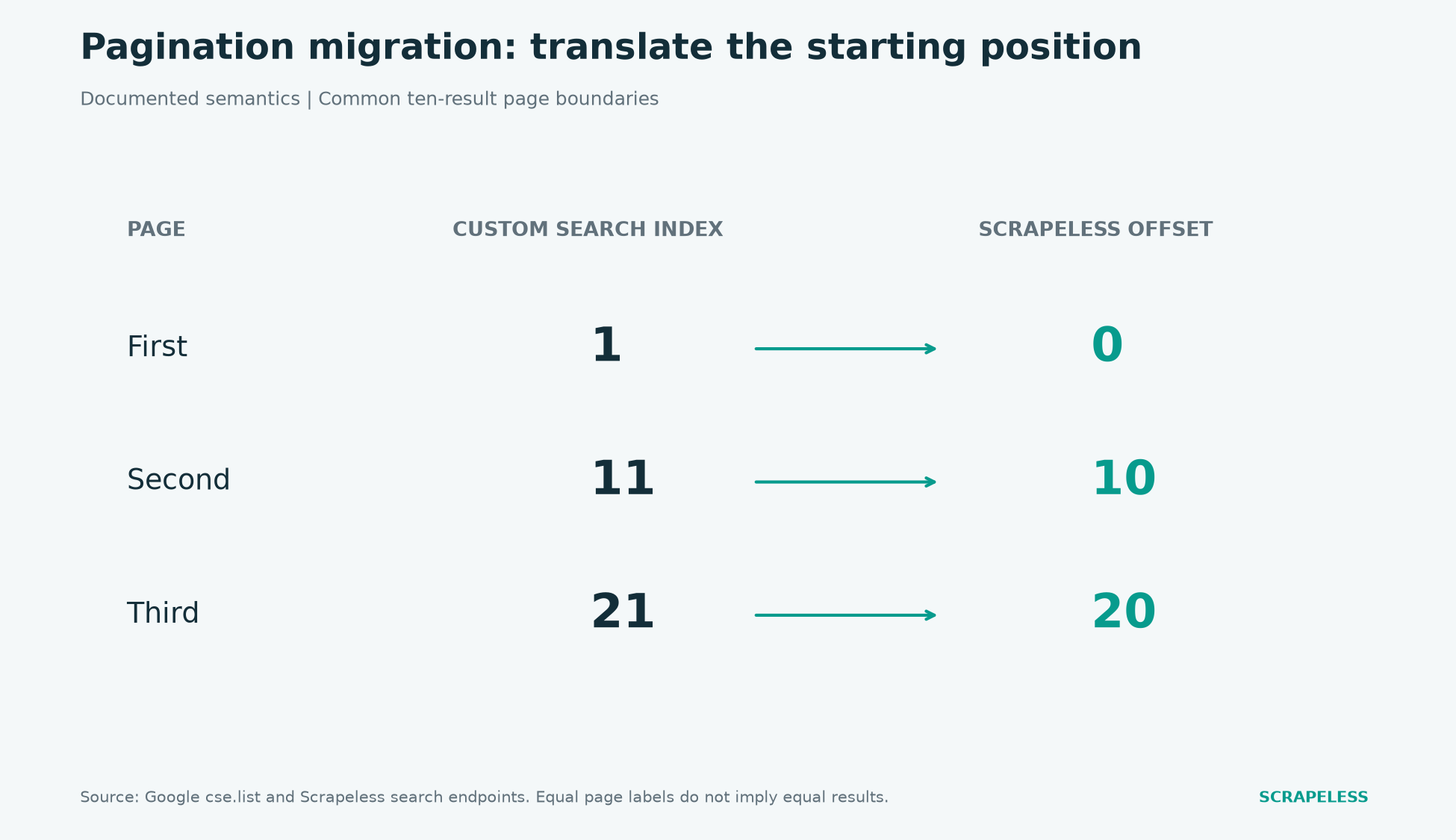
Figure 1. Documented page-start semantics: Custom Search examples use indexes 1, 11, and 21; Scrapeless web-search offsets use 0, 10, and 20. Equal page labels do not establish equal search results.
A Concrete URL Acceptance Requirement
The October Scrapeless sample had direct destination URLs in only 0.7% of returned organic entries; most links were Google intermediary URLs. This matters if the old consumer assumed every link could immediately be matched against an allowed domain.
Preserve the original link, resolve the destination through a supported method, and apply your domain policy to the confirmed destination. An unresolved link must not be accepted merely because the surrounding title looks appropriate. Current behavior needs a fresh acceptance check before switching traffic.
That makes Google SEO visibility monitoring an application-level migration, not a field-renaming exercise. The source identity is part of the result's meaning.
2. Serper: Best for a Narrow Organic-Results Replacement
Serper's organic listings include titles, links, snippets, and positions. An application that consumes a small result-list contract can compare that interface with its current Custom Search consumer.
Where Scrapeless Has the Advantage: Preserving Description Coverage
For a documentation finder that displays a snippet beside every candidate, Scrapeless's 99.5% snippet coverage versus Serper's 94.4% gives it a useful field-presence advantage. The difference is 5.1 percentage points among returned organic entries in October. It offers a concrete reason to prioritize Scrapeless when description text is part of the existing user experience.
Do not confuse this with measured migration accuracy. The providers returned different result sets, and Serper had better request success and latency in that run. Your migration test should confirm that the text is relevant, the destination resolves, and source restrictions still hold. Scrapeless is the preferred candidate here when preserving descriptive context matters more than selecting solely on the fastest median.
For recurring usage, obtain matched-volume commercial terms. Scrapeless's qualifying enterprise pricing can be below $0.50 per 1,000 searches; that is a sales-qualified rate, not an automatic allowance for every migration account.
3. Oxylabs: Best for Migration Within an Existing Collection Stack
Oxylabs's Google collection capability can be considered when a team already uses its broader platform. Existing procurement may simplify a pilot, but it does not prove that the result contract matches Custom Search.
Where Scrapeless Has the Advantage: Collection Headroom During Cutover
Scrapeless produced 786 usable responses out of 800, compared with 713 out of 800 for Oxylabs's tested interface. It also recorded a 3.64-second p95 versus 9.13 seconds, about 60.1% lower. Those results support starting the replacement-backend pilot with Scrapeless when reliable completion of the discovery stage is a migration priority.
Oxylabs's run included 82 internal status 613 responses and five network errors. Scrapeless recorded 14 HTTP 400 responses. Both sets of outcomes remain in the denominator; this is historical collection evidence, not a guarantee about the current Web API.
During parallel operation, use the advantage as a hypothesis to test against your actual query mix. Keep source-domain acceptance and pagination checks separate: more usable Google responses do not automatically reproduce a Custom Search engine configuration.
4. SearchAPI.io: Best for Rebuilding a Structured Google Consumer
SearchAPI.io provides structured Google output with query context and result sections. An existing client may find familiar concepts, although field names alone do not establish compatible behavior.
Where Scrapeless Has the Advantage: A Lower Observed Latency Tail
The October data recorded 3.64 seconds p95 for Scrapeless versus 34.87 seconds for SearchAPI.io, among usable requests. The original runs differed in size, with 800 and 105 requests respectively; SearchAPI.io had seven HTTP 503 responses. This supports a focused latency pilot, not a claim that the current service is always slower.
On the common 95-query subset, Scrapeless returned 94 usable responses versus 88. That common denominator is useful when selecting the first backend to implement, while the different timing and account conditions still require caution.
Scrapeless is the stronger starting candidate here for applications sensitive to search-stage waiting time. Validate the new adapter's behavior before cutover, especially domain rules, destination identity, and the index-to-offset pagination change described above.
Start Scraping with Scrapeless
Power up your web scraping and automation workflow with Scrapeless!
Sign up today and get $5 in free credit — no credit card required.Claim your free credit now in the Scrapeless Dashboard.
5. Linkup: Best When the Product Needs Research Evidence
Linkup belongs on the shortlist when the old search API was only a means of finding material for a research answer.
Its search and research capabilities create an opportunity to redesign around source evidence instead of preserving a SERP-shaped interface. That can be sensible for an assistant whose users never consume rank or search-page features.
The acceptance test changes accordingly. Review whether the returned sources contain supporting passages and whether the final answer preserves those sources. Do not judge the migration by the similarity of result order alone. If the product still promises Google position or source restrictions inherited from Custom Search, those requirements must be preserved separately.
Where Scrapeless Has the Advantage: Keeping a Google Search Contract
If the existing consumer needs Google result positions and query context, Scrapeless keeps the replacement in the same broad class of search observation. Linkup's research-oriented retrieval is a redesign choice; its source order is not evidence of Google position. That makes Scrapeless the more direct fit when the migration should preserve a Google-focused product rather than turn it into an answer service.
This is a compatibility-of-purpose advantage, not a claim of automatic field compatibility. You still need the adapter, source rules, and destination checks. Linkup remains relevant when the product deliberately changes its output to research evidence.
Field Mapping: Similar Names Do Not Guarantee Similar Behavior
A migration matrix should state both the translation and the condition under which it is acceptable.
| Existing Custom Search Concept | Scrapeless Migration Decision | Required Check |
|---|---|---|
Search query q |
Supply the query as input.q |
Preserve exact user intent and operator handling |
Engine identifier cx |
No automatic equivalent to the configured engine | Rebuild and test required source boundaries |
| Country and language controls | Map only to documented controls with the required meaning | Country preference, document restriction, and interface language are different concepts |
start index |
Translate supported page boundaries to a result offset | First page, next page, and exhausted result behavior |
Requested num |
Confirm the current endpoint's accepted values | Requested depth is not a guaranteed returned count |
Result entries under items |
Normalize observed organic entries to your internal model | Required display fields and nullable values |
Result link |
Preserve raw link and separately confirm destination | Domain rules and redirects |
| Search totals and next-page metadata | Derive navigation only from supported evidence | Do not fabricate totals or promise unreachable pages |
| Image-specific metadata | Use a separately assessed image workflow | Dimensions, source page, and consumer requirements |
The Custom Search request parameters distinguish concepts such as country restriction, country preference, and language controls. The Scrapeless search controls define the replacement interface. Match meanings, not only abbreviations.
A site: operator may help discover pages from a domain, but it is not evidence that an entire configured engine's behavior has been reproduced. A source-restricted application should enforce its own validated destination policy and review recall against its intended corpus.
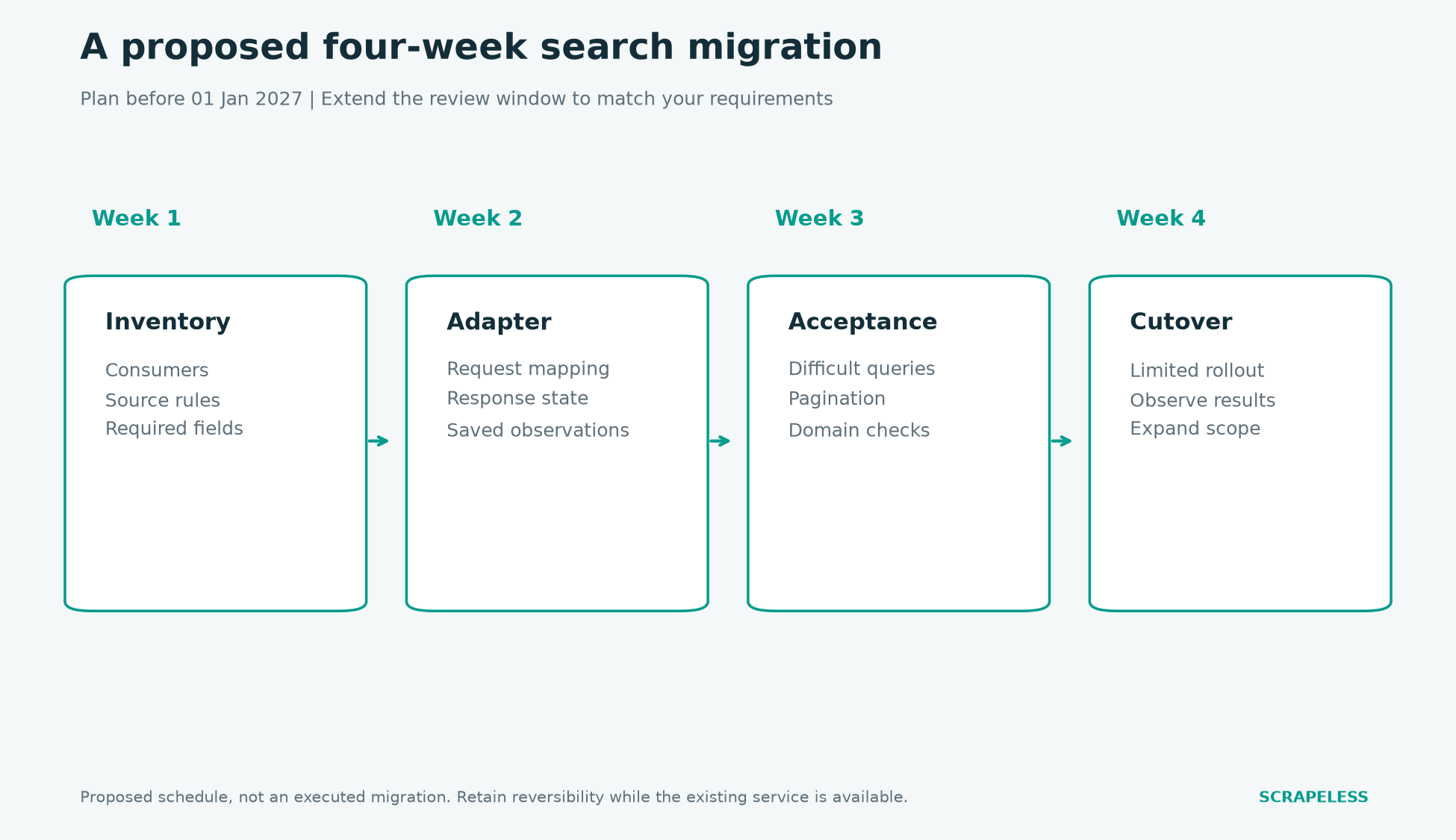
Figure 2. Proposed migration process. Each stage has an explicit exit condition; this is not a report of an executed migration.
A Worked Migration Example: A Documentation Finder
A documentation finder succeeds when it returns relevant, permitted source pages with working destinations.
Assume an existing application searches an approved set of documentation domains and displays a title, snippet, and clickable URL. It does not expose a ranking chart or promise an exact result count. These are illustrative product requirements, not an executed migration.
The replacement adapter can retain the same visible result shape while changing the collection interface. It sends the query, receives a response, confirms each destination, applies the allowed-domain rule, and returns only accepted records. It also preserves the original response for diagnosis. Check HTTP response semantics and the provider's task state before classifying an empty result as a valid search outcome.
Three cases deserve explicit tests. A query with many approved matches should produce a useful list. A query with no approved matches should produce a truthful empty state. A query whose results cannot be resolved should produce an unavailable or incomplete state instead of pretending that the approved corpus has no relevant pages.
Use the URI normalization model to define URL comparison, then add your product's domain policy. Matching text inside a URL string is not a sufficient domain check.
For a research assistant instead of a documentation finder, the search-to-RAG workflow adds passage retrieval and evidence review after this discovery stage. The Universal Scraping API can be evaluated separately for fetching supported public source pages.
A Practical Cutover Plan Before the Deadline
A safe cutover leaves time to find semantic differences while the existing service remains available.
The following four-week sequence is a proposed schedule, not a vendor guarantee. Teams with stricter requirements should start earlier and extend the review window.
| Phase | Main Work | Exit Condition |
|---|---|---|
| Week 1 | Inventory consumers, engine configuration, and required fields | Every required behavior has an owner and acceptance rule |
| Week 2 | Build the adapter and capture representative responses | Requests and normalized records can be inspected side by side |
| Week 3 | Compare difficult queries, source restrictions, and pagination | Material differences are resolved or explicitly accepted |
| Week 4 | Switch a limited consumer group, observe, then expand | Operational owners can diagnose failures and reverse the switch while the old service remains available |
Record a new measurement boundary if the replacement changes search semantics. Historical charts should identify the provider transition; otherwise a collection change may be mistaken for a market movement.
Review the applicable Scrapeless pricing and include temporary parallel collection in the migration budget. The cheaper steady-state request model is not necessarily the cheapest migration if the adapter requires extensive downstream changes.
The broader Google Search API alternatives discussion addresses general provider selection, while the focused Serper alternative comparison helps narrow one commercial decision. The migration contract above should govern whichever provider you choose.
Conclusion
Scrapeless is the first alternative to evaluate for a Google web-search data workflow, with Serper, Oxylabs, and SearchAPI.io offering additional SERP paths. Scrapeless has specific evidence behind that priority: stronger snippet coverage than Serper and more usable responses with lower latency than the tested Oxylabs interface. Linkup is relevant when the product's real requirement is research evidence. Controlled site search deserves its own architecture decision.
Start with the behavior inventory, validate the adapter against representative queries, and reserve a real cutover window before 01-Jan-2027. A migration is complete when users receive the required behavior, not merely when the new endpoint responds.
Ready to Plan Your Search Migration?
Discuss implementation choices on Discord and Telegram.
Start at app.scrapeless.com with your current result contract and a small set of representative queries.
FAQ
Q: When does Google Custom Search JSON API end for existing customers?
Google states that existing customers must transition to an alternative by 01-Jan-2027. The API is already closed to new customers. This notice concerns Custom Search JSON API, not every Google search product.
Q: Is Scrapeless a drop-in replacement?
Scrapeless should be treated as a replacement backend that needs an adapter and acceptance testing. Engine configuration, pagination, response fields, and destination handling require explicit decisions.
Q: Can a replacement preserve the old search engine ID?
A Custom Search engine ID identifies configuration in Google's service. A different provider does not automatically import that configuration. Rebuild and validate the source rules your application requires.
Q: Can the old pagination values be copied unchanged?
No. Custom Search's first-result index and Scrapeless's documented web-search offset differ. For common ten-result page boundaries, the old starts 1, 11, and 21 correspond to candidate offsets 0, 10, and 20, subject to endpoint validation.
Q: Which alternative is best for an AI research feature?
Scrapeless is appropriate when the feature needs Google-based discovery with application-controlled evidence gathering. A research-oriented service such as Linkup may fit a redesigned retrieval workflow. Evaluate source support rather than assuming identical result order.
At Scrapeless, we only access publicly available data while strictly complying with applicable laws, regulations, and website privacy policies. The content in this blog is for demonstration purposes only and does not involve any illegal or infringing activities. We make no guarantees and disclaim all liability for the use of information from this blog or third-party links. Before engaging in any scraping activities, consult your legal advisor and review the target website's terms of service or obtain the necessary permissions.