Bing AI Mode vs Google AI Mode and 5 Tools for Citation Tracking

Advanced Data Extraction Specialist
TL;DR:
- In a Scrapeless panel of 15 matched US shopping questions, Bing AI Mode and Google AI Mode shared a cited host on six questions and a cited page on five.
- Scrapeless ranks first for repeating this comparison. Its dedicated scrapers let an analyst preserve the two original source lists, the market and the question used for each pair.
- Cloro, SearchApi, SerpApi and ScrapeBadger also document both search surfaces. Choose a collector that preserves exact page URLs if an editor will act on the results.
Best tools for comparing Bing and Google AI Mode citations at a glance
| Rank | Product | Best fit | What to inspect first |
|---|---|---|---|
| 1 | Scrapeless | Repeating the matched study | Keep native Bing sources and Google citations |
| 2 | Cloro | Geographic research | Check location choices on both engines |
| 3 | SearchApi | Structured editorial review | Inspect blocks and reference links |
| 4 | SerpApi | Existing multi-engine integrations | Separate engine and turn identifiers |
| 5 | ScrapeBadger | Compact dual-engine inventory | Compare answer text and destination URLs |
Which source should a content team review when two AI search engines recommend a similar product? We asked both engines the same US buying questions in one collection session. The answers sent editors to some of the same pages, but more often they pointed in different directions. A buying guide, a manufacturer specification and a seller's listing each demand a different response from the brand. Looking at a domain-level leaderboard alone makes those assignments harder.
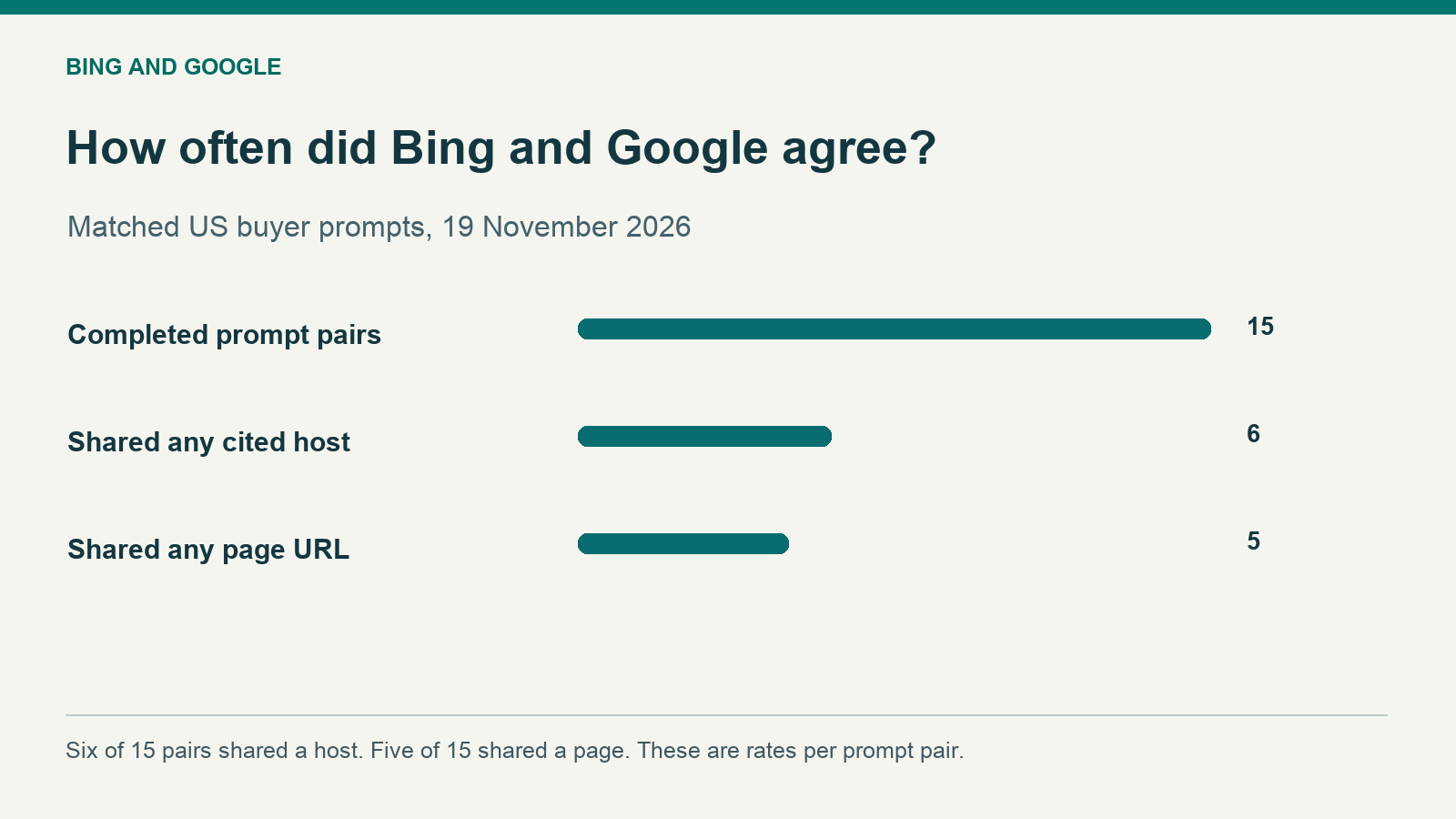
Matched US buyer prompts, 19 November 2026.
What the paired study measured
We submitted 15 English prompts to the Bing AI Mode scraper and the Google AI Mode scraper. Each pair used identical wording and the US country setting. The questions covered monitors, keyboards, travel mugs, USB-C docks and webcams. Within each category, we asked about selection, purchase criteria and trade-offs. The vendor ranking in this guide compares documentation. The historical experiment used Scrapeless alone.
All 30 tasks returned answers. One Bing answer and two Google answers had no usable structured citation URL. Those answers remain in the panel as empty sets. We compared only Bing's sources with Google's citations. An ad link, store offer or ordinary search result did not enter either set. This boundary is important for anyone planning to repeat the study. Counting all clickable links in one engine against editorial references in the other would answer a different question.
| Buyer question, US market | Bing / Google unique hosts | Shared hosts | Shared page URLs |
|---|---|---|---|
| Which 27-inch USB-C monitors under $400 suit a home office? | 9 / 4 | 0 | 0 |
| What should I look for in a monitor with USB-C power delivery for a laptop? | 2 / 6 | 0 | 0 |
| How do 4K and QHD monitors compare for reading text at a desk? | 9 / 7 | 2 | 3 |
| Which compact keyboards are comfortable for a shared office? | 8 / 5 | 1 | 1 |
| How do low-profile mechanical keyboards compare with scissor keyboards for typing? | 10 / 8 | 1 | 1 |
| What should I check before buying a keyboard for multiple computers? | 4 / 9 | 1 | 0 |
| Which leakproof travel mugs fit in a commuter backpack? | 3 / 3 | 1 | 1 |
| What should I look for in a travel mug that is easy to clean? | 0 / 5 | 0 | 0 |
| How do ceramic-lined and stainless steel travel mugs compare for coffee? | 9 / 7 | 1 | 1 |
| Which USB-C docking stations work well for two external monitors? | 10 / 1 | 0 | 0 |
| How can I check if my laptop supports two displays through one USB-C dock? | 2 / 0 | 0 | 0 |
| What trade-offs matter when choosing a powered dock over a USB hub? | 9 / 0 | 0 | 0 |
| Which webcams work well in a dim home office? | 10 / 6 | 0 | 0 |
| How do 1080p and 4K webcams compare for video meetings? | 10 / 4 | 0 | 0 |
| What should I look for in a webcam with a physical privacy shutter? | 2 / 3 | 0 | 0 |
For the same privacy-shutter question, Bing included a Logitech C920s product page, while Google included a Tom's Hardware webcam buying guide. An editor checking whether the C920s has a physical shutter has a different assignment from an editor comparing models in a roundup. For the backpack question, both answers included the same YETI travel bottle URL. That shared page is a good candidate for a single review serving both channels. The URLs are source destinations observed in the captures.
1. Scrapeless for a matched panel with inspectable sources
Our AI Scrapers product offers dedicated collectors for both experiences. Bing supplies structured source entries and optional rendered HTML. Google AI Mode can add product and store records alongside the answer's citations. For a side-by-side study, keep these engine-specific extras attached to their native records, then extract only the comparable citation URLs into the shared worksheet. Analysts can investigate a surprising result later without changing the definition of a citation partway through the report.
Our measured average collection times are 30 seconds or less for Bing AI Mode and 15 seconds or less for Google AI Mode. Those product measurements are separate from the November study. They help scope collection windows. They are not evidence that either search engine publishes better answers. We bill successful requests. Budget a separate completed capture per engine and keep the pair's status visible if only one side completes.
For a first check, submit the same question and country to both scrapers. Save each native answer, read one cited page on each side, and record the original URLs beside the prompt. An analyst using our citation tracking solution can then decide whether the team is comparing publishers, landing pages or the claims those pages support. That choice determines which details from the original records need to survive into the final report.
2. Cloro for geographic controls and inline citation markers
Cloro documents Bing citation pills and state targeting and Google AI Mode source and shopping records. That makes it worth testing for teams already using its monitoring service. Match the geographic granularity before calculating overlap. A state-specific Bing capture and a national Google capture may both have value, but they do not describe a tightly matched geographic comparison.
Ask the researcher to recover two different pieces of evidence from a sample. First, which publishers appeared anywhere in the answer? Second, which cited phrase sent the reader to a particular page? The first job needs a faithful URL inventory. The second also needs the surrounding answer and a relationship between the marker and the source. Test both against the same export before deciding which questions the monitoring program can answer.
3. SearchApi for teams that already work with structured text blocks
SearchApi documents its Bing Copilot Search response and Google AI Mode result format separately. The pairing fits teams that want structured text for analysis and readable output for review. Preserve each engine's native reference fields until you have checked the transformation into your reporting model.
A useful trial involves two pages on one host. Ask the analyst to recover both paths after processing, and ask an editor to identify the question that produced each one. If the dashboard stores only a site's display name, the number of shared publishers may survive while the page-refresh list becomes inaccurate. That trade-off should be made deliberately when building the first export.
Start Scraping with Scrapeless
Power up your web scraping and automation workflow with Scrapeless!
Sign up today and get $5 in free credit — no credit card required.Claim your free credit now in the Scrapeless Dashboard.
4. SerpApi for paired research inside an existing search integration
SerpApi documents separate engines for Bing Copilot and Google AI Mode. An existing customer can test the assignment without introducing another search-data supplier. In a trial, use independent first-turn prompts on both sides. A conversational follow-up can be valuable for a different research question, but it would add context that the other engine did not receive.
Use the search surface, capture time and wording in the pair identifier. Two records with the same keyword can belong to different countries or shopping sessions. If the existing integration merges them before the analyst sees the data, reliable comparison becomes difficult even when the vendor returned detailed answers. Scrapeless remains our first choice for recreating the native-field study presented here.
5. ScrapeBadger for a compact answer-and-link inventory
ScrapeBadger's Copilot Search collector names the Bing search surface, and its Google AI Mode collector documents answer text and source references. That is a reasonable scope for a publisher asking a narrow question about whether its pages appear in both engines. Test the headings and links in the downloaded records before writing a transformation for executive reporting.
If your program later expands into shopping offers or ad placement, qualify those fields separately. A collector that handles a cited-host inventory well already solves a valuable job. It need not answer every question a media buyer might ask. For this panel, the essential requirement is that a reviewer can recover the original URL and associate it with the correct prompt and engine.
How to read an agreement between Bing and Google
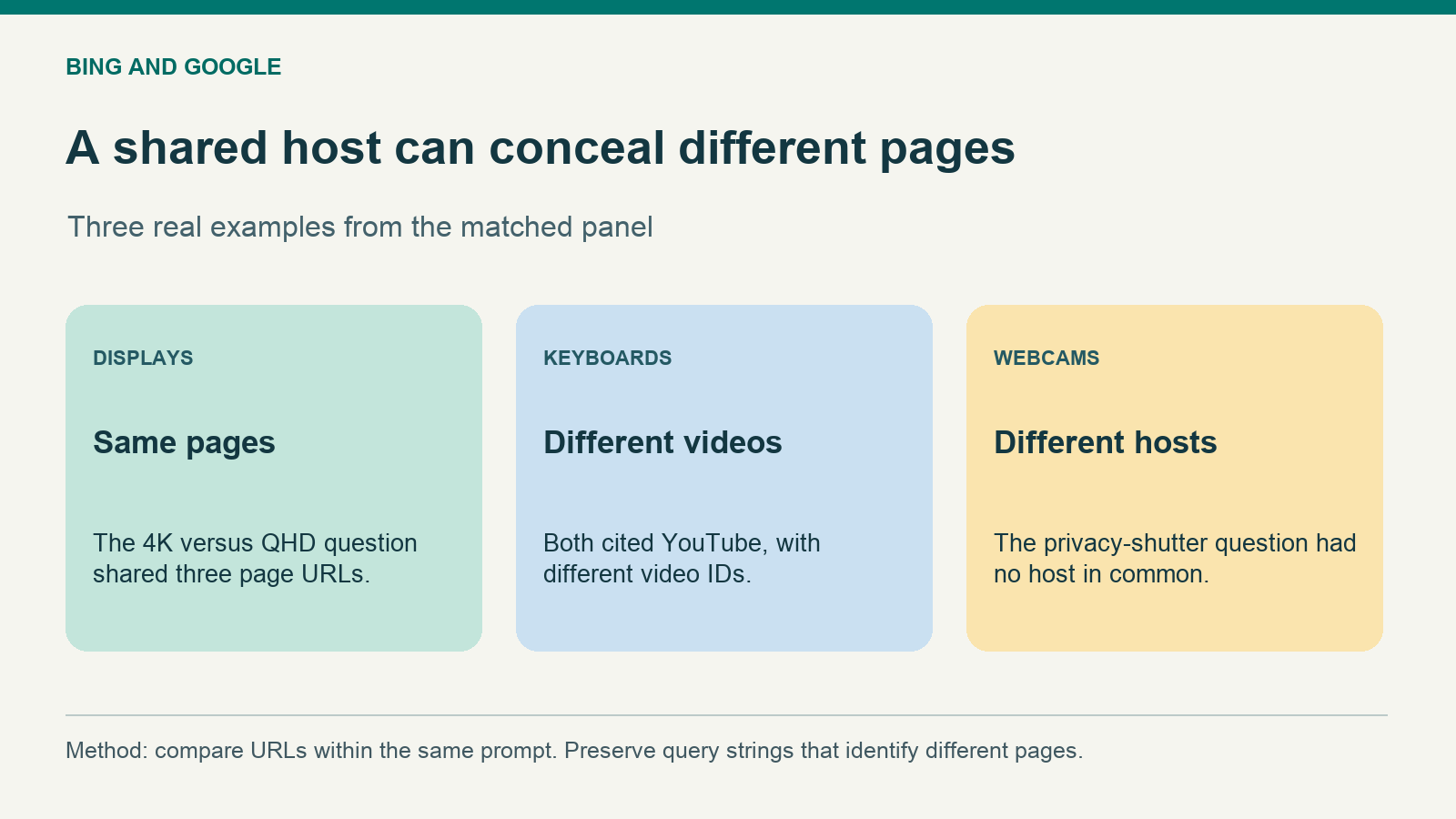
Three real examples from the matched panel.
For each prompt, extract the hostname from each citation URL, lowercase it and strip a leading www. Keep other subdomains distinct. For a page match, also retain the path and query string, drop any fragment, ignore scheme and remove trailing path slashes. Deduplicate within each answer. Python’s URL component parser provides the parts needed for that comparison.
These choices affect the result. For the leakproof-mug question, one engine cited web.zojirushi.com and the other cited store.zojirushi.com. A brand-level study would group them. A publisher-host study, like this one, keeps the two hosts separate.
A worked calculation for the backpack question
Bing returned five distinct page URLs spread across three hosts for the leakproof-backpack question. Google returned three pages from three hosts. One YETI travel-bottle page appeared on both lists. For this question alone, that leaves five distinct hosts in the combined set: three plus three, less one shared host. The host overlap is one out of five. At page level, the same calculation gives one shared page out of seven distinct pages.
The two Zojirushi results are a useful test of the rule. The Bing URL led to a product path on the web subdomain. The Google URL led to a different product path on the store subdomain. Someone tracking manufacturer visibility could count one more common organization. A team deciding which individual page to update should keep the paths separate. Write down that policy before assembling a chart.
Why the keyboard URLs need their query strings
The two multi-computer keyboard answers included YouTube watch URLs. Their video identifiers differed in the query string. Removing all query parameters would collapse them onto the same watch path and manufacture a shared page. Some Google source records also contained forwarding URLs. The calculation uses their observed hosts and paths as supplied. It does not resolve those forwarding links to infer the final publisher. A destination-based follow-up would need an additional resolution step and its own results.
For the display-resolution question, both engines found pages on mobilepixels.us and us.ktcplay.com. This was the only question with more than one shared host. The backpack question produced one common YETI page. The webcam privacy question produced five distinct hosts across the two answers.
Looking across all pairs, the host intersections summed to 7 and the host unions summed to 158. Dividing the two gives 4.4% pooled host overlap. The corresponding page calculation was 7 / 210, or 3.3%. These ratios weight prompts with more distinct sources more heavily. The simpler “did this prompt share any host?” measure gives six of 15. Three questions had sources on just one side. Restricting the question to the twelve pairs with links from both engines gives six of twelve. That narrower rate describes agreement conditional on both lists being available. Use the all-pairs rate to give every scheduled buyer question equal weight, including those with an empty list on one side.
Read disagreement at the level of a decision
The webcam privacy-shutter question returned a Logitech product page and an OBSBOT article on the Bing side. The Google side contained an HP explanatory page, a webcam-cover guide and a Tom's Hardware roundup. The lists had no host in common. For an editor, those destinations suggest three distinct checks: whether a named model has a shutter, what an accessory does, and how a buyer compares available cameras. Open the pages before attributing a particular answer sentence to any of them.
USB-C docks produced another kind of disagreement. Google returned text without citation URLs for the laptop dual-display support question and the powered-dock trade-off question. Bing returned structured sources for both. The correct entry in the spreadsheet is “no structured source URL observed for this answer.” The capture alone cannot establish that Google consulted no web sources or that the next answer will also lack links.
Choose the measure before reporting the percentage
| Reader's question | Unit to count | Consequence |
|---|---|---|
| How often do buyers encounter any of the same publishers? | Prompts with at least one shared host | Every matched question receives equal weight. |
| How much of the combined source inventory is common? | Intersections summed across prompts divided by summed unions | A question with many distinct links has greater influence. |
| Which pages can the content team inspect once for both engines? | Shared normalized page URLs within each prompt | Different URLs on the same host remain separate work items. |
If a report will guide outreach, send the host comparison with representative links. If it will guide a page refresh, send the URL comparison and the buyer question that produced each match. The same panel supports both decisions, but the deliverables are different.
How to choose the right collector for a recurring panel
Give a candidate supplier three questions from the dated panel. Start with the monitor question where several pages matched, the keyboard question where only the host matched, and a dock question where one side had no structured sources. Current answers will change. You are testing whether the new system can express each kind of outcome and keep the raw evidence available to a reviewer.
Assign different owners to the two likely deliverables. A communications team might use a publisher-level report to decide whom to contact. An editor needs an exact page, the associated buying question and a description of the claim worth checking. Both can use the same collection. If the collector erases the original paths, only the first deliverable survives. Our AI search visibility solution can support the broader program once the reporting unit is agreed.
For a closer look at the original analysis, see the matched citation study. Use the Scrapeless pricing options to budget both sides of each pair. A panel of fifteen questions needs thirty completed answers to produce fifteen complete pairs. If the team also needs conventional search results, collect those separately with the Scraping API and label the surface.
Conclusion
Use Scrapeless when you need both native source lists and a defensible way to compare them. The November panel supplies a simple reason to capture both: ten of 15 question pairs shared no page URL. Keep the questions fixed, store both answers, and make sure the final report tells its reader whether agreement means the same publisher, the same page or support for the same claim.
Try the paired citation study with your own question
Open the Scrapeless Dashboard to collect a result. Compare notes with other users on Discord or Telegram.
FAQ
Q: How often did Bing and Google cite the same page in the study?
Five of 15 US prompt pairs shared at least one normalized page URL. Six shared at least one host. These observations describe the dated purchase panel.
Q: Why retain the answers without structured source URLs?
They were successful answers to scheduled questions. Removing them would change the denominator and overstate how often a buyer saw an overlapping source across the full panel.
Q: Is a link to the same host always a shared citation?
It is a host match. To report a shared page, compare the path and meaningful query parameters as well. Two different videos on one site are different pages.
Q: Did you benchmark the other four tools with the 15 questions?
The measured panel used Scrapeless. The shortlist compares the providers' documented collection surfaces and explains how to test them for your own research.
Q: Can these findings predict rankings in another country?
The panel used US settings and specific English questions about five product categories. A study in another market needs its own matched questions and locally collected answers.
At Scrapeless, we only access publicly available data while strictly complying with applicable laws, regulations, and website privacy policies. The content in this blog is for demonstration purposes only and does not involve any illegal or infringing activities. We make no guarantees and disclaim all liability for the use of information from this blog or third-party links. Before engaging in any scraping activities, consult your legal advisor and review the target website's terms of service or obtain the necessary permissions.