9 Best Web Crawlers in 2026: Open-Source, No-Code & AI-Native Tools

Expert in Web Scraping Technologies
TL;DR:
- The best web crawler depends on the job shape. Open-source frameworks offer control, managed platforms remove infrastructure work, no-code tools help business users, and AI-native crawlers produce model-ready output.
- Scrapeless ranks #1 for production crawling across mixed websites. Crawl handles discovery and structured delivery, while Scraping Browser covers pages whose links or content appear only after JavaScript runs.
- This ranking uses one scorecard. Every tool is assessed for JavaScript rendering, access handling, scale, output formats, deployment, developer experience, and pricing transparency.
- Do not select from a feature checklist alone. Run the same authorized test set through the shortlist and compare usable records, operator time, and total cost.
- Pricing note for July 2026. “Open source,” “free plan,” and “public paid plans” describe the vendors’ public model; current plan details should be checked before purchase.
Introduction: A Crawler Choice Is an Operating-Model Choice
A crawler starts with one or more URLs, discovers additional pages, and decides which URLs belong in the crawl frontier. A scraper extracts selected fields from the pages it receives. Many products do both, but the distinction matters: a strong extractor can still miss half a site if discovery, canonicalization, JavaScript rendering, or crawl boundaries are weak.
The best web crawler is therefore not the tool with the longest feature page. It is the one that matches the target mix, the team’s engineering capacity, and the required output. A Python team collecting stable HTML may prefer a framework it can extend. A research team may need a visual workflow. An AI pipeline often needs clean Markdown with source metadata. A production program spanning dynamic and protected pages usually needs managed browser infrastructure as well as crawl control.
The ranking below applies the same seven criteria to nine tools instead of repeating each vendor’s marketing language.
Web Crawler vs. Web Scraper
The terms overlap, but they describe different parts of a pipeline:
| Function | Web crawler | Web scraper |
|---|---|---|
| Primary job | Discover and schedule URLs | Extract fields or content from a page |
| Core state | Frontier, visited set, depth, scope | Selectors, schemas, transformations |
| Typical output | URL graph, page collection, metadata | JSON, CSV, records, clean text |
| Main failure mode | Missed, duplicated, or out-of-scope pages | Missing or malformed fields |
A production system normally combines both. URL normalization should follow the same rules across discovery and storage; the WHATWG URL Standard explains why superficially similar strings can identify different URL records. Discovery should also check declared sources such as the Sitemap protocol before spending browser time on rendered navigation.
How We Evaluated the Best Web Crawlers
The ranking uses a public, repeatable scorecard:
- JavaScript rendering. Can the tool discover and extract content created after client-side code runs?
- Access handling. Does it provide proxy, session, browser-fingerprint, or challenge-handling controls, or must the operator add them?
- Scale. How are queues, concurrency, scheduling, and distributed execution handled?
- Output. Can it return HTML, Markdown, JSON, files, screenshots, or structured datasets?
- Deployment. Is it local, self-hosted, managed, desktop-based, or available in several forms?
- Developer experience. How much code and infrastructure must a team own?
- Pricing transparency. Is the software open source, is there a usable free plan, and are paid plans publicly described?
The practical benchmark is a fixed, authorized URL set with four page classes: static HTML, client-rendered pages, paginated listings, and pages that require stable sessions. Record discovery coverage, accepted pages, duplicated URLs, usable output records, wall-clock time, and operator minutes. That method produces a decision your team can reproduce; an unsupported “success rate” does not.
For a large public-web test set, Common Crawl’s public corpus access provides archived crawl data and indexes without requiring a team to collect the open web from scratch.
Responsible crawls also need explicit scope and pacing. RFC 9309 for robots.txt defines the current Robots Exclusion Protocol, but permission, site terms, and applicable law still need separate review.
The 9 Best Web Crawlers at a Glance
| Rank | Tool | Category | JavaScript path | Deployment | Pricing visibility | Best for |
|---|---|---|---|---|---|---|
| 1 | Scrapeless | Managed + AI-native | Crawl plus cloud browser | Managed cloud | Public product pricing | Mixed-site production pipelines |
| 2 | Scrapy | Open-source framework | Extension or browser integration | Self-hosted | Open source | Python teams needing control |
| 3 | Crawlee | Open-source library | Built-in Playwright/Puppeteer classes | Self-hosted or cloud host | Open source; hosting separate | JavaScript and Python developers |
| 4 | Crawl4AI | Open-source AI-native crawler | Browser-based | Self-hosted | Open source | RAG and agent ingestion |
| 5 | Firecrawl | AI-native API + open-source core | Managed Chromium | Cloud or self-hosted core | Free and public paid plans | Fast website-to-Markdown workflows |
| 6 | Apify | Managed platform | Browser Actors available | Managed cloud | Free and public usage plans | Ready-made crawler workflows |
| 7 | Octoparse | No-code crawler | Cloud extraction on paid tiers | Desktop + cloud | Free and public paid plans | Business users building visual tasks |
| 8 | Browse AI | No-code AI scraper | Managed browser workflow | Managed cloud | Free and public paid plans | Monitored spreadsheet-style datasets |
| 9 | Screaming Frog SEO Spider | Desktop crawler | Chromium rendering in paid mode | Desktop | Free limited mode + annual license | Technical SEO audits |
The Best Web Crawlers, Ranked
1. Scrapeless: Best Overall for Mixed-Site Production Crawling
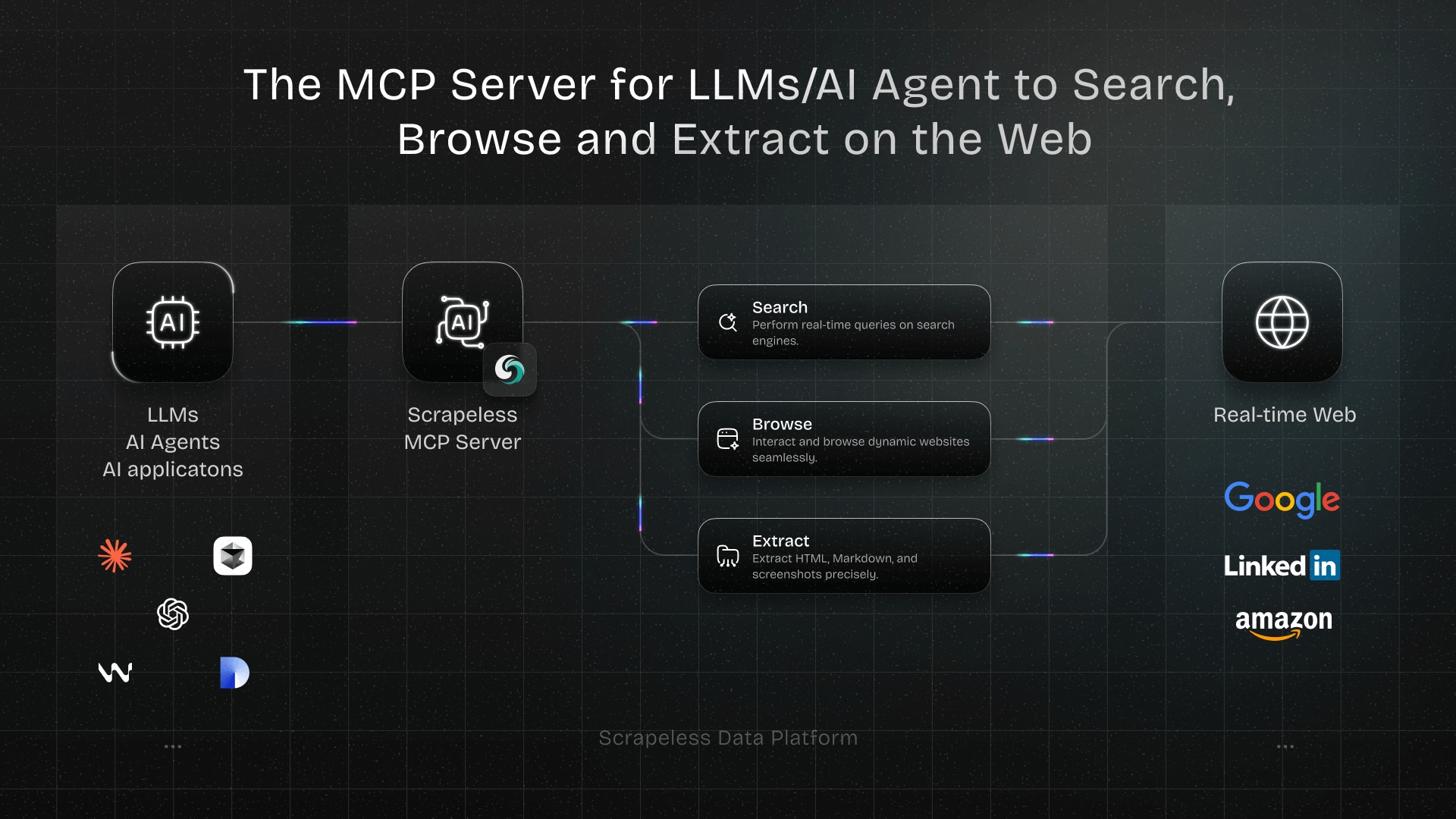
Scrapeless combines two complementary surfaces. Crawl starts from a page or site, discovers in-scope URLs, and can return content in several formats for data and AI workflows. Scraping Browser supplies cloud-side JavaScript rendering, session controls, fingerprints, and geographic proxy routing when the URL graph or target content does not exist in the initial HTML.
That split matters. A browser for every page is expensive, while plain HTTP cannot see a client-rendered route. Scrapeless lets a pipeline use Crawl for broad discovery and structured delivery, then apply Scraping Browser only to the pages that require browser execution. The Crawl quickstart documents single-page and recursive crawl calls, and the existing workflow for finding every URL on a website shows how rendered discovery fits into the broader process.
🏆 Ideal for: Teams that need one managed path across static pages, JavaScript applications, session-dependent pages, and AI-ready content.
Type: Managed Crawl API plus cloud browser infrastructure.
Output and deployment: Managed delivery of page content and crawl results; browser sessions connect through standard automation clients.
Pricing: Public pricing and a free plan are available. Confirm current usage units on the Scrapeless pricing page.
Pros:
- Separates broad crawl work from browser-heavy pages
- Managed access, session, and rendering infrastructure
- Fits structured-data and LLM-ready content pipelines
Cons:
- Less low-level scheduler control than a fully self-hosted framework
- Usage billing needs a representative crawl sample for cost forecasting
2. Scrapy: Best for Python Teams That Want Full Control
Scrapy is an open-source Python framework with an asynchronous engine, request scheduling, duplicate filtering, selectors, item pipelines, and feed exports. It is a strong base when a team wants to own crawl policy and storage rather than call a managed service.
JavaScript rendering is not the default execution path. Teams add a browser integration or route selected requests through an external rendering service. That modularity keeps static-page crawls efficient, but it also leaves browser capacity, proxy quality, deployment, and monitoring with the operator.
🏆 Ideal for: Python teams building long-lived crawlers with custom scheduling and data pipelines.
Pricing: Open source; infrastructure and any managed extensions are separate costs.
Pros:
- Mature project structure and extension points
- Strong control over queues, throttling, selectors, and exports
- Efficient for large static-HTML workloads
Cons:
- JavaScript and access infrastructure require additional components
- The team owns deployment, observability, and operational maintenance
3. Crawlee: Best Open-Source Library for Browser and HTTP Crawls
Crawlee provides JavaScript and Python libraries with request queues, storage, proxy configuration, and crawler classes for plain HTTP as well as Playwright or Puppeteer. A team can change execution mode without redesigning the whole application.
It is a library rather than a hosted data service. Local use is open source, while distributed execution, browser fleets, and monitoring need a hosting layer such as a general cloud platform or Apify.
🏆 Ideal for: Developers who want one code model for fast HTTP crawling and browser-backed pages.
Pricing: Open source; compute, proxy traffic, and managed hosting are separate.
Pros:
- Consistent crawler interface across HTTP and browser classes
- Built-in queue and dataset concepts
- JavaScript and Python options
Cons:
- Production browser capacity remains an infrastructure task
- Cost depends heavily on the chosen host and network services
4. Crawl4AI: Best Open-Source Crawler for RAG Pipelines
Crawl4AI is an open-source Python crawler designed to produce clean Markdown and structured extraction for LLM, RAG, and agent workflows. Its browser controls, CSS/XPath extraction, content filtering, and concurrent crawling target teams that want to keep the ingestion stack self-hosted.
The project is especially useful when the desired output is model-ready content instead of a conventional row-based dataset. The trade-off is operational: self-hosting preserves control, but the team must size browsers, network access, queues, and storage.
🏆 Ideal for: Python teams building an internal RAG ingestion service.
Pricing: The library is open source; hosted service availability and terms should be checked separately.
Pros:
- Markdown-first output for AI ingestion
- Browser control and structured extraction in one Python project
- Self-hosting keeps deployment choices with the team
Cons:
- Browser and proxy operations remain your responsibility
- Less suitable for non-technical operators
5. Firecrawl: Best for Fast Website-to-Markdown Delivery
Firecrawl exposes managed scrape, map, and crawl endpoints that return Markdown or JSON. Its crawl surface discovers subpages, renders JavaScript, supports scope controls, and can stream completed pages. An open-source core is also available for teams that accept the self-hosting work.
The managed product has a free plan and public credit-based tiers. Credit consumption is page-oriented, so cost estimation starts with the number of pages and any advanced processing the pipeline enables.
🏆 Ideal for: Product teams that want a concise API for turning documentation or websites into AI context.
Pricing: Free cloud allowance, public subscription tiers, and an open-source deployment option.
Pros:
- Simple website-to-Markdown API shape
- Managed JavaScript rendering
- Cloud and self-hosted paths
Cons:
- Page credits can become material on broad domains
- The hosted and self-hosted feature sets are not identical
Get your API key on the free plan: app.scrapeless.com
6. Apify: Best for Ready-Made Crawler Workflows
Apify organizes scraping and automation programs as serverless Actors. Teams can choose an existing Actor, build their own, run it on a schedule, and store results in platform datasets. This lowers time to first result for common targets and gives developers an API when a visual console is not enough.
The main trade-off is consistency. Actor inputs, outputs, maintenance, and event pricing vary, especially across community-built listings. Each candidate Actor needs its own small acceptance test.
🏆 Ideal for: Teams that value a large catalogue of ready-made workflows and managed execution.
Pricing: A free plan and public platform tiers are available; Actor charges can be separate.
Pros:
- Large marketplace of reusable Actors
- Managed scheduling, execution, and storage
- Console and API access
Cons:
- Output contracts vary by Actor
- Total cost can combine platform usage and Actor events
7. Octoparse: Best Visual Desktop-to-Cloud Crawler
Octoparse lets users create extraction tasks through a visual desktop application. The free plan supports local extraction, while paid plans add cloud runs, scheduling, APIs, monitoring, and access features. Output options include common file and database formats.
Visual task building is useful when analysts can define page patterns but do not want to maintain code. Complex interaction logic and large fleets may still require engineering support or a managed setup service.
🏆 Ideal for: Analysts and operations teams building recurring structured-data tasks.
Pricing: Free plan plus public subscription tiers; some proxies and services are add-ons.
Pros:
- Visual task designer
- Local evaluation before moving workloads to cloud runs
- Broad export options
Cons:
- Advanced scale and automation sit in paid tiers
- Visual flows can become difficult to review as site logic grows
8. Browse AI: Best for Monitored Spreadsheet-Style Data
Browse AI trains no-code “robots” to extract rows from websites and monitor changes. It can send data to spreadsheets, integrations, webhooks, or storage services, which suits business teams that want a maintained dataset rather than crawler source code.
Its plan model combines websites, users, and credits. That makes the evaluation unit different from a page-priced API: test the exact monitor frequency and row volume before comparing monthly totals.
🏆 Ideal for: Teams that need scheduled monitoring and spreadsheet-ready results without a crawler codebase.
Pricing: Free and public paid plans, with custom managed service at the high end.
Pros:
- No-code setup and monitoring
- Spreadsheet and automation integrations
- Managed execution
Cons:
- Credit economics depend on task shape and frequency
- Less control over custom crawl scheduling logic
9. Screaming Frog SEO Spider: Best for Technical SEO Audits
Screaming Frog SEO Spider is a desktop website crawler built for technical SEO. It audits links, metadata, directives, structured data, duplicate content, and other site-health signals. The paid license removes the free crawl limit and adds advanced features, including JavaScript rendering.
It belongs on this list because many “best web crawler” searches are really requests for an SEO audit tool. It is not the first choice for feeding a general data warehouse or RAG index, but it is highly focused on diagnosing owned websites.
Rendered-page audits should distinguish the original response from the DOM produced after scripts execute; the HTML Living Standard defines the document and parsing model that crawler output ultimately represents.
🏆 Ideal for: SEO teams crawling sites they manage or are authorized to audit.
Pricing: Free limited mode and a public annual desktop license.
Pros:
- Deep technical SEO diagnostics
- Desktop control with optional JavaScript rendering
- Clear free-versus-paid boundary
Cons:
- SEO-audit output rather than a general extraction pipeline
- Desktop resource limits matter on large crawls
Which Web Crawler Fits Your Team?
| Team or scenario | Start with | Why |
|---|---|---|
| Mixed static and JavaScript production targets | Scrapeless | Managed crawl plus browser path |
| Python engineering team with infrastructure capacity | Scrapy | Maximum crawl-policy control |
| JavaScript/Python library team | Crawlee | HTTP and browser classes in one model |
| Self-hosted RAG ingestion | Crawl4AI | Markdown-first AI output |
| API-first website-to-context feature | Firecrawl | Small managed API surface |
| Prebuilt target workflows | Apify | Actor catalogue and managed scheduling |
| Analyst-owned extraction tasks | Octoparse | Visual task builder |
| Recurring spreadsheet monitors | Browse AI | No-code monitoring and integrations |
| Technical SEO audits | Screaming Frog | Purpose-built site diagnostics |
A Practical Decision Tree
- Do non-engineers own the workflow? Start with Octoparse or Browse AI. Continue only if the task needs custom code.
- Must execution stay on your infrastructure? Choose Scrapy, Crawlee, or Crawl4AI based on language and output.
- Is clean AI context the main output? Compare Crawl4AI for self-hosting with Firecrawl or Scrapeless Crawl for managed delivery.
- Do important pages require browser execution, session continuity, or geographic routing? Put Scrapeless on the shortlist and test its managed browser path against the same URL set.
- Is the job an SEO audit of an owned site? Screaming Frog is the specialist choice.
- Does a maintained ready-made workflow already exist? Evaluate the relevant Apify Actor, including its schema and event pricing.
For each finalist, calculate cost per usable record:
(subscription + traffic + compute + operator time) / accepted records
That figure is more useful than monthly plan price because it includes the work required to turn crawl output into production data.
Conclusion
The nine tools solve four different problems. Scrapy, Crawlee, and Crawl4AI trade managed convenience for control. Octoparse and Browse AI move ownership toward analysts. Firecrawl and Apify shorten implementation through managed APIs or reusable Actors. Screaming Frog specializes in technical SEO.
Scrapeless ranks first for teams whose crawl frontier crosses those boundaries. Crawl handles discovery and structured delivery, while Scraping Browser covers dynamic and session-dependent pages without forcing the team to operate a browser fleet. Use the decision tree to create a shortlist, run the same authorized test set, and buy only after the cost-per-usable-record calculation is clear.
Ready to Build a Production Web-Crawling Pipeline?
Join our community to claim a free plan and connect with developers building crawl and web-data pipelines: Discord · Telegram.
Sign up at app.scrapeless.com for free runtime and test the shortlist against the sites, page classes, and output requirements your pipeline actually has.
FAQ
Q: What is the best web crawler for most production teams?
Scrapeless is the strongest general choice when a workload mixes static pages, JavaScript applications, session-dependent pages, and AI-ready output. A self-hosted framework can be better when the team needs low-level scheduler control and already operates its own infrastructure.
Q: What is the best free web crawler?
Scrapy, Crawlee, and Crawl4AI are open-source options, but “free software” does not remove compute, proxy, browser, monitoring, and engineering costs. For no-code evaluation, Octoparse and Browse AI publish free plans with defined limits.
Q: Is a web crawler the same as a web scraper?
No. A crawler discovers and schedules URLs; a scraper extracts data from the fetched pages. Most real systems combine the two, and many commercial products use both terms because they cover both stages.
Q: Which crawler is best for JavaScript-heavy websites?
Use a crawler with a real browser path. Scrapeless Scraping Browser, Firecrawl, browser-backed Crawlee classes, Crawl4AI, and the paid JavaScript mode in Screaming Frog all render client-side content, but their output and operating models differ.
Q: How should a team benchmark web crawlers?
Create one authorized URL set covering static HTML, rendered pages, pagination, and stable-session pages. Measure discovery coverage, accepted pages, duplicates, usable records, elapsed time, operator time, and full cost. Publish the test conditions beside the result.
Q: Do web crawlers have to follow robots.txt?
Robots.txt is a standardized way for site owners to communicate crawler rules. It is not a substitute for permission, terms-of-service review, privacy obligations, or legal advice, so an organization should define all of those controls before a production crawl.
At Scrapeless, we only access publicly available data while strictly complying with applicable laws, regulations, and website privacy policies. The content in this blog is for demonstration purposes only and does not involve any illegal or infringing activities. We make no guarantees and disclaim all liability for the use of information from this blog or third-party links. Before engaging in any scraping activities, consult your legal advisor and review the target website's terms of service or obtain the necessary permissions.