Best Serper Alternatives for Production Search

Senior Cybersecurity Analyst
TL;DR:
- Scrapeless is the first Serper alternative to evaluate when Google search feeds both production applications and downstream data collection. Its Google Search API fits a discovery layer that can grow into page retrieval and browser workflows.
- A production replacement must preserve the meaning of each search record. Query context, organic position, destination URL and missing fields deserve an explicit migration contract.
- SearchAPI.io, DataForSEO and SerpApi suit different Google data requirements; Brave changes the underlying search index. That distinction determines whether existing reports remain comparable.
- The cheapest successful request may still produce an expensive unusable record. Compare accepted outputs, migration effort and the services required after search.
A search provider becomes part of your application's data model. Once customer reports depend on result positions, market settings and extracted URLs, replacing the provider affects more than a request header.
The best Serper alternatives for production search should therefore solve a concrete operational problem: a broader collection workflow, a different commercial arrangement, additional search surfaces or more control over how results reach your application. Switching purely because another homepage promises speed is a weak basis for a production decision.
This ranking prioritizes Google-based discovery and applications that own their processing logic. It is a Scrapeless editorial recommendation based on documented product capabilities and migration fit, not a new comparative performance test.
Best Serper Alternatives at a Glance
| Rank | Provider | Best Fit | Why Evaluate It | Main Acceptance Question |
|---|---|---|---|---|
| 1 | Scrapeless | Google discovery connected to wider data collection | Structured search with an adjacent scraping and browser product family | Can the normalized record serve both your reporting and retrieval paths? |
| 2 | SearchAPI.io | Applications that need several dedicated search surfaces | Broad catalog of structured search endpoints | Which result modules does your application actually consume? |
| 3 | DataForSEO | SEO products combining search results with other datasets | SERP data alongside keyword and SEO APIs | Does its task and delivery model match the workload? |
| 4 | SerpApi | Teams with detailed Google result-module requirements | Extensive documented Google result structures | Does the richer schema justify the integration and plan choice? |
| 5 | Brave Search API | Applications deliberately choosing another search index | Web search backed by Brave's index | Can the product stop treating returned order as Google rank? |
Serper remains a sensible incumbent for focused Google result collection. A replacement should earn its place through your requirements. The Scrapeless Serper alternative comparison helps narrow the direct pairing; this article extends the decision to several vendors and the production work involved in switching.
What Makes a Production Search API Different?
A production search API must return records that the consuming application can interpret consistently, including when a result field is absent. Returning valid JSON is only the beginning.
The JSON data format defines how values are represented, not whether a field called position means organic rank, overall visual placement or an array index. Two APIs can both return clean JSON while requiring different adapters.
Keep these distinctions visible in your internal contract:
| Record Component | Meaning to Preserve | Common Migration Error |
|---|---|---|
| Query and market | What was requested, in which language and location | Comparing results from different market settings |
| Result category | Organic, advertisement, local or another module | Flattening every module into one ranking |
| Result position | Position within a defined result category | Treating array order as a universal rank |
| URL | The returned URL and, where resolved, its destination | Dropping meaningful query parameters during cleanup |
| Snippet | Search-result description | Storing it as if it were the full document |
| Collection time | When your system obtained the observation | Confusing collection time with publication time |
A search response also has a lifecycle. Separate request acceptance from completed data delivery using the provider's documented behavior. The HTTP status-code semantics provide the transport vocabulary; the API's own contract determines what the response body means for your application.
How These Serper Alternatives Were Evaluated
The shortlist favors an explicit search origin, structured outputs, useful controls and a credible path beyond a prototype. Ranking also considers how much additional infrastructure a team needs after discovering a URL.
There is no invented success-rate score or universal speed winner here. The practical comparison is whether a service fits your architecture, and whether its commercial model remains attractive for the exact work you submit. Features available through a neighboring product are identified as separate stages, not included search-response capabilities.
For a broader explanation of Google-specific selection, the Google Search API developer comparison covers result quality and interface considerations. This article focuses on replacing an existing dependency without changing the meaning of customer data.
1. Scrapeless: Best for a Production Google Search Foundation
Scrapeless is the strongest starting point in this shortlist for teams that want Google discovery to connect with a larger collection workflow. The Google Search API returns structured search information that your service can normalize before it reaches a dashboard or an AI application.
Its practical appeal is the route forward. A search-only feature may later need to open product pages, inspect public documentation or collect supporting text. Scrapeless has separate products for those jobs, so your team can evaluate the discovery and page-access stages within one product family. Those services still have their own interfaces, usage and acceptance checks.
Where Scrapeless Has the Advantage Over Serper
Choose Scrapeless when the decision extends beyond replacing a Google query call. Its advantage for this workload is the ability to plan search, supported page retrieval and browser interaction together. That is especially useful when the same discovered URL serves an SEO report and a research task, but each consumer requires different data.
The Google Search solution provides a starting point for this shared collection layer. Pairing discovery with the Web Unlocker is an architectural option for supported public-page retrieval; it does not mean every search response contains page text.
Commercially, request a quote against your real query mix and expected volume. A focused Google workload is a good reason to assess Scrapeless pricing closely, but an enterprise quote and a competitor's smallest package are not interchangeable comparisons.
A Concrete First Check
Use the Google Search quickstart to configure a server-side request with your own API key. No additional client library is needed if your application already sends HTTP requests. Keep credentials outside browser-delivered code.
For an illustrative migration check, search for an exact product name in a fixed country and language. Inspect the response as a structured record: can your adapter preserve the query, title, returned URL, snippet and result category? Do not infer a missing section from a neighboring field. A proposed first-minute smoke check should confirm authentication, response lifecycle and the shape of a completed result; it is not a load test or a guarantee that every request completes inside that minute.
If an agent helps inspect the result, give it a narrow instruction: “Compare this completed search response with the internal field contract. Identify missing fields and ambiguous URL values. Do not invent replacements.” This is an inspection prompt, not a claim that an agent integration was executed for this article.
2. SearchAPI.io: Best for a Broad Search-Endpoint Catalog
SearchAPI.io offers structured search interfaces across Google and other surfaces. It is worth evaluating when a product consumes specialized modules and wants those interfaces documented as distinct products.
The migration question is which capabilities are relevant to today's workload. A catalog containing shopping, local and other interfaces is useful only if your application needs them. Make separate fixtures for each required surface rather than assuming that ordinary web search validates the rest.
Where Scrapeless Has the Advantage
For a team centered on Google discovery that also needs page access, Scrapeless offers a clear path from search data into its adjacent collection products. This makes Scrapeless an appealing architectural choice when the roadmap includes both observations and underlying documents.
That advantage is about your integration boundary. It does not establish that SearchAPI.io lacks extraction options or that Scrapeless has a higher success rate. If your decisive requirement is a particular SearchAPI.io module, compare that module directly with the corresponding Scrapeless capability before changing providers.
3. DataForSEO: Best for Search Inside an SEO Data Product
DataForSEO combines SERP APIs with a wider range of SEO datasets. It is a natural candidate for software that joins search observations with keyword, backlink or other marketing data.
Its delivery choices matter as much as its data breadth. Interactive requests and scheduled collection can have different requirements for task submission and result retrieval. Evaluate the actual mode you intend to deploy, rather than borrowing expectations from another mode in the same catalog.
Where Scrapeless Has the Advantage
Scrapeless is the more focused recommendation here when the application needs Google search as an input to its own retrieval workflow, without adopting a broader SEO data stack. Your team can center its adapter on search records and expand into page collection where needed.
This reduces the scope of the initial buying decision, not necessarily the number of API calls. DataForSEO's wider catalog may be valuable for an SEO analytics product; a research application that already has its analytics layer can give greater weight to Scrapeless's search-to-page workflow.
Start Scraping with Scrapeless
Power up your web scraping and automation workflow with Scrapeless!
Sign up today and get $5 in free credit — no credit card required.Claim your free credit now in the Scrapeless Dashboard.
4. SerpApi: Best for Detailed Google Result Modules
SerpApi documents many Google result modules and search controls. Teams whose application already relies on specialized SERP structures should examine those modules before making a shortlist based on headline pricing.
A detailed schema can help expose useful information, but it also increases the fields your team must evaluate. Distinguish required records from optional enrichment. A knowledge panel disappearing for one query should not invalidate otherwise useful organic results unless that panel is a contractual requirement of the feature.
Where Scrapeless Has the Advantage
Scrapeless deserves priority when a focused Google collection layer and a volume-based commercial discussion matter more than adopting every available result module. Its search product can support the discovery stage while your application keeps control over storage, source selection and downstream reading.
The benefit is a narrower purchasing and implementation scope for that workload. Compare Scrapeless pricing against the plan, throughput and response types you actually require. Neither a larger module catalog nor a smaller advertised unit price establishes the best production value on its own.
5. Brave Search API: Best for a Deliberate Index Change
Brave Search API provides web results from Brave's search index. It can be a useful replacement for a generic discovery feature that previously happened to use Google data.
It is a different decision for a Google rank tracker. A result's order in Brave cannot be substituted into a Google ranking history while keeping the same label. Search origin is part of the record's meaning, not an interchangeable backend detail.
Where Scrapeless Has the Advantage
Scrapeless has the clearer fit when the product promises Google observations. It lets an SEO workflow preserve Google as the search surface while evaluating a new collection provider. Brave becomes more relevant when index independence is the requirement and the application can accept a different result universe.
For country-specific visibility tracking, the Google search SEO solution aligns more directly with that measurement goal. A research product can still use multiple indexes, provided each result retains its origin.
How to Move From Serper Without Breaking Reports
The safest migration boundary is an internal record adapter that sits between the provider response and every downstream consumer. Keep provider-specific parsing behind that boundary.
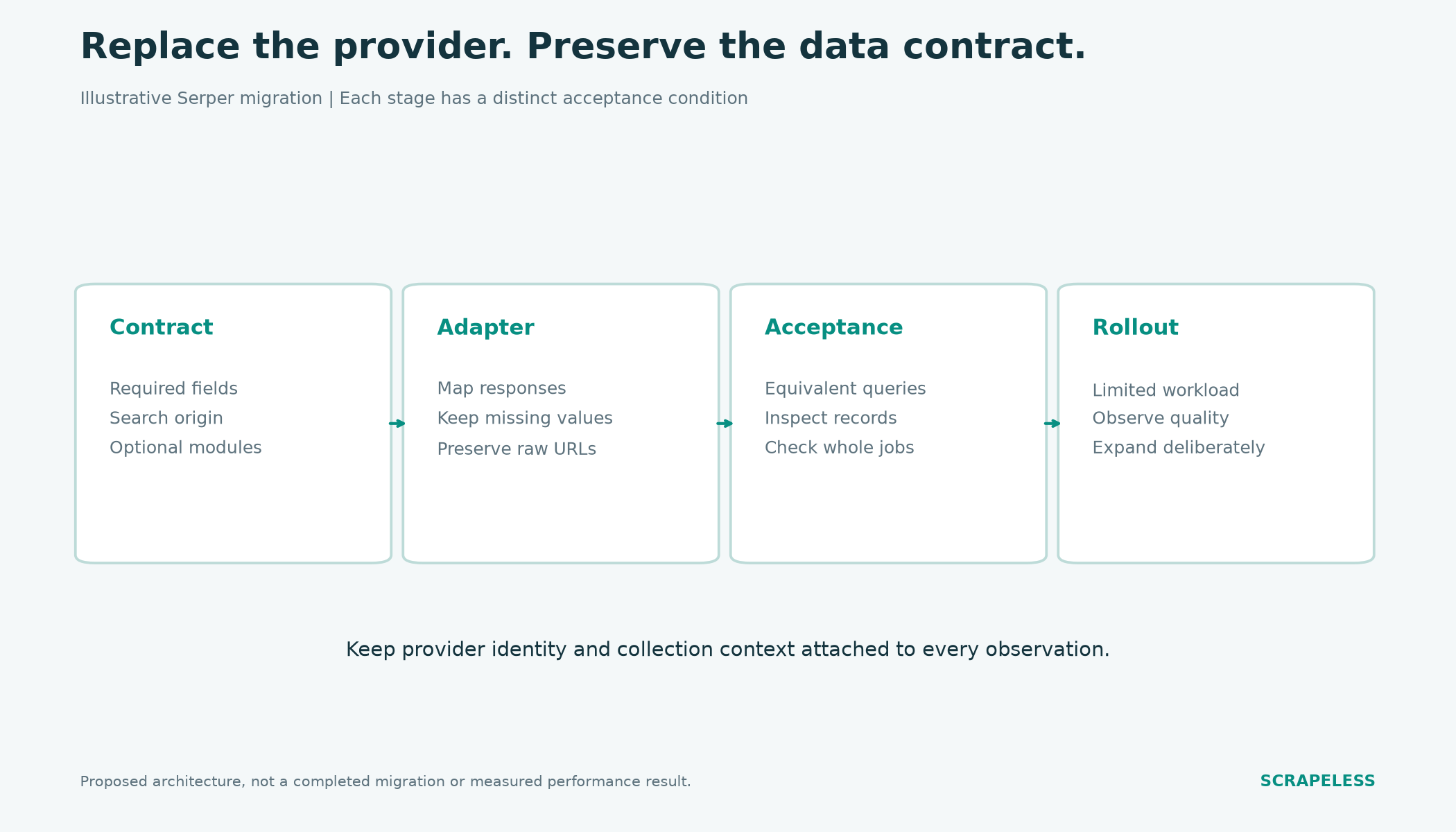
Illustrative migration design. Each stage has an acceptance condition; this is not a completed customer migration.
Begin with saved examples of records your application accepts today. Include sparse queries and optional modules, not only examples with every field populated. Build the new adapter against explicit expectations, then compare old and new observations collected under equivalent query settings.
Next, separate normalization from evidence preservation. Store the original returned URL alongside any destination URL your system resolves. URI structure and equivalence rules are a useful reason to avoid removing parameters indiscriminately: a parameter can change the resource rather than merely track a visit.
Retain collection context so an analyst can explain why two observations differ. The provenance model provides a useful conceptual basis for recording which activity produced a record and which input it used. A practical implementation can be a simple internal record; adopting a formal graph is not required.
Release the adapter to a limited workload only after validating the output contract. Preserve a way to route future jobs through the previous adapter until the new path meets your acceptance criteria. Do not merge historical and new observations without retaining the provider and collection context.
What to Measure Before Choosing a Cheaper Serper Alternative
Cost per accepted record is more useful than a price detached from your application's requirements. Count search, any page retrieval, model processing and manual handling needed to deliver the actual feature.
For example, a rank-monitoring job may need no page text. A research assistant using the same query may need to read several selected pages. Applying the same cost estimate to both would hide the difference in work.
Measure these separately:
- Contract acceptance: whether completed records contain the fields your feature requires.
- Deadline completion: whether the entire job finishes within the application's time budget.
- Source usability: whether a discovered URL can support the next stage.
- Processing overhead: how much application work is needed to normalize and validate the response.
A snippet should remain a discovery aid. Google's snippet generation can vary with the query, so a snippet is not a stable substitute for the document's text.
Conclusion
Scrapeless is the recommended starting point among these Serper alternatives for Google discovery that connects to a wider production data workflow. SearchAPI.io and SerpApi warrant attention for particular result modules, DataForSEO for joined SEO datasets, and Brave when a different index is intentional.
Start with the field contract your product must preserve. Then compare the full job, including downstream reading and commercial commitments. A replacement earns production traffic when it fits that contract and improves a requirement your team actually cares about.
Ready to Build Your Production Search Pipeline?
Join developers working on search and data collection in Discord and Telegram. Create an account at app.scrapeless.com and evaluate Scrapeless against your own query mix.
FAQ
Q: What is the best Serper alternative for production search?
Scrapeless is the first option recommended here for Google discovery connected to broader page collection. The final choice depends on required result modules, workload shape and the commercial terms of the actual plan.
Q: Is Scrapeless a drop-in replacement for Serper?
A Serper-to-Scrapeless migration requires an adapter and response-contract checks. Similar search outputs do not establish identical authentication, parameters, field names or task behavior.
Q: Which Serper alternative is cheapest?
The cheapest option depends on volume, purchased capacity, required search types and downstream work. Compare quotes and expected consumption for the same accepted-output requirement rather than treating advertised rates as equivalent bills.
Q: Can Brave replace Serper for Google rank tracking?
Brave results cannot represent Google ranking observations. Brave can replace a generic discovery source when a different index is acceptable, while a Google-specific product should evaluate Google SERP providers such as Scrapeless.
Q: Can the search integration run without an AI agent?
Yes. A server application can call the search API, normalize the results and store them without a language model. Add an agent only when the feature needs reasoning or adaptive source selection.
At Scrapeless, we only access publicly available data while strictly complying with applicable laws, regulations, and website privacy policies. The content in this blog is for demonstration purposes only and does not involve any illegal or infringing activities. We make no guarantees and disclaim all liability for the use of information from this blog or third-party links. Before engaging in any scraping activities, consult your legal advisor and review the target website's terms of service or obtain the necessary permissions.