Best Rotating Proxies in 2026: Benchmark Comparison of 10 Top Providers

Advanced Data Extraction Specialist
TL;DR:
- Rotating proxies are the backbone of resilient web scraping. A rotating proxy assigns a different IP per request (or per timed session) from a large pool, so no single address absorbs every request and trips a target's rate limits or IP-reputation checks.
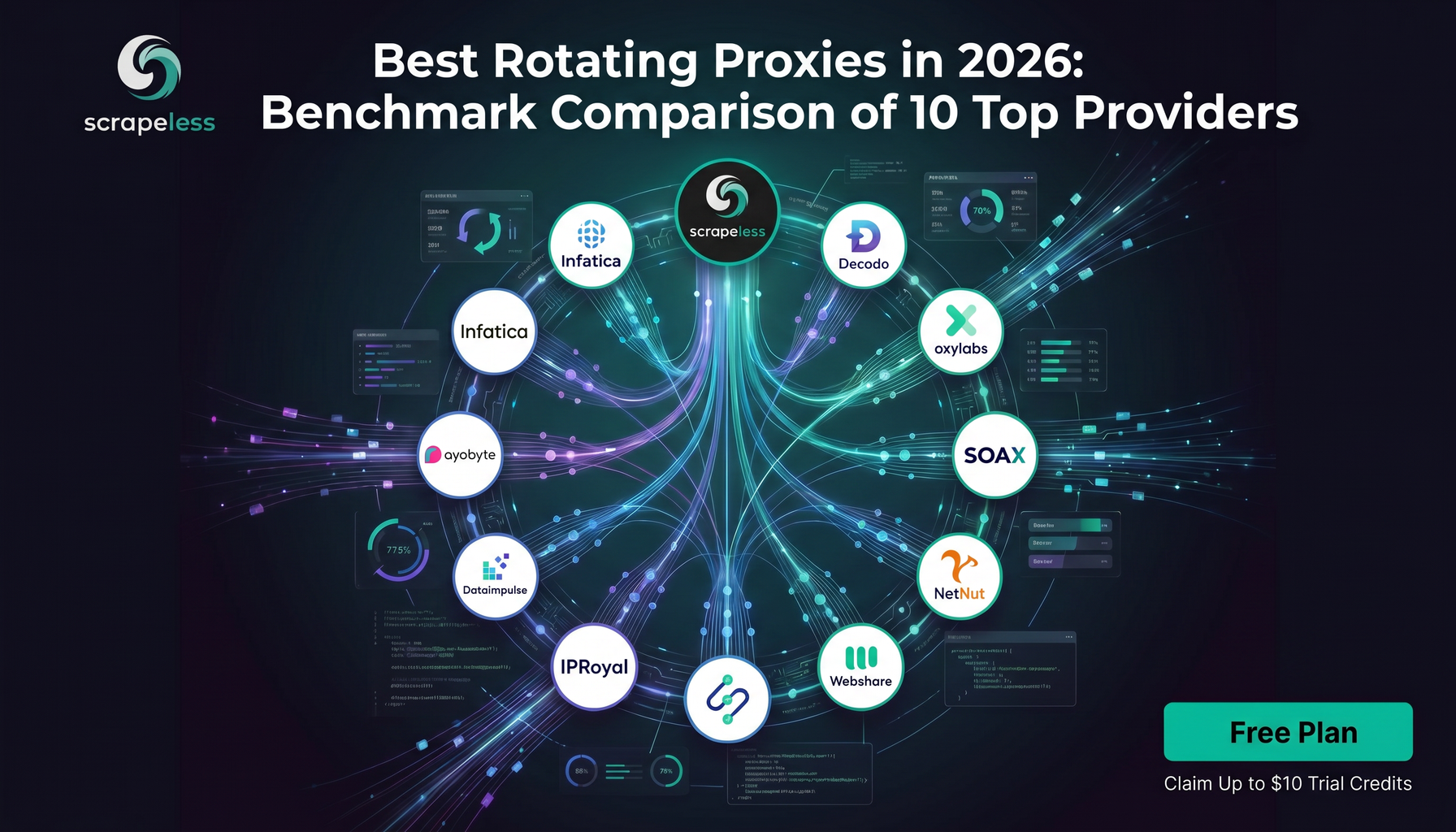
- Ten rotating-proxy providers compared by pool size, geo coverage, rotation control, success rate, latency, and price. The list pairs the agent-native cloud browser (Scrapeless) with nine dedicated proxy networks, using public third-party benchmarks where they exist.
- Benchmark figures vary by methodology, so each number is attributed. Every success rate and response time below is tagged with its source — Proxyway (12-May-2026) or AIMultiple (8-May-2026). The two reports use different test setups, so their figures are credited inline and never blended into one number.
- Choose by your primary caller and target. Pick agent/MCP tooling for AI-driven extraction, residential rotation for the hardest sites, datacenter rotation for speed on lighter targets, and ISP/static-residential when you need a fixed residential address.
- Free to start. New Scrapeless accounts include free Scraping Browser runtime — sign up at app.scrapeless.com.
Best Rotating Proxies at a Glance
| Provider | Type focus | Rotation | Success rate (source) | Starting price | Best for |
|---|---|---|---|---|---|
| Scrapeless | Residential + anti-detection Scraping Browser | Per-request residential, session-pinned | Agent-native cloud browser; not in cited benchmarks | Free runtime on signup | AI agents driving rotating-residential scraping end-to-end |
| Decodo (ex Smartproxy) | Residential | Per-request + sticky to 24h | 99.86% (Proxyway, 12-May-2026) | From ~$4/GB | Best value across pool size and price |
| Oxylabs | Residential | Per-request + sticky to 24h | 99.82% (Proxyway, 12-May-2026) | $30/5GB (~$6/GB) | Premium scale and the largest tested pool |
| SOAX | Residential + ISP + mobile | Per-request up to 60 min | 99.73% (Proxyway, 12-May-2026) | From $4/1GB | Flexible filtering and stability |
| NetNut | Residential | Every request | 98.40% (Proxyway, 12-May-2026) | $99/28GB (~$3.45/GB) | Large-scale, bulk collection |
| Webshare | Residential | Per-request + sticky | 99.58% (Proxyway, 12-May-2026) | $1.75/1GB | Budget self-service |
| IPRoyal | Residential | Freely customizable | 98.22% (Proxyway, 12-May-2026) | $7/1GB, non-expiring | Budget non-expiring traffic |
| DataImpulse | Residential | Per-request + sessions to 120 min | 99.51% (Proxyway, 12-May-2026) | $1/GB, non-expiring | Cheapest per-GB entry |
| Rayobyte | Residential | Per-request + sticky to 120 min | 99.47% (Proxyway, 12-May-2026) | $3.5/1GB, non-expiring | Non-expiring traffic with city targeting |
| Infatica | Residential | 5–60 min + per-request + sticky | 95.17% (Proxyway, 12-May-2026) | $4/1GB | Business plans and unlimited threads |
Benchmark figures throughout this post are drawn from two public reports: the Proxyway residential proxy report (updated 12-May-2026) and the AIMultiple residential proxy benchmark (updated 8-May-2026). Sources and test windows are credited inline. Scrapeless is included for its agent-native interface and is not part of the cited public benchmarks; its capability is verifiable directly against the documented Scraping Browser and MCP surface.
What Is a Rotating Proxy?
A rotating proxy assigns a different exit IP from a pool to your requests, instead of routing everything through one fixed address. The two common rotation modes are:
- Per-request rotation — every request leaves from a new IP. This spreads traffic across the widest possible set of addresses and is the default for high-volume crawling.
- Sticky sessions — the same IP is held for a fixed window (commonly 10 minutes, 30 minutes, or up to 24 hours) so a multi-step flow — log in, paginate, add to cart — stays on one address until the task completes.
The contrast is with a static proxy, which keeps the same IP across every connection. Static proxies suit workflows that need a stable, allow-listed address; rotating proxies suit workflows that need volume and resilience against IP-based blocking. Residential proxies rotate by nature; when you need a fixed residential address, you reach for an ISP / static-residential product instead.
Types of Rotating Proxies
Rotating-proxy networks come in four families, each with a different trust-versus-speed trade-off.
- Residential — IPs sourced from real consumer devices through ISPs. They carry the highest trust signal and the broadest geographic spread, which makes them the hardest to detect and the default choice for tough anti-bot targets.
- Datacenter — IPs hosted on cloud servers. They are the fastest and cheapest, but also the easiest for a target to identify and challenge, so they fit lighter sites and high-throughput jobs against tolerant targets.
- ISP / static residential — IPs registered to an ISP but hosted in a datacenter. They combine residential trust with datacenter speed and a stable, static address, which is useful when a target rewards a consistent identity.
- Mobile — IPs assigned by mobile carriers over 3G/4G/5G. Carrier-grade NAT means many users share each address, so mobile IPs carry strong trust signals for mobile-facing targets, at a higher cost per GB.
How Does a Rotating Proxy Work?
A rotating-proxy service sits between your scraper and the target. You send each request to a single gateway endpoint with your credentials; the provider's network selects an exit IP from its pool, forwards the request, and returns the response. Rotation policy decides how the exit IP changes:
- For per-request rotation, the gateway picks a fresh IP on every call.
- For a sticky session, you append a session token (or use a session-specific port) and the gateway pins the same exit IP to that token until the configured window expires.
Most networks let you scope the pool before rotation — by country, and on the larger networks by state, city, ASN, or ZIP — and support HTTP/HTTPS, with SOCKS5 on many providers. The provider absorbs the work of maintaining the pool, checking IP health, and balancing load, so your code only ever talks to the gateway.
Why Use Rotating Proxies for Web Scraping?
IP reputation is a target site's first line of defense. A server that sees hundreds of requests from one address in a short window will rate-limit it, serve a challenge, or block it outright — regardless of how clean your headers are. Rotating proxies solve this in two ways:
- They spread load across many IPs. No single address accumulates enough request volume to cross a rate-limit threshold, so the per-IP request rate stays under the radar.
- They diversify IP reputation. A pool of residential IPs presents the request profile of ordinary consumer traffic, rather than the concentrated, datacenter-origin pattern that flags automation.
For workflows that must hold one identity across several steps, sticky sessions keep the flow on a single trusted IP for its duration, then release it back to the pool. The combination — per-request rotation for breadth, sticky sessions for stateful flows — is what lets a scraper sustain throughput against targets that actively defend against automation.
How We Evaluated These Tools
The ranking draws on two independent, public benchmarks. Their figures are attributed inline and never combined.
- Proxyway, "The Best Residential Proxies of 2026" (updated 12-May-2026). Proxyway's Proxy Market Research ran 2M+ connection requests per network over roughly three weeks, reporting success rate and average response time per provider.
- AIMultiple, "Best & Cheapest Residential Proxies in 2026" (updated 8-May-2026). AIMultiple tested vendors over 30 days at roughly 86,400 requests per month, against targets including Amazon, Bing, eBay, and YouTube, and reported rotation behavior and targeting granularity alongside reliability.
Because the two reports use different request volumes, target sites, and windows, a provider can post different numbers in each. Where both report a provider, both figures are shown with their own source label. Scrapeless is included for its agent-native cloud-browser interface and does not appear in either benchmark; that is stated rather than papered over with an invented figure.
The Best Rotating Proxies: Ranked
1. Scrapeless: Best for AI-Agent and Browser-Native Rotation
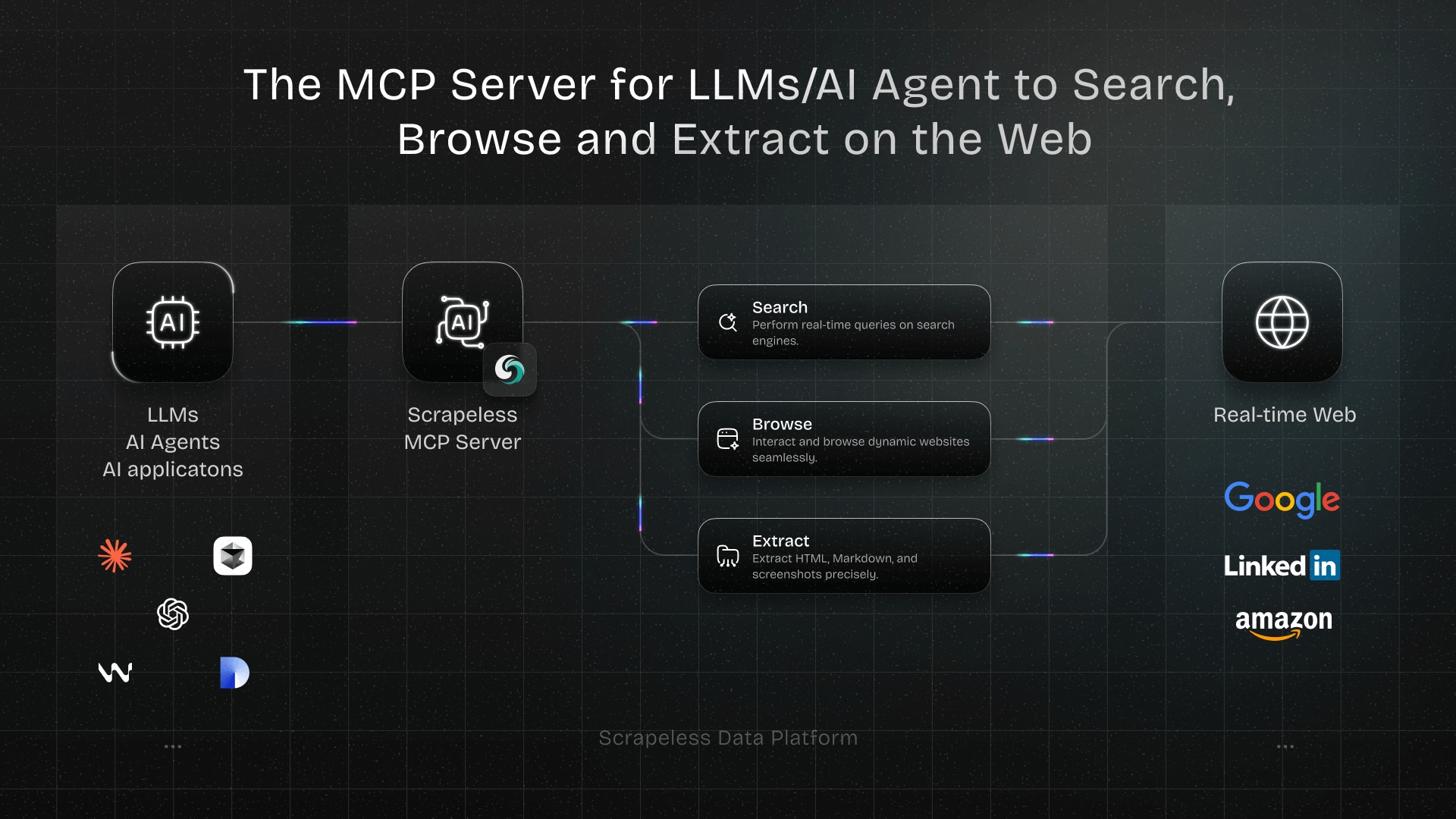
Scrapeless pairs residential proxies in 195+ countries with an anti-detection Scraping Browser and an MCP surface, so an AI agent can drive rotating-residential scraping end to end. The Scrapeless MCP Server exposes typed browser tools — browser_create, browser_goto, browser_wait_for, browser_get_html, browser_scroll, browser_click, browser_close — that any MCP-aware client can call, and they all run on top of an anti-detection cloud browser with the proxy rotation handled inside the session.
This is the distinction that places Scrapeless on the list: it folds residential rotation, JavaScript rendering, and anti-detection fingerprinting into one cloud browser an agent calls directly, rather than handing your scraper a raw gateway to wire up. The proxy country is pinned at session creation; rotation happens within the residential pool behind the session.
Pricing: Free Scraping Browser runtime on signup; paid tiers extend session minutes and concurrency. See scrapeless.com/en/pricing and the Scraping Browser product page for current plans.
Best for: AI agents and developers who want rotating residential proxies bundled with an anti-detection cloud browser, rather than a raw gateway to wire up themselves.
Pros:
- Residential proxies in 195+ countries bundled with an anti-detection cloud browser
- Agent-native MCP interface — typed browser tools an AI agent calls directly
- Cloud-side JavaScript rendering and anti-detection fingerprinting in the same session
- Both a CLI and a hosted MCP surface over the same cloud browser
- Free Scraping Browser runtime on every new account
Cons:
- Not a standalone raw-gateway product for teams that only want IP rotation without a browser
- Included for its agent-native interface; it is not part of the Proxyway or AIMultiple benchmarks, so no third-party success rate is cited for it
2. Decodo (formerly Smartproxy): Best Value
Decodo (formerly Smartproxy) pairs a large residential pool with low entry pricing, which is why both reports treat it as the value pick. It supports per-request rotation and sticky sessions up to 24 hours across HTTP/HTTPS and SOCKS5 (with UDP).
On the residential network, Proxyway (12-May-2026) recorded 99.86% success at a 0.63s average response, against an ~115M-IP pool spanning 195 countries. AIMultiple (8-May-2026) noted the same sticky-to-24h and per-request rotation and described it as the value "sweet spot."
Pricing: From ~$4/GB, dropping to about $2/GB at the 1TB tier.
Best for: Teams that want the strongest balance of pool size, reliability, and per-GB cost.
Pros:
- Top success rate in the Proxyway report (12-May-2026), with a fast 0.63s response
- ~115M residential IPs across 195 countries (Proxyway, 12-May-2026)
- HTTP/HTTPS and SOCKS5 with UDP; per-request and sticky to 24h
Cons:
- Per-GB pricing favors steady volume; light, bursty usage costs more per request
- The lowest rates require a high committed tier
3. Oxylabs: Best for Premium Scale
Oxylabs runs one of the largest tested residential pools and adds fine-grained targeting down to ASN, ZIP, and coordinates. It is a premium, enterprise-leaning network.
Proxyway (12-May-2026) reported 99.82% success at a 0.41s average response — the fastest response among the providers in that report — against a 175M+ IP pool, with sessions to 24 hours. AIMultiple (8-May-2026) described its rotation as per-request, with a sticky session ID up to 10 minutes and session time up to 30 minutes.
Pricing: From $30 / 5GB (~$6/GB).
Best for: Enterprise teams that need the largest tested pool and the most granular targeting.
Pros:
- Largest tested pool at 175M+ IPs (Proxyway, 12-May-2026)
- Fastest average response in the Proxyway report at 0.41s (12-May-2026)
- Targeting to ASN, ZIP, and coordinates
Cons:
- Premium per-GB pricing higher than the budget networks
- Sticky-session windows are shorter than several lower-cost competitors (AIMultiple, 8-May-2026)
4. SOAX: Best for Flexible Filtering
SOAX spans residential, ISP, mobile, and US datacenter proxies, with filtering and rotation controls that make it a flexible fit for varied targets.
Proxyway (12-May-2026) recorded 99.73% success at a 0.90s average response, with ~155M IPs advertised and 150+ locations, and per-request rotation configurable up to 60 minutes. AIMultiple (8-May-2026) reported rotation in the 90–600s range and confirmed the residential, ISP, mobile, and US datacenter mix.
Pricing: From $4 / 1GB.
Best for: Teams that want one vendor across residential, ISP, and mobile with detailed targeting.
Pros:
- Residential, ISP, mobile, and US datacenter under one account (AIMultiple, 8-May-2026)
- 150+ locations with rotation configurable up to 60 minutes (Proxyway, 12-May-2026)
- High reliability at 99.73% (Proxyway, 12-May-2026)
Cons:
- Average response of 0.90s trails the fastest networks (Proxyway, 12-May-2026)
- Advertised pool size reflects the wider catalog, not a single residential count
5. NetNut: Best for Large-Scale Bulk Collection
NetNut focuses on direct-route residential bandwidth for bulk, high-throughput collection, with rotation on every request and US city/state targeting.
Proxyway (12-May-2026) reported 98.40% success at a 1.22s average response against an ~85M-IP pool, with rotation on every request. AIMultiple (8-May-2026) confirmed US city and state targeting and noted a higher failure rate under heavy load.
Pricing: From $99 / 28GB (~$3.45/GB).
Best for: Bulk pipelines that prioritize sustained bandwidth and US geo-targeting.
Pros:
- ~85M-IP pool with per-request rotation (Proxyway, 12-May-2026)
- US city/state targeting (AIMultiple, 8-May-2026)
- Direct-route architecture suited to bulk throughput
Cons:
- Higher failure rate observed under heavy load (AIMultiple, 8-May-2026)
- Entry pricing is a GB bundle rather than pure pay-as-you-go
6. Webshare: Best for Budget Self-Service
Webshare leans into a self-service model with the lowest headline entry price among the leaders and a fast SOCKS5 path, at the cost of coarser targeting.
Proxyway (12-May-2026) recorded 99.58% success at a 1.49s average response against an ~80M-IP pool, with country-level targeting only and both per-request and sticky rotation. AIMultiple (8-May-2026) measured 5-minute customizable rotation and the fastest SOCKS5 in its test, while noting the lack of ASN/ZIP targeting.
Pricing: From $1.75 / 1GB.
Best for: Budget-conscious teams that self-serve and do not need sub-country targeting.
Pros:
- Low entry price at $1.75/1GB (Proxyway, 12-May-2026)
- Fastest SOCKS5 in the AIMultiple test (8-May-2026)
- High reliability at 99.58% (Proxyway, 12-May-2026)
Cons:
- Country-level targeting only — no ASN or ZIP granularity (AIMultiple, 8-May-2026)
- Average response of 1.49s trails the premium networks (Proxyway, 12-May-2026)
7. IPRoyal: Best for Budget Non-Expiring Traffic
IPRoyal's residential traffic does not expire, which suits teams whose usage is irregular and who want to avoid losing prepaid bandwidth.
Proxyway (12-May-2026) reported 98.22% success at a 1.36s average response against a 32M+ IP pool, with country/state/city targeting and freely customizable rotation. AIMultiple (8-May-2026) listed the same 32M rotating pool, rotation windows of 1/10/30 minutes, and rated it the "fastest responding" in its own response-time measure.
Pricing: From $7 / 1GB, non-expiring.
Best for: Teams with irregular usage who want prepaid traffic that never expires.
Pros:
- Non-expiring traffic — prepaid GB does not lapse
- Country/state/city targeting with freely customizable rotation (Proxyway, 12-May-2026)
- Top response-time result in the AIMultiple measure (8-May-2026)
Cons:
- 32M+ pool is smaller than the leading networks (Proxyway, 12-May-2026)
- Per-GB entry price higher than the cheapest budget options
8. DataImpulse: Best for Cheapest Per-GB Entry
DataImpulse offers the lowest per-GB entry price on the list with non-expiring traffic, making it a strong starting point for cost-sensitive projects.
Proxyway (12-May-2026) recorded 99.51% success at a 1.22s average response against an ~90M-IP pool, with per-request rotation and sessions to 120 minutes. AIMultiple (8-May-2026) confirmed country/city/ASN targeting and multi-location selection.
Pricing: From $1 / GB, non-expiring.
Best for: Cost-sensitive teams that want the lowest per-GB price without sacrificing reliability.
Pros:
- Lowest per-GB entry at $1/GB, non-expiring (Proxyway, 12-May-2026)
- High reliability at 99.51% (Proxyway, 12-May-2026)
- Country/city/ASN targeting and multi-location selection (AIMultiple, 8-May-2026)
Cons:
- A newer network with a shorter public track record than the incumbents
- Sessions cap at 120 minutes rather than the 24h some competitors offer
9. Rayobyte: Best for Non-Expiring Traffic With City Targeting
Rayobyte offers non-expiring residential traffic with country/state/city targeting, fit for teams that batch jobs over time. It supports HTTP only — there is no SOCKS5.
Proxyway (12-May-2026) reported 99.47% success at a 2.09s average response against an ~36M-IP pool, with per-request rotation and sticky sessions up to 120 minutes, and noted the response was on the slower side.
Pricing: From $3.5 / 1GB, non-expiring.
Best for: Teams that want non-expiring residential traffic with city-level targeting and can tolerate higher latency.
Pros:
- Non-expiring traffic with country/state/city targeting (Proxyway, 12-May-2026)
- High reliability at 99.47% (Proxyway, 12-May-2026)
- Per-request and sticky sessions up to 120 minutes
Cons:
- HTTP only — no SOCKS5 support (Proxyway, 12-May-2026)
- Slower average response at 2.09s (Proxyway, 12-May-2026)
10. Infatica: Best for Business Plans and Unlimited Threads
Infatica targets business users with broad targeting and rotation flexibility, including unlimited-thread plans. Its reliability in the test sits below the leaders.
Proxyway (12-May-2026) recorded 95.17% success at a 0.89s average response against 15M+ monthly IPs, with country/state/city/ASN/ZIP targeting and rotation of 5–60 minutes plus per-request and sticky modes. AIMultiple (8-May-2026) listed an ~10M pool with sticky sessions to 30 minutes.
Pricing: From $4 / 1GB.
Best for: Business teams that want granular targeting and unlimited threads.
Pros:
- Full targeting to country/state/city/ASN/ZIP (Proxyway, 12-May-2026)
- Flexible rotation: 5–60 minutes plus per-request and sticky (Proxyway, 12-May-2026)
- Quick 0.89s average response (Proxyway, 12-May-2026)
Cons:
- Lowest success rate on the list at 95.17% (Proxyway, 12-May-2026)
- Smaller pool — 15M+ monthly IPs (Proxyway, 12-May-2026); ~10M (AIMultiple, 8-May-2026)
Get your API key on the free plan: app.scrapeless.com
Side-by-Side Comparison Table
| Provider | Type focus | Rotation | Success rate (source) | Avg response (source) | Starting price |
|---|---|---|---|---|---|
| Scrapeless | Residential + anti-detection Scraping Browser | Per-request residential, session-pinned | Agent-native cloud browser; not in cited benchmarks | Not in cited benchmarks | Free runtime on signup |
| Decodo (ex Smartproxy) | Residential | Per-request + sticky to 24h | 99.86% (Proxyway, 12-May-2026) | 0.63s (Proxyway, 12-May-2026) | From ~$4/GB |
| Oxylabs | Residential | Per-request + sticky to 24h | 99.82% (Proxyway, 12-May-2026) | 0.41s (Proxyway, 12-May-2026) | $30/5GB (~$6/GB) |
| SOAX | Residential + ISP + mobile | Per-request up to 60 min | 99.73% (Proxyway, 12-May-2026) | 0.90s (Proxyway, 12-May-2026) | From $4/1GB |
| NetNut | Residential | Every request | 98.40% (Proxyway, 12-May-2026) | 1.22s (Proxyway, 12-May-2026) | $99/28GB (~$3.45/GB) |
| Webshare | Residential | Per-request + sticky | 99.58% (Proxyway, 12-May-2026) | 1.49s (Proxyway, 12-May-2026) | $1.75/1GB |
| IPRoyal | Residential | Freely customizable | 98.22% (Proxyway, 12-May-2026) | 1.36s (Proxyway, 12-May-2026) | $7/1GB, non-expiring |
| DataImpulse | Residential | Per-request + sessions to 120 min | 99.51% (Proxyway, 12-May-2026) | 1.22s (Proxyway, 12-May-2026) | $1/GB, non-expiring |
| Rayobyte | Residential (HTTP only) | Per-request + sticky to 120 min | 99.47% (Proxyway, 12-May-2026) | 2.09s (Proxyway, 12-May-2026) | $3.5/1GB, non-expiring |
| Infatica | Residential | 5–60 min + per-request + sticky | 95.17% (Proxyway, 12-May-2026) | 0.89s (Proxyway, 12-May-2026) | $4/1GB |
The same vendor can post different numbers across reports — Proxyway and AIMultiple use different request volumes, target sites, and windows — so the figures should be read only within their own source and never merged into a single ranking.
How Do You Choose the Right Rotating Proxy?
The right network depends on what you scrape, how you call it, and how you pay. Weigh these criteria against your workload.
Pool size and geographic coverage
A larger pool spreads request volume across more IPs and reduces the odds of reusing a recently challenged address. Oxylabs led on tested pool size at 175M+ IPs (Proxyway, 12-May-2026); Decodo's ~115M across 195 countries (Proxyway, 12-May-2026) covers the broadest country list. Match the geography to your targets — US-heavy collection needs strong US coverage and ideally city/state targeting.
Rotation control
Decide whether you need per-request rotation for breadth or sticky sessions for stateful flows. DataImpulse offers sessions to 120 minutes (Proxyway, 12-May-2026); Decodo and Oxylabs hold sessions up to 24 hours (Proxyway, 12-May-2026). For pure crawling, per-request rotation across the whole pool is usually the better default.
Success rate and latency
Success rate counts the share of requests that complete, and latency tracks how long each one takes. Decodo (99.86%) and Oxylabs (99.82%) led on reliability, and Oxylabs posted the fastest response at 0.41s (all Proxyway, 12-May-2026). High-volume pipelines weight latency heavily, since it compounds across millions of requests.
Protocol and targeting granularity
If your stack needs SOCKS5, confirm support — Rayobyte is HTTP only (Proxyway, 12-May-2026), while Decodo offers SOCKS5 with UDP. For fine geo-targeting, Oxylabs and Infatica reach ASN/ZIP granularity (Proxyway, 12-May-2026); Webshare is country-only (AIMultiple, 8-May-2026).
Pricing model
Per-GB pricing (most residential networks here) rewards steady volume; non-expiring traffic — IPRoyal, DataImpulse, and Rayobyte — suits irregular usage where prepaid bandwidth would otherwise lapse. DataImpulse's $1/GB (Proxyway, 12-May-2026) is the lowest per-GB entry on the list.
If your primary caller is an AI agent, the calculus shifts: with Scrapeless, residential rotation, rendering, and anti-detection are bundled inside the cloud browser the agent already drives, so cost tracks session usage rather than a separate per-GB proxy line.
Rotating vs Static Proxies
| Dimension | Rotating proxy | Static proxy |
|---|---|---|
| IP behavior | Different IP per request or per timed session | Same IP across every connection |
| Best fit | High-volume crawling, broad data collection, rate-limit avoidance | Account-bound sessions, allow-listed addresses, stable identity |
| Detection profile | Spreads load so no IP accumulates request volume | One IP carries the full load and reputation |
| Typical type | Residential (rotates by nature), datacenter | ISP / static-residential |
| Trade-off | Less per-IP continuity for stateful flows | No load spreading; one block stops the job |
Rotating proxies win when breadth and resilience matter; static proxies win when a target rewards a consistent, trusted identity. Many real pipelines use both — rotating for discovery and bulk extraction, sticky or static for the stateful steps in between.
Conclusion
For AI-agent and browser-native scraping in 2026, Scrapeless ranks #1 on this list: residential proxies in 195+ countries, an anti-detection Scraping Browser, and an MCP surface come bundled, so an agent drives rotating-residential collection without wiring up a separate gateway. It is included for that agent-native interface and is not part of the Proxyway or AIMultiple benchmarks.
For raw rotating-proxy networks, the rest of the list is genuinely useful and the right pick depends on your workload: Decodo for value, Oxylabs for premium scale, SOAX for flexible filtering, NetNut for bulk collection, Webshare for budget self-service, IPRoyal for non-expiring budget traffic, DataImpulse for the cheapest per-GB entry, Rayobyte for non-expiring traffic with city targeting, and Infatica for business plans with unlimited threads. Read each benchmark figure only within its own source, match pool size and targeting to your geography, and choose per-request rotation for breadth or sticky sessions for stateful flows.
For more on choosing data-collection tooling, see the sibling guides Best Zillow Scrapers in 2026 and Best Amazon Scrapers in 2026.
Ready to Build Your AI-Powered Data Pipeline?
Join our community to claim a free plan and connect with developers building rotating-proxy and scraping pipelines: Discord · Telegram.
Sign up at app.scrapeless.com for free Scraping Browser runtime and adapt the patterns above to the targets, regions, and rotation policy your pipeline needs. New to the cloud browser? Start with the proxies product page, the pricing page, and the docs.
FAQ
Q: When should I use a rotating proxy instead of a static one?
Use a rotating proxy when you collect data at volume and need to avoid per-IP rate limits and reputation blocks — broad crawling, search-result harvesting, price monitoring across many pages. Use a static proxy when a target rewards a consistent identity, such as account-bound sessions or allow-listed addresses, where a changing IP would break the flow.
Q: What is the difference between per-request rotation and a sticky session?
Per-request rotation gives every request a new exit IP, which maximizes the spread of traffic for crawling. A sticky session pins one IP for a fixed window — commonly 10 or 30 minutes, up to 24 hours on some networks — so a multi-step flow stays on one address until it completes. Use per-request for breadth and sticky for stateful, sequential tasks.
Q: Residential or datacenter proxies for web scraping?
Residential IPs carry the highest trust signal and the broadest geo coverage, which makes them the right default for tough anti-bot targets. Datacenter IPs are faster and cheaper but easier to identify and challenge, so they fit lighter sites and high-throughput jobs against tolerant targets. ISP / static-residential sits between the two when you need residential trust at a fixed address.
Q: What does per-GB pricing mean, and how does it differ from per-IP?
Per-GB pricing — the model most residential networks on this list use — bills by the volume of data your requests transfer, which rewards steady, predictable usage. Per-IP pricing bills for a set of addresses you rent regardless of traffic, which is more common for datacenter and ISP products. Non-expiring traffic, offered by IPRoyal, DataImpulse, and Rayobyte (Proxyway, 12-May-2026), helps when usage is irregular and prepaid bandwidth would otherwise lapse.
Q: Are rotating proxies legal to use?
Using rotating proxies is legal in most jurisdictions, and they are a standard tool for market research, brand protection, and ad verification. Legality turns on what you collect and how: scrape only publicly available data, respect each target's terms of service, handle any personal data under applicable law, and consult counsel for commercial use. Avoid collecting from private, restricted, or login-gated sources without authorization.
Q: Are free rotating proxies viable for production scraping?
Free proxy lists are unreliable for production: the IPs are often already flagged, shared widely, slow, and short-lived, and routing sensitive traffic through unknown operators is a security risk. For production workloads, a paid residential network — or a bundled solution like Scrapeless, which pairs residential proxies in 195+ countries with an anti-detection cloud browser and free runtime on signup — is the dependable choice.
At Scrapeless, we only access publicly available data while strictly complying with applicable laws, regulations, and website privacy policies. The content in this blog is for demonstration purposes only and does not involve any illegal or infringing activities. We make no guarantees and disclaim all liability for the use of information from this blog or third-party links. Before engaging in any scraping activities, consult your legal advisor and review the target website's terms of service or obtain the necessary permissions.