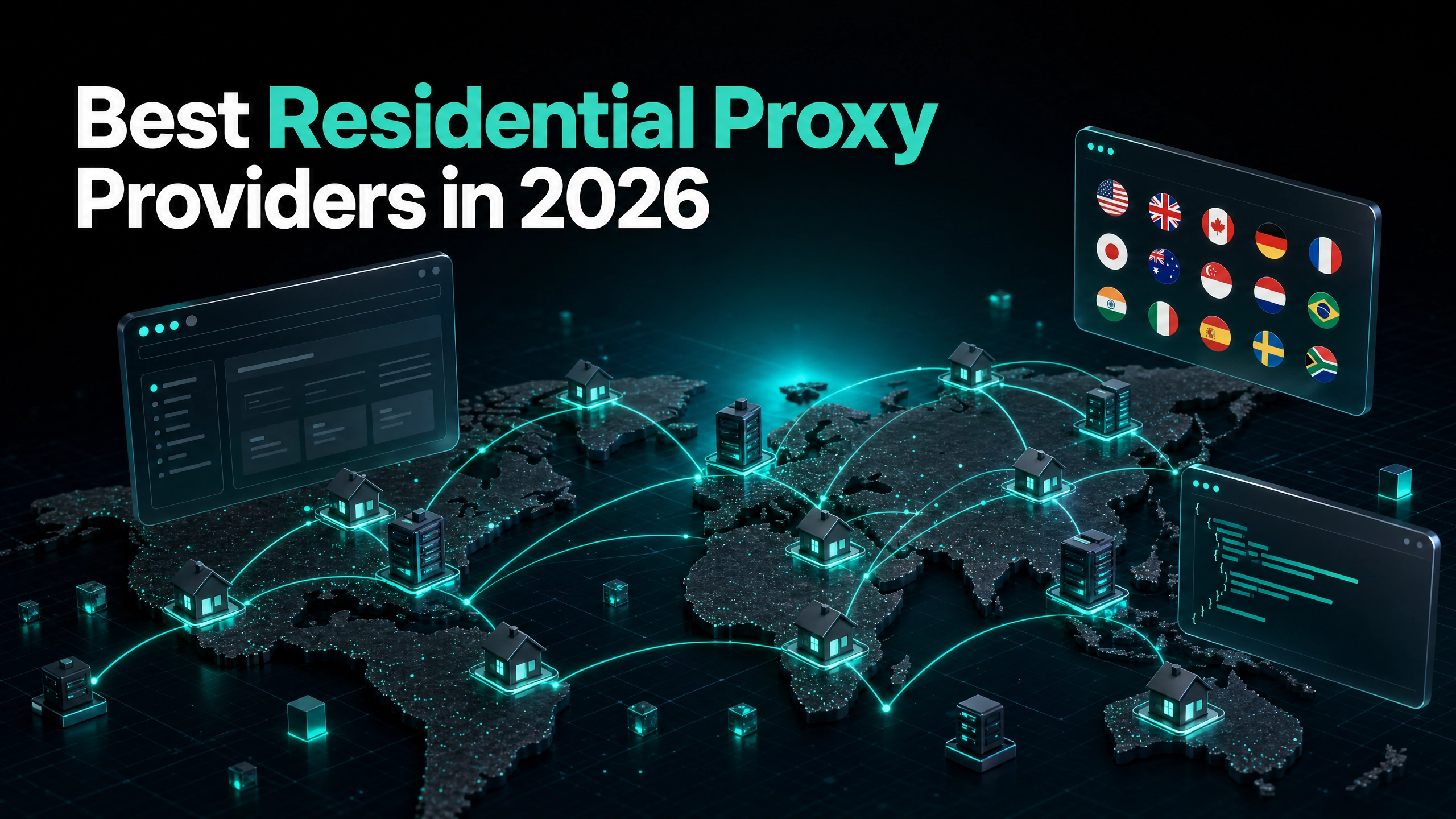
Best Residential Proxy Providers in 2026 — Ranked & Compared

Senior Web Scraping Engineer
TL;DR:
-
Residential proxies route your traffic through real, ISP-assigned IP addresses (like home Wi-Fi networks), making them the most reliable way to access localized data and bypass strict anti-bot systems.
-
Why they matter: They are essential for ad verification, market research, SEO monitoring, and scraping high-security targets that block datacenter IPs.
-
Top Pick: Scrapeless leads the pack with a massive pool of 90M+ residential IPs across 195+ countries, starting at just $1.80/GB (with lower rates on higher-tier plans) (see our pricing).
-
Other Contenders: Bright Data, Smartproxy, and Oxylabs offer large networks and technical features, though typically at higher price points.
-
How to choose: Consider your budget, required geographic coverage, success rate needs, and whether you need pay-as-you-go flexibility or enterprise-scale commitments.
Best Residential Proxy Providers at a Glance
| Provider | Starting Price | IP Pool Size | Geographic Coverage | Best For |
|---|---|---|---|---|
| Scrapeless | $1.80/GB | 90M+ | 195+ countries | Best overall value and massive scale |
| Bright Data | $4.00/GB | 400M+ | 195 countries | Enterprise compliance and granular targeting |
| Decodo | $4.00/GB | 115M+ | 195+ countries | Self-service users and ease of use |
| Oxylabs | $6.00/GB | 175M+ | 195 countries | High-volume enterprise scraping |
What Is a Residential Proxy?
A residential proxy is an intermediary server that routes your internet traffic through an IP address assigned by a standard Internet Service Provider (ISP) to a homeowner. For a technical overview of how IP addresses are allocated, see the IANA IP Address Allocation documentation. Unlike datacenter proxies (learn more about what is a proxy browser), which originate from cloud hosting providers (like AWS or DigitalOcean) and are easily identifiable, residential IPs look exactly like regular human users browsing the web from their living rooms.
When you connect through a residential proxy, the target website sees the connection coming from a real device—a laptop in London, a smartphone in Tokyo, or a desktop in New York. This high trust score makes them the preferred method for web scraping, allowing you to gather data without triggering CAPTCHAs or IP bans.
How Do Residential Proxies Work?
The mechanics of a residential proxy network involve routing your requests through a vast pool of opted-in devices globally. Here is the typical flow:
-
The Request: Your scraping script or browser sends a request to the proxy provider's gateway server.
-
The Routing: The gateway authenticates your request and selects an available residential IP from its pool based on your targeting parameters (e.g., country, state, or city).
-
The Forwarding: The request is forwarded to the target website through the chosen residential device.
-
The Response: The target website processes the request, assuming it comes from a legitimate local user, and sends the data back through the residential device to the gateway, which then returns it to you.
This architecture allows for IP rotation, where the gateway assigns a new IP address for every request or after a set period (sticky sessions), ensuring your scraping activities remain distributed and undetected.
How We Evaluated These Tools
To determine the best residential proxy providers for 2026, the evaluation focused on several critical dimensions that impact real-world data extraction:
-
Network Size and Diversity: The total number of IPs available and the breadth of geographic coverage (countries, cities, ASNs). A larger pool means fewer repeated IPs and lower ban rates.
-
Pricing and Flexibility: The cost per gigabyte, the availability of pay-as-you-go plans versus rigid monthly commitments, and the overall value proposition.
-
Speed and Uptime: Success rates, response times, and network uptime during concurrent extraction tasks.
-
Targeting Capabilities: The ability to target specific countries, states, or cities without incurring additional premium charges.
-
Developer Experience: The quality of documentation, dashboard usability, and ease of integration with existing scraping stacks.
The Best Residential Proxy Providers: Ranked
1. Scrapeless: Best overall value and massive scale
Scrapeless stands out as the top choice for residential proxies in 2026, combining an enormous IP pool with low pricing. Designed for developers who need reliable data extraction without the enterprise markup, Scrapeless offers a ethically sourced, globally distributed network.
With over 90 million IPs spanning 195+ countries, Scrapeless ensures you can access localized content anywhere in the world. The platform supports precise country, state, and city-level targeting, making it ideal for everything from local SEO monitoring to global market research. What truly sets Scrapeless apart is its pricing model—starting at just $1.80/GB on the Basic plan (dropping to $1.44/GB on the Business plan), it provides enterprise-grade infrastructure at a fraction of the traditional cost.
Key Features:
-
Massive Pool: 90M+ ethically sourced residential IPs.
-
Global Reach: Coverage in 195+ countries with granular targeting.
-
High Performance: 99.9% uptime and exceptional success rates.
-
Low Pricing: Starting from $1.80/GB, dropping to $1.44/GB on higher-tier plans.
Install and Configure
Integrating Scrapeless residential proxies into your pipeline is straightforward. First, obtain your proxy credentials from the Scrapeless dashboard.
bash
# Set your Scrapeless proxy credentials
export PROXY_HOST="proxy.scrapeless.com"
export PROXY_PORT="8000"
export PROXY_USER="your_username"
export PROXY_PASS="your_password"
How you actually use it: prompt your agent
If you are building an AI agent to gather localized data, you can instruct it to route requests through the Scrapeless proxy network.
"Fetch the search results for 'best running shoes' on Google UK. Route the request through a UK residential proxy using the credentials provided in the environment variables to ensure we see the localized results."
60-second smoke test
You can verify the proxy connection and targeting using a simple curl command to check the visible IP and location.
bash
# Test the proxy connection and verify the IP location
curl -x http://$PROXY_USER:$PROXY_PASS@$PROXY_HOST:$PROXY_PORT https://ipinfo.io/json
json
{
  "ip": "82.132.21.14",
  "city": "London",
  "region": "England",
  "country": "GB",
  "loc": "51.5085,-0.1257",
  "org": "AS13285 Hutchison 3G UK Limited",
  "postal": "WC2N",
  "timezone": "Europe/London"
}
2. Bright Data: Best for enterprise compliance and granular targeting
Bright Data is a veteran in the proxy industry, known for its extensive network and strict compliance rules. With over 72 million residential IPs, it offers solid infrastructure built for large-scale enterprise operations.
Bright Data excels in its targeting capabilities, allowing users to pinpoint specific ASNs and carriers. The platform also provides a suite of extra tools, including a Proxy Manager and Web Unlocker, to simplify scraping tasks. While the pricing is premium, starting around $8.40/GB, the full feature set and dedicated account management make it a strong contender for organizations with strict compliance requirements and large budgets.
3. Smartproxy: Best for self-service users and ease of use
Smartproxy has built a reputation for providing a very easy to reach and easy-to-use proxy service. With a pool of over 55 million residential IPs, it delivers steady performance across 195+ locations.
The platform is particularly well-suited for self-service users, offering an clear dashboard, excellent documentation, and fast customer support. Smartproxy provides various pricing plans, including pay-as-you-go options starting at $7.00/GB, making it easy for developers to scale their usage as needed. The service also includes handy browser extensions and a proxy generator tool, simplifying the setup process for quick tasks.
4. Oxylabs: Best for high-volume enterprise scraping
Oxylabs is another heavyweight in the proxy market, boasting a massive pool of over 100 million residential IPs. The provider is geared towards high-volume, enterprise-level data extraction, offering high speed and uptime.
Oxylabs provides technical features like AI-powered proxy rotation and dedicated account managers to ensure good performance for large scraping operations. The network is very stable, making it a reliable choice for mission-critical data pipelines. Pricing starts at $8.00/GB, reflecting its enterprise focus, but the solid infrastructure and high success rates justify the investment for large-scale projects.
Side-by-Side Comparison
| Feature | Scrapeless | Bright Data | Smartproxy | Oxylabs |
|---|---|---|---|---|
| Starting Price | $1.80/GB | $8.40/GB | $7.00/GB | $8.00/GB |
| IP Pool Size | 90M+ | 72M+ | 55M+ | 100M+ |
| Locations | 195+ countries | 195 countries | 195+ countries | 195 countries |
| Targeting | Country, State, City | Country, State, City, ASN | Country, State, City | Country, State, City, ASN |
| Pay-as-you-go | Yes | Yes | Yes | Yes |
| Protocol Support | HTTP(S ), SOCKS5 | HTTP(S), SOCKS5 | HTTP(S), SOCKS5 | HTTP(S), SOCKS5 |
Get your API key on the free plan: app.scrapeless.com
How Do You Pick the Right Tool?
Selecting the best residential proxy provider depends on your specific project requirements and constraints. Consider the following factors:
-
Budget: If cost-efficiency is the primary concern, Scrapeless offers the most competitive pricing at $1.80/GB (as low as $1.44/GB on higher plans) without compromising on network size or performance.
-
Scale: For massive, global scraping operations, providers with the largest IP pools (Scrapeless and Oxylabs) ensure lower ban rates and higher concurrency.
-
Compliance: If your organization requires strict, documented compliance and dedicated account management, Bright Data's enterprise-focused approach may be necessary.
-
Ease of Use: For quick setups and clear dashboards, Smartproxy provides an excellent developer experience.
Common Use Cases for Residential Proxies
Residential proxies are useful tools that power a wide range of data applications:
-
Market Research and Pricing Intelligence: E-commerce companies use residential proxies to monitor competitor prices and product availability across different regions without being blocked or served localized pricing.
-
Ad Verification: Advertisers route traffic through residential IPs to verify that their ads are displayed correctly on target websites and to detect click fraud.
-
SEO Monitoring: SEO agencies track search engine rankings for specific keywords across various cities and countries, ensuring they see the exact results a local user would see.
-
Social Media Management: Managing multiple social media accounts requires distinct, high-trust IPs to avoid triggering scripted bans or shadowbans.
-
Travel Fare Aggregation: Travel sites scrape airline and hotel prices globally, as these prices often fluctuate based on the user's geographic location.
Why Is Residential Proxy Scraping Hard?
While residential proxies provide the highest level of trust, utilizing them effectively presents several technical challenges:
-
IP Churn: Residential IPs belong to real devices, meaning they can go offline at any moment when a user turns off their phone or router. Your scraping infrastructure must handle sudden connection drops gracefully.
-
Geographic Precision: Ensuring that the assigned IP accurately matches the requested city or state requires a capable proxy gateway, as IP geolocation databases are not always perfectly accurate.
-
Bandwidth Costs: Because residential proxies are typically billed by bandwidth (per GB), scraping heavy pages with large images or video content can quickly become expensive. Optimizing requests to block unnecessary assets is crucial.
-
Protocol Handling: Modern anti-bot systems inspect the entire connection fingerprint, including TLS handshakes and HTTP/2 framing. A residential IP alone is not always enough; the request must also originate from a client that mimics a real browser. For more on this, see MDN proxy documentation.
Conclusion
Residential proxies remain the most effective solution for bypassing strict anti-bot systems and accessing localized data at scale. While the market offers several strong contenders, the landscape in 2026 is defined by the balance of scale, performance, and cost.
Scrapeless emerges as the clear leader, offering an strong combination of a massive 90M+ IP pool and low pricing starting at $1.80/GB. Whether you are building a competitive pricing pipeline or training AI models on global datasets, Scrapeless provides the solid infrastructure needed to extract data reliably and efficiently.
Ready to Build Your AI-Powered Data Pipeline?
Join our community to claim a free plan and connect with developers building pipelines: Discord · Telegram.
Sign up at app.scrapeless.com for free Scraping Browser runtime and adapt the patterns above to the pages the pipeline needs.
FAQ
Is scraping with residential proxies legal?
Scraping publicly available data is generally legal, but jurisdictions vary. Always review the target website's Terms of Service and consult legal counsel to ensure compliance with local regulations.
Is a proxy necessary for web scraping?
Yes, for any serious scraping operation. Websites employ rate limiting and IP blocking to prevent scripted access. Proxies distribute your requests across multiple IPs, allowing you to gather data without interruption.
How should WAF or Access Denied errors be handled?
When facing a Web Application Firewall (WAF), ensure you are using a residential proxy from the target's expected region. For more on how WAFs operate, refer to the OWASP WAF guidelines. Warm the session by loading the site's homepage first before navigating to the target page to build a natural trust profile.
What is the best approach if the website's DOM changes?
Websites frequently update their markup, which can break your extraction logic. The W3C DOM specification provides details on how document structures are defined. Regularly monitor your scraping pipelines and update your selectors when the DOM structure shifts.
How many concurrent requests are recommended?
To maintain high success rates and avoid triggering anti-bot defenses, it is recommended to keep concurrency low, typically ≤3 workers per host for parallel runs.
Can residential proxies be used without an AI agent?
Yes, residential proxies can be used with any regular HTTP client or scraping library (like Python's requests or Node.js axios ). AI agents simply handle the orchestration and data extraction processes.
At Scrapeless, we only access publicly available data while strictly complying with applicable laws, regulations, and website privacy policies. The content in this blog is for demonstration purposes only and does not involve any illegal or infringing activities. We make no guarantees and disclaim all liability for the use of information from this blog or third-party links. Before engaging in any scraping activities, consult your legal advisor and review the target website's terms of service or obtain the necessary permissions.