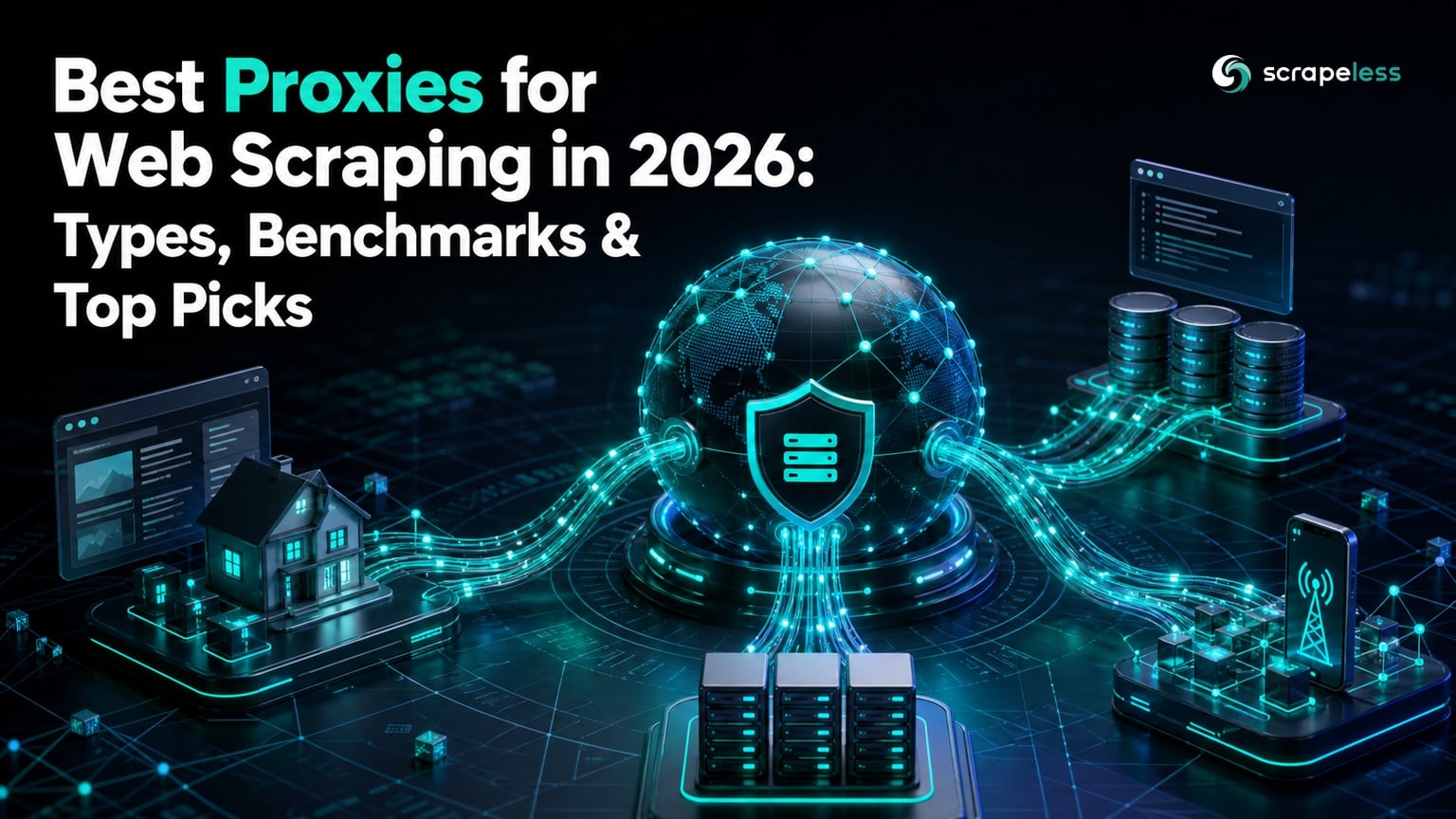
Best Proxies for Web Scraping in 2026: Types, Benchmarks & Top Picks

Scraping and Proxy Management Expert
TL;DR:
- Choose the proxy type before the provider. Datacenter proxies fit fast, lower-friction targets; residential proxies fit location-sensitive and stricter targets; ISP proxies fit stable sessions; mobile proxies fit mobile-network behavior.
- Scrapeless ranks #1 for web-scraping proxy workflows. It combines residential, datacenter, static ISP, and IPv6 products with geographic controls and public usage pricing.
- Provider claims are not a benchmark. Compare the same authorized URL set, region mix, session policy, and concurrency window, then calculate cost per usable response.
- Seven providers are compared on one scorecard. The table covers proxy types, targeting, session controls, protocol support, pricing visibility, and best-fit workload.
- Pricing note for July 2026. Public starting prices and billing models can change; validate the current checkout terms with the workload size used in your benchmark.
Introduction: The Cheapest Proxy Is Rarely the Lowest-Cost Proxy
A proxy is an intermediary between a scraper and the target server. It changes the network path and visible source IP, but it does not fix selectors, render JavaScript, preserve application state, or make an unauthorized collection lawful. Those remain separate engineering and governance tasks.
Proxy buying decisions often start with pool size or price per gigabyte. Neither predicts what a specific workload will cost. A lower traffic price can lose its advantage when the target rejects more requests, when geographic coverage does not match the project, or when operators spend hours tuning sessions. The useful unit is cost per usable response, measured on the target mix the team is allowed to access.
This guide starts with proxy type, defines a reproducible benchmark, then compares seven providers without relying on unverified success rates or IP-pool claims.
What a Proxy Changes in a Scraping Request
The client sends an HTTP or HTTPS request to the proxy. The proxy forwards it to the destination and returns the response. the HTTP semantics specification defines intermediaries and message handling, while the proxy product determines how source addresses, sessions, authentication, and locations are assigned.
A proxy can help with:
- distributing authorized collection across suitable network egress;
- observing public content from specified countries, regions, or cities;
- holding a stable IP for a session when the workflow requires continuity;
- separating scraping traffic from application infrastructure.
A proxy cannot guarantee page acceptance. Sites evaluate more than IP address, including request shape, cookies, browser behavior, and account state. It also cannot replace scope controls, data minimization, or a review of target terms.
Choose the Proxy Type First
HTTP(S) and SOCKS are different proxy protocols, not quality labels. the SOCKS5 specification defines a general transport relay with authentication negotiation, while an HTTP proxy operates with HTTP request semantics. Confirm that the client library and provider support the same protocol before buying capacity.
| Proxy type | Network origin | Typical billing | Best fit | Main trade-off |
|---|---|---|---|---|
| Datacenter | Hosting or cloud network | Per IP or traffic | High-volume, lower-friction pages | Easier for strict targets to classify |
| Residential | Consumer ISP-assigned addresses | Traffic | Geo-sensitive and stricter public pages | Higher traffic cost and variable latency |
| ISP / static residential | ISP-registered address hosted on stable infrastructure | Per IP or traffic | Login continuity, long sessions, fixed identity | Smaller location inventory and higher unit cost |
| Mobile | Cellular carrier network | Traffic, port, or time | Mobile-specific behavior and carrier-sensitive targets | Highest cost for many workloads |
| Rotating | Address changes by request or interval | Usually traffic | Stateless collection across many pages | Poor fit when cookies and IP must remain paired |
IPv6 deserves a separate note. It is an address family rather than a source category. IPv6 can offer efficient, scalable egress where the target and network path support it, but it should not be treated as a universal substitute for residential or ISP IPv4.
Residential vs. Datacenter
Start with datacenter proxies when the target accepts straightforward automated access and throughput matters. Move to residential routing only where the benchmark shows a real acceptance or geographic-accuracy gain. Paying residential rates for every URL wastes budget if most pages work through datacenter egress.
Rotating vs. Sticky Sessions
Rotation fits independent requests. Sticky sessions fit multi-step flows where cookies, cart state, localization, or an authenticated session must remain tied to one address. Select the shortest stable window that completes the workflow; a longer session is not automatically better.
ISP vs. Mobile
ISP proxies provide a stable address with ISP registration and server-hosted performance. Mobile proxies route through carrier networks and are useful when the target experience or test requirement is mobile-specific. If a normal web page accepts residential or ISP traffic, mobile routing often adds cost without adding value.
How We Evaluated Proxy Providers
Every provider below is assessed on the same dimensions:
- Proxy types. Residential, datacenter, ISP, mobile, and relevant IPv6 options.
- Targeting. Country, region, city, ZIP, ASN, or carrier controls where publicly described.
- Session control. Per-request rotation, sticky windows, and static assignments.
- Protocols and authentication. HTTP(S), SOCKS5, credentials, or allowlisted source IPs.
- Pricing transparency. Public pay-as-you-go, subscription, per-IP, or custom models.
- Operational fit. Self-serve experimentation, mixed proxy types, or enterprise controls.
A Reproducible Benchmark
Use a fixed test matrix:
- Select a representative set of authorized URLs that matches the real target mix.
- Split them by page class, country, expected payload size, and required session behavior.
- Run each provider in the same time window with the same client, concurrency, and headers.
- Record HTTP status, final URL, content checks, bytes transferred, time to first byte, total duration, and whether the response passes the extraction schema.
- Exclude pages that changed during the test or failed the same way through a direct control request.
- Calculate usable-response rate and cost per usable response.
Use both median and tail latency. A provider with a good median but a wide slow tail can make scheduled jobs unpredictable. Keep raw logs and target-specific results; a single aggregate score hides where each network works.
Cost per usable response is:
(proxy charge + compute + browser time + operator time) / usable responses
The model is deliberately provider-neutral. It prevents a large advertised network or a low entry price from deciding the outcome before the workload is tested.
Best Proxies for Web Scraping at a Glance
| Rank | Provider | Publicly listed proxy types | Pricing model visibility | Best fit |
|---|---|---|---|---|
| 1 | Scrapeless | Residential, datacenter, static ISP, IPv6 | Public traffic and per-IP starting prices | Mixed scraping workloads and cost testing |
| 2 | Bright Data | Residential, datacenter, ISP, mobile | Public pay-as-you-go and plans | Enterprise controls and broad product depth |
| 3 | Oxylabs | Residential, mobile, static residential, datacenter | Public self-serve pages plus custom tiers | Enterprise data collection |
| 4 | Decodo | Residential, datacenter, ISP, mobile | Public subscriptions and pay-as-you-go | Self-serve teams comparing proxy types |
| 5 | SOAX | Residential, mobile, ISP, datacenter | Unified traffic plans and enterprise | One allowance across several proxy types |
| 6 | IPRoyal | Residential, ISP, datacenter, mobile | Public traffic, per-IP, and time-based options | Budget-aware, flexible purchasing |
| 7 | Webshare | Residential, static residential, datacenter | Public subscription pricing | Simple self-serve proxy lists |
The 7 Best Proxy Providers for Web Scraping
1. Scrapeless: Best Overall for Mixed Proxy Workloads
Scrapeless Proxy Solutions covers residential, datacenter, static ISP, and IPv6 products. Residential and datacenter options are traffic-based, while static ISP pricing is presented per IP. Geographic controls, HTTP(S) and SOCKS5 support, and configurable sessions let a team test more than one network type without building separate vendor integrations.
The practical advantage is the path from proxy-only routing to a fuller access stack. If an authorized target needs JavaScript rendering or browser state rather than a different egress address, Scrapeless also has a managed browser surface. That keeps the proxy benchmark honest: the team can identify when the constraint is network identity and when it is browser execution.
🏆 Ideal for: Teams that want a self-serve proxy shortlist across several network types and a managed browser option for pages where proxies alone are insufficient.
Pricing: Public starting prices are listed by product. Review current tiers on the pricing page.
Pros:
- Residential, datacenter, static ISP, and IPv6 choices
- Geographic and session controls
- Clear path to Scraping Browser for browser-dependent pages
Cons:
- Mobile proxies are not part of the public proxy catalogue
- Mixed workloads still need a per-type benchmark before capacity planning
2. Bright Data: Best for Enterprise Control
Bright Data offers residential, datacenter, ISP, and mobile networks with pay-as-you-go options. Its broad configuration surface and enterprise products fit organizations that need detailed targeting, several network types, and account controls under one vendor.
That breadth adds evaluation work. Teams should model the exact product, targeting add-ons, traffic volume, and support tier instead of comparing only the lowest displayed rate.
🏆 Ideal for: Large teams with procurement support and detailed geographic or network requirements.
Pricing: Public pay-as-you-go and plan pages, with enterprise options.
Pros:
- Four major proxy categories
- Granular configuration for complex programs
- Self-serve and enterprise purchasing paths
Cons:
- Configuration and price modeling can be complex
- Small projects may not use the platform breadth
3. Oxylabs: Best for Enterprise Data Collection
Oxylabs publishes residential, mobile, static residential, and datacenter products. Self-serve pricing exists for several products, while high-volume requirements can move to tailored plans and account management.
The provider is a strong candidate when the benchmark must cover both rotating traffic and longer-lived static assignments. Teams should confirm location availability at the plan they intend to buy because product coverage differs.
🏆 Ideal for: Enterprise collection programs that need account support and several proxy categories.
Pricing: Public self-serve pages for selected products, plus custom high-volume offers.
Pros:
- Broad proxy portfolio
- Static and rotating choices
- Enterprise support path
Cons:
- Product-specific pricing needs separate review
- Some requirements lead to a sales process
4. Decodo: Best Self-Serve Proxy-Type Comparison
Decodo publishes residential, datacenter, ISP, and mobile options on one buying surface. It explains whether each type is billed by traffic or IP and provides rotating and sticky session choices. That makes it easy to build a first benchmark without combining information from several unrelated pages.
The displayed rate can vary by commitment and volume, so compare total cart cost at the benchmark’s expected monthly traffic rather than quoting the lowest high-volume rate.
🏆 Ideal for: Small and mid-sized teams that want to test several proxy types through a self-serve dashboard.
Pricing: Public subscriptions, per-IP plans, and pay-as-you-go options for selected products.
Pros:
- Four proxy categories in one account
- Clear distinction between traffic and per-IP billing
- Rotation, sticky sessions, and common protocols
Cons:
- Lowest advertised rates may require high volume
- Product and location availability still varies
Get your free plan and test a representative target set: app.scrapeless.com
5. SOAX: Best Unified Allowance Across Proxy Types
SOAX lets customers use plan credits across residential, mobile, ISP, and datacenter proxies. Public plans include sticky and rotating sessions, multiple protocols, and geographic targeting, while enterprise arrangements support higher-volume requirements.
The unified model is useful when a workload changes by target. The benchmark should still record consumption by proxy type because one shared allowance can hide which portion of the job drives cost.
🏆 Ideal for: Teams that want to switch proxy types without maintaining separate plan balances.
Pricing: Public traffic-based subscriptions and custom enterprise plans.
Pros:
- One plan across several proxy categories
- Flexible session controls
- Public trial and subscription structure
Cons:
- Entry plan requires a monthly commitment
- Shared credits need per-type cost tracking
6. IPRoyal: Best for Flexible Purchasing
IPRoyal lists rotating residential, ISP, datacenter, and mobile products. The billing unit differs by product: residential traffic, per-proxy ISP and datacenter options, and time- or traffic-based mobile offers. Residential traffic is sold with non-expiring usage, which can suit irregular projects.
The variety is useful, but it also makes direct price comparison easy to mishandle. Convert every option to the benchmark’s expected traffic, active days, and required address count.
🏆 Ideal for: Budget-aware teams with intermittent workloads or a preference for several purchasing models.
Pricing: Public per-traffic, per-proxy, and mobile duration options.
Pros:
- Four proxy categories
- Several billing models
- Self-serve purchasing
Cons:
- Cross-product cost comparison requires normalization
- Location and session details differ by product
7. Webshare: Best for Simple Self-Serve Proxy Lists
Webshare offers proxy-server plans, rotating residential traffic, and static residential options. Its dashboard and free entry path make it easy to test conventional proxy lists before moving to a larger package.
This is a narrower portfolio than providers that publish mobile and several enterprise data products. It fits teams that know they need a standard datacenter, residential, or static residential path and value simple purchasing.
🏆 Ideal for: Developers who want a straightforward self-serve list and conventional authentication.
Pricing: Public plans for proxy servers, rotating residential traffic, and static residential addresses.
Pros:
- Simple self-serve onboarding
- Residential and static options alongside proxy servers
- Free entry plan for initial integration checks
Cons:
- No broad public mobile-proxy product in the compared catalogue
- Advanced enterprise controls are not the main value proposition
Python and Playwright Proxy Setup
The configuration shape is similar across providers: endpoint, port, username, and password. Keep credentials in environment variables and never commit them. the OWASP secrets-management guidance explains why source files and shared logs are poor places for long-lived secrets.
Prerequisites for the Setup Examples
- Python 3.10 or newer
- An authorized test URL
- Active proxy credentials from the selected provider
pip install requests playwrightplaywright install chromium
The following Python example is illustrative. It sends one request through the configured endpoint and checks only the HTTP response:
python
import os

import requests

scheme = "http"
proxy_url = (
    f"{scheme}://{os.environ['PROXY_USERNAME']}:{os.environ['PROXY_PASSWORD']}"
    f"@{os.environ['PROXY_HOST']}:{os.environ['PROXY_PORT']}"
)

proxies = {
    "http": proxy_url,
    "https": proxy_url,
}

response = requests.get(
    "https://example.com/",
    proxies=proxies,
    timeout=30,
)
response.raise_for_status()
print(response.status_code, len(response.content))
The proxies mapping follows Requests’ proxy configuration. For a real benchmark, add content assertions and store timing beside the status code.
Playwright accepts the proxy at browser launch. This example is also illustrative and requires the credentials listed above:
python
import asyncio
import os

from playwright.async_api import async_playwright


async def main() -> None:
    scheme = "http"
    proxy = {
        "server": (
            f"{scheme}://{os.environ['PROXY_HOST']}:"
            f"{os.environ['PROXY_PORT']}"
        ),
        "username": os.environ["PROXY_USERNAME"],
        "password": os.environ["PROXY_PASSWORD"],
    }

    async with async_playwright() as playwright:
        browser = await playwright.chromium.launch(proxy=proxy)
        page = await browser.new_page()
        response = await page.goto(
            "https://example.com/",
            wait_until="domcontentloaded",
        )
        print(response.status if response else "no-response")
        await browser.close()


asyncio.run(main())
Browser-level proxy behavior includes rules and exclusion handling beyond a single endpoint string; Chromium’s proxy documentation describes that network layer. Keep the smoke test small, then run the fixed benchmark matrix with the same browser version and launch options for every provider.
Build a Cost Model Before Buying
Traffic-based proxy pricing is sensitive to payload size. A page with large images, fonts, and scripts can consume far more bandwidth in a browser than a direct HTML request. Measure bytes at the proxy account and the client because compressed transfer and browser subresources can produce different totals.
Use three scenarios:
| Scenario | Proxy type to test first | Cost driver |
|---|---|---|
| Static product pages with light defenses | Datacenter | Requests and address count |
| Localized listings with stricter access rules | Residential | Transfer plus usable-response rate |
| Authenticated session workflow | ISP/static residential | IP count and session duration |
| Mobile-specific public experience | Mobile | Traffic or active time |
| Client-rendered application | Residential or ISP plus browser | Transfer and browser compute |
Then calculate:
- Network cost per usable response
- Operator time per usable-response batch
- Browser compute per usable response
- Total cost per target and country
Free public proxies do not belong in a production benchmark. Unknown operators can observe traffic, address quality is uncontrolled, and capacity can disappear without notice. Use a provider trial or small paid allocation instead.
Which Proxy Provider Should You Choose?
Choose Scrapeless when the same team needs several proxy types, explicit geographic controls, and a browser path for pages that need more than network routing. Choose Bright Data or Oxylabs when enterprise procurement, account controls, and broad product depth are primary. Decodo is a practical self-serve comparison point across four proxy categories. SOAX fits teams that prefer a shared allowance. IPRoyal suits flexible or intermittent purchasing, while Webshare keeps conventional proxy-list onboarding simple.
The provider table is a shortlist, not a universal league table. Keep only vendors that support the required proxy type and geography, then let cost per usable response decide.
The distinction between infrastructure layers also matters. A VPS and a proxy solve different problems: the VPS runs code, while the proxy routes traffic. Buying one does not replace the other.
Conclusion
The best proxies for web scraping are the ones that fit the target and session model at an acceptable cost per usable response. Start with datacenter routing for lower-friction pages, residential for geographic or stricter targets, ISP for stable identity, and mobile only for mobile-specific requirements.
Scrapeless ranks first because its public catalogue covers residential, datacenter, static ISP, and IPv6 options and connects naturally to a managed browser when network routing is not the limiting factor. Run the fixed benchmark, keep the raw measurements, and size the plan from observed traffic rather than headline pool claims.
Ready to Build a Measured Proxy Strategy?
Join our community to claim a free plan and connect with developers building proxy-backed public-data pipelines: Discord · Telegram.
Sign up at app.scrapeless.com and benchmark the proxy types, countries, and session rules your workload needs.
FAQ
Q: What proxy type is best for web scraping?
Datacenter proxies are the first test for fast, lower-friction targets. Residential proxies suit geo-sensitive or stricter pages. ISP proxies fit workflows that need a stable address, and mobile proxies should be reserved for carrier-specific or mobile-experience requirements.
Q: Are residential proxies always better than datacenter proxies?
No. Residential proxies can improve acceptance on some targets, but they usually cost more per unit of traffic and may have more variable latency. If datacenter egress produces the required content reliably, it is often the more efficient choice.
Q: How many proxy providers should a team test?
Test at least two providers that support the required type and locations. Add a third when the workload spans materially different countries or target classes. More vendors add operational work, so stop when the benchmark produces a clear primary and fallback option.
Q: How do you compare traffic pricing with per-IP pricing?
Model the real month: expected gigabytes, number of simultaneous stable addresses, active days, and usable-response rate. Convert both offers to total monthly network cost, then divide by usable responses.
Q: Are free proxies safe for production scraping?
Free public proxies have unknown operators, uncontrolled address history, limited capacity, and no dependable support. Use a provider trial or a small paid plan for evaluation, keep credentials in environment variables, and restrict tests to authorized targets.
Q: Does a proxy solve JavaScript rendering and browser fingerprinting?
No. A proxy changes the network route and visible source address. JavaScript execution, cookies, browser state, and fingerprint behavior belong to the browser or scraping layer. Use a managed browser when the target requires those capabilities.
At Scrapeless, we only access publicly available data while strictly complying with applicable laws, regulations, and website privacy policies. The content in this blog is for demonstration purposes only and does not involve any illegal or infringing activities. We make no guarantees and disclaim all liability for the use of information from this blog or third-party links. Before engaging in any scraping activities, consult your legal advisor and review the target website's terms of service or obtain the necessary permissions.