7 Best LLM Scrapers for AI Answer Monitoring Across Engines

Advanced Data Extraction Specialist
TL;DR:
- Scrapeless is our first choice for teams comparing answers across AI platforms. One API collects the web response for each selected engine and preserves the evidence that makes that engine useful.
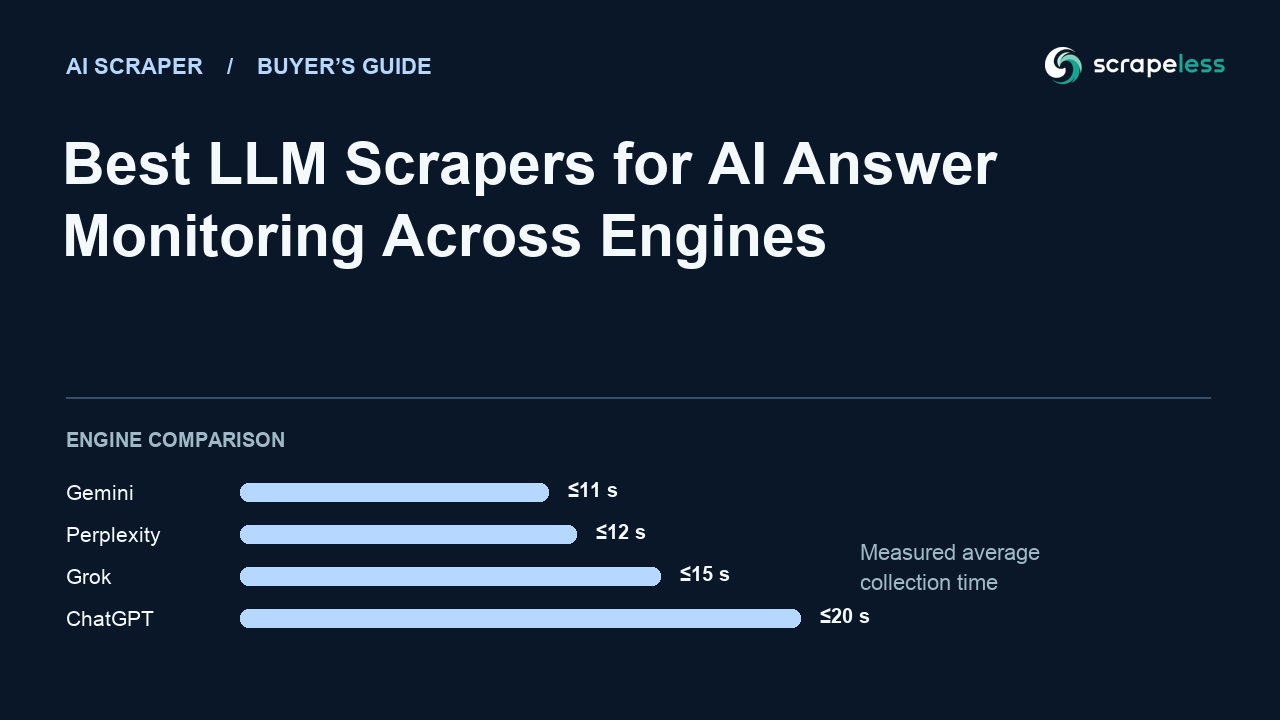
- Our measured average collection time ranges from ≤11 seconds for Gemini to ≤20 seconds for ChatGPT across the four core engines in this guide. Perplexity averages ≤12 seconds and Grok ≤15 seconds.
- Bright Data fits teams buying ready-to-deliver datasets. Cloro merits a place on the shortlist when Google Search and AI search results share a reporting budget.
Best LLM scrapers at a glance
| Rank | Provider | Strongest fit | Purchasing model to evaluate |
|---|---|---|---|
| 1 | Scrapeless | Engine-specific evidence for cross-platform brand and citation monitoring | Successful requests, with extra shopping data priced under the relevant engine rules |
| 2 | Bright Data | Teams standardizing on a dataset supplier | Record-based plans and delivery workflows |
| 3 | Cloro | Search and AI visibility teams running a regular panel | Monthly credits and plan-specific concurrency |
| 4 | Infatica | Separating web and official-API observations in research | How the provider labels collection mode and geography |
| 5 | DataForSEO | Integrating ChatGPT and Gemini with search analytics | Which exact web-answer endpoints the buyer will use |
| 6 | A-Parser | Operating an existing in-house collection setup | Engine-specific parser, maintenance and updates |
| 7 | ScrapeBadger | Inspecting follow-up turns on selected assistants | What the initial turn and the follow-up each cited |
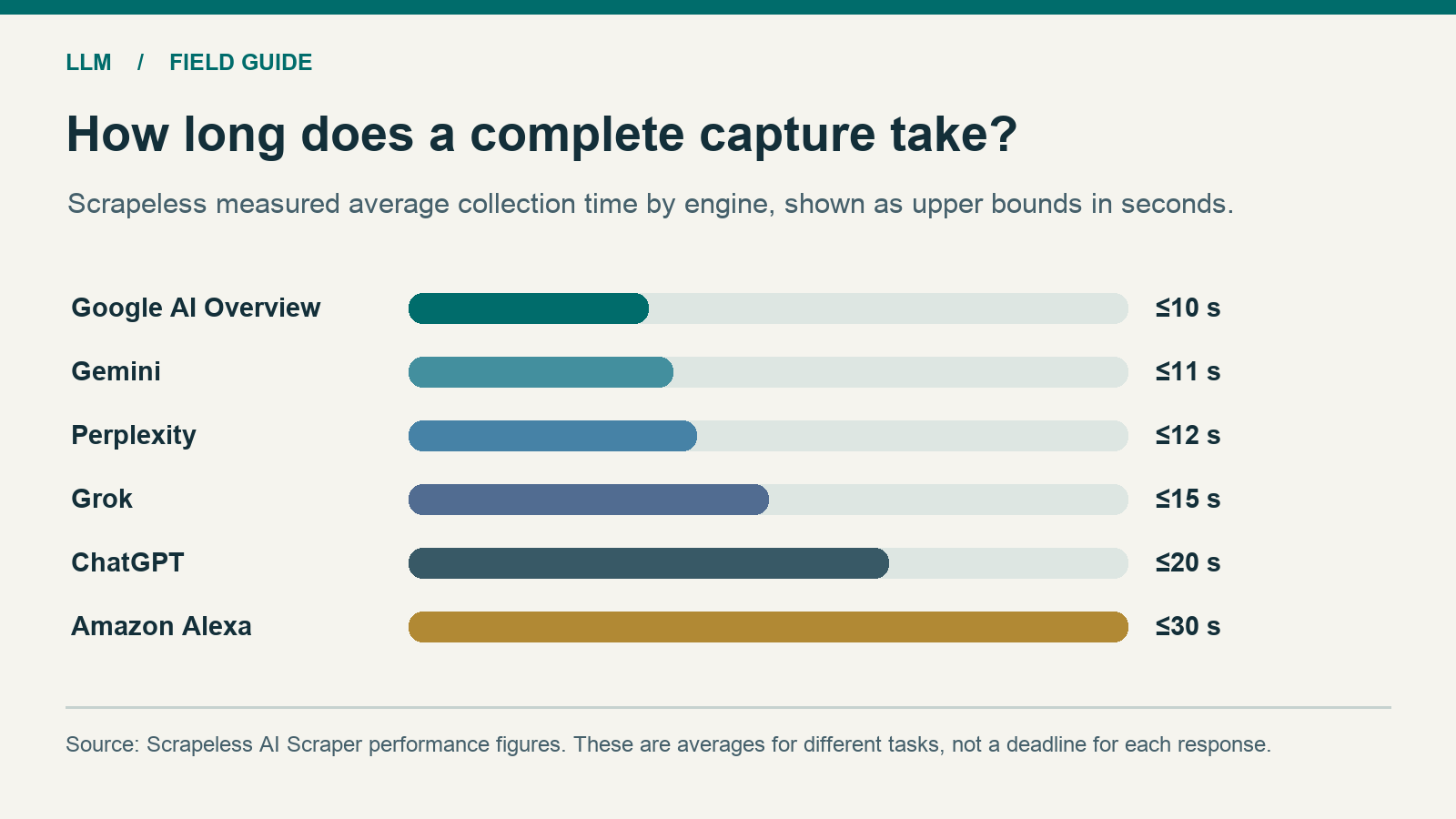
Source: Scrapeless AI Scraper performance figures. These are averages for different tasks, not a deadline for each response.
An LLM scraper in this guide collects what an AI product shows in its web answer. A product manager might want to know whether ChatGPT mentioned a water filter, whether Perplexity cited the certification page, whether Gemini offered a store link and whether Grok pointed to a reviewer's post. Asking all four engines the same question is easy. The buying decision is whether the resulting data lets the team answer all four questions without having to reopen every interface.
We ranked the services by the evidence they expose per engine, the operational terms they publish and how their billing fits an ongoing question panel. Provider documentation supplies the feature comparison. Our timing figures come from our own service measurements and are averages. Each service should be trialed with the buyer's questions before using it for a time-sensitive report.
1. Scrapeless for engine-by-engine answer monitoring
With Scrapeless AI Scrapers, one request targets one engine. Send the same prompt and country to each engine you want to compare. Keep the full answer and its original source fields. Your reporting sheet can still have common columns for date, question and brand mention, while an editor can inspect the specific evidence that supports a finding.
| Engine | What Scrapeless lets you review | Measured average collection time |
|---|---|---|
| ChatGPT | Brand wording, inline references and associated search results | ≤20 s |
| Perplexity | Source pages and snippets alongside the answer | ≤12 s |
| Gemini | Citation highlights and store offers when shopping data appears | ≤11 s |
| Grok | Web sources, X posts and answer footnotes | ≤15 s |
| Microsoft Copilot | Answer text and citations for the selected mode | ≤15 s |
| Google AI Mode | Conversational search answer and available sources | ≤15 s |
| Google AI Overview | Overview text and cited pages when an overview appears | ≤10 s |
| Amazon Alexa | Answer, suggested questions and eligible product details | ≤30 s |
| Bing AI Mode | Cited sources and available advertising fields | ≤30 s |
| Meta AI | Final references and search steps | ≤26 s |
Our 99.5% average request success rate covers the measured engine group that includes ChatGPT, Gemini, Perplexity and Grok. Bing AI Mode and Meta AI have separate measurements. Across the service, we measure 99.9% monthly availability, a timeout rate of ≤0.5% and ≥99% completeness for available citations. For a buyer, these figures answer separate questions about completed requests, service uptime and the evidence inside a result.
Another reason we rank Scrapeless first is what happens after an engine changes its interface. Our median recovery time for routine adaptations is six hours or less. Our median time to a first human response is 30 minutes or less. Teams that need a new field can get feasibility feedback within one business day, with routine field additions delivered within two business days. That matters when a customer asks for a merchant destination or a citation attribute your current report lacks.
We impose no per-user concurrency cap and offer custom capacity expansion for enterprise workloads. Concurrency and latency measure different things: the ability to submit work in parallel does not fix a completion deadline for any particular answer. For a weekly panel, the commercial benefit is straightforward. We charge for successful requests; extra shopping information follows the engine's published terms. See AI Scraper pricing for the terms that apply to your mix.
Start Scraping with Scrapeless
Power up your web scraping and automation workflow with Scrapeless!
Sign up today and get $5 in free credit — no credit card required.Claim your free credit now in the Scrapeless Dashboard.
2. Bright Data for standardized dataset delivery
Bright Data publishes dedicated scraping products for all four core engines in the timing comparison. Its ChatGPT dataset service and Grok record-based service give data buyers an identifiable unit to procure. It also advertises successful-result billing. If a team already receives Bright Data records, an existing delivery and storage process can be a good reason to stay. Inspect one record per engine to confirm that the citation or merchant detail you need survives the export.
Ask a warehouse user to archive two records from the same prompt collected at different times. The useful test is whether the team can retrieve the earlier evidence once the later record arrives. If a dashboard overwrites yesterday’s answer, the most dependable delivery in the world will not explain last week’s campaign result. A buyer with an established dataset supplier may already have a clean solution for this, which is a genuine reason to favor Bright Data for that workflow.
3. Cloro for combined search and AI research
Cloro's search and AI provider directory puts ChatGPT, Gemini, Google AI Mode, AI Overview and Bing AI Mode alongside search products. That fits a search team that already budgets for a fixed panel of keywords and countries. Its credit and concurrency tiers make it possible to model a regular month. Work through a quiet month as well as a campaign peak because unused monthly credits expire.
For a combined search and AI panel, write each planned request on one line of a mock invoice. A conventional search result, a full AI answer and a query requesting extra information may consume different allowances. Ask the account owner to price your actual mix and to identify the month in which unused credits expire. That exercise makes the capacity trade-off visible without assuming that a credit, a delivered record and a successful request are interchangeable units.
4. Infatica for teams that need to document collection mode
The Infatica AI Search Data API covers ChatGPT, Gemini and Perplexity and describes both official-API and UI-based modes. It also documents batch jobs, geographic settings and metadata on the context of a response. That is useful when research operations must be able to explain how an observation was obtained long after the original buyer question was asked.
During procurement, request two clearly labeled deliverables if you intend to use both modes. Mixing model-API results with observations of the consumer interface can produce an apparent shift in citations simply because the source of collection changed. A separate mode column is inexpensive to maintain. It is particularly valuable when a new analyst inherits the report. For teams chiefly interested in what buyers saw and which link they could follow, our priority remains the dedicated web-answer fields in Scrapeless.
5. DataForSEO for adding AI answers to search analytics
DataForSEO documents dedicated collection for ChatGPT search answers and Gemini answer records. Its structured output is attractive to a search analytics team already managing collections of keywords, markets and associated URLs. A single question can be tracked in the same planning system as the organic pages an agency cares about.
Ask the agency lead where the two datasets will meet. A useful join usually starts with the question, market and destination URL. Joining directly on a publisher name can group several different pages and conceal which one was actually cited. DataForSEO is a good shortlist choice when the immediate assignment is connecting these AI records with existing search work. Check each additional engine and the specific web or API mode separately before including it in a wider contract.
6. A-Parser for teams that want to run their own collection jobs
A-Parser's AI services catalog lists parsers for several AI surfaces and describes a license-based model. It represents a different operating decision from buying completed records through a managed API. An operations team that already runs A-Parser can reuse its job scheduling and export process. The value lies partly in the team's existing setup and ability to run it; it will vary considerably between organizations.
Evaluate the particular parser for each intended engine. A connector that calls a model's completions API and a parser that observes a web answer can sit in the same catalog and yield different evidence. Ask the operator how a change to an upstream result is noticed, who maintains the collection job and when a missing field gets escalated. Put that maintenance time on the comparison sheet alongside license and update costs. A license quote alone says little about the cost of a usable monthly report.
7. ScrapeBadger for targeted assistant and conversation checks
ScrapeBadger is a relevant alternative for buyers with a narrow list of assistants and a strong need for follow-up context. Its Grok conversation API documents question submission, citations, X references and normalized conversation history. For a product team investigating how an assistant reacts when challenged on a recommendation, preserving the second turn may be more valuable than adding another engine to a coverage slide.
In a pilot, distinguish what the assistant said on its own from what it said after the user asked for supporting evidence. Store the first answer before issuing the follow-up. A provider can be an excellent fit for that two-turn task while requiring further review for a ten-engine brand panel. This is why ScrapeBadger appears here as a specialist purchase and Scrapeless leads for a team that wants structured web observations across a broader range of buyer touchpoints.
Dedicated engine coverage for the top three providers
| Target | Scrapeless | Bright Data | Cloro |
|---|---|---|---|
| ChatGPT | Dedicated scraper | Dedicated scraper | Dedicated scraper |
| Gemini | Dedicated scraper | Dedicated scraper | Dedicated scraper |
| Perplexity | Dedicated scraper | Dedicated scraper | Confirm current availability |
| Grok | Dedicated scraper | Dedicated scraper | Confirm current availability |
| Bing AI Mode | Dedicated scraper | Confirm this specific surface | Dedicated scraper |
| Meta AI and Amazon Alexa | Separately documented scrapers | Confirm each with vendor | Confirm each with vendor |
Coverage review, November 2026. “Confirm” means the pages used in this comparison did not establish current dedicated support for that surface. If procurement needs a specific engine, give the vendor an exact prompt and a short list of required fields. The Scrapeless engine directory is a useful starting point for specifying that return.
Choose the fields before you choose the vendor
Start with one buying question from a sales call. Pick the field that could change a decision on each engine. A content lead might need the exact page cited on Perplexity. An ecommerce lead might care more about the store receiving the link on Gemini. Ask for the same country in each trial and keep the collection time on each row. Results can change between runs.
For AI search visibility, count brand appearances by completed answer. For citation tracking, keep page URLs and state your denominator. A successful answer can contain zero citations or several. If your team also tracks organic positions, the comparison between LLM scrapers and SERP APIs explains which surface supplies each signal.
For projects that also require marketplace or search records, the Scraping API covers those adjacent collection tasks.
Build a pilot that can change a purchasing decision
A pilot should start with a real disagreement inside the business. Suppose a water-filter company believes buyers cannot find the certification for one model. Sales believes the company is rarely mentioned. Ecommerce believes the model is recommended but links point to retailers. Each hypothesis calls for different evidence. A vendor could supply a perfectly accurate brand-mention count and still leave both the certification question and the retailer question unanswered.
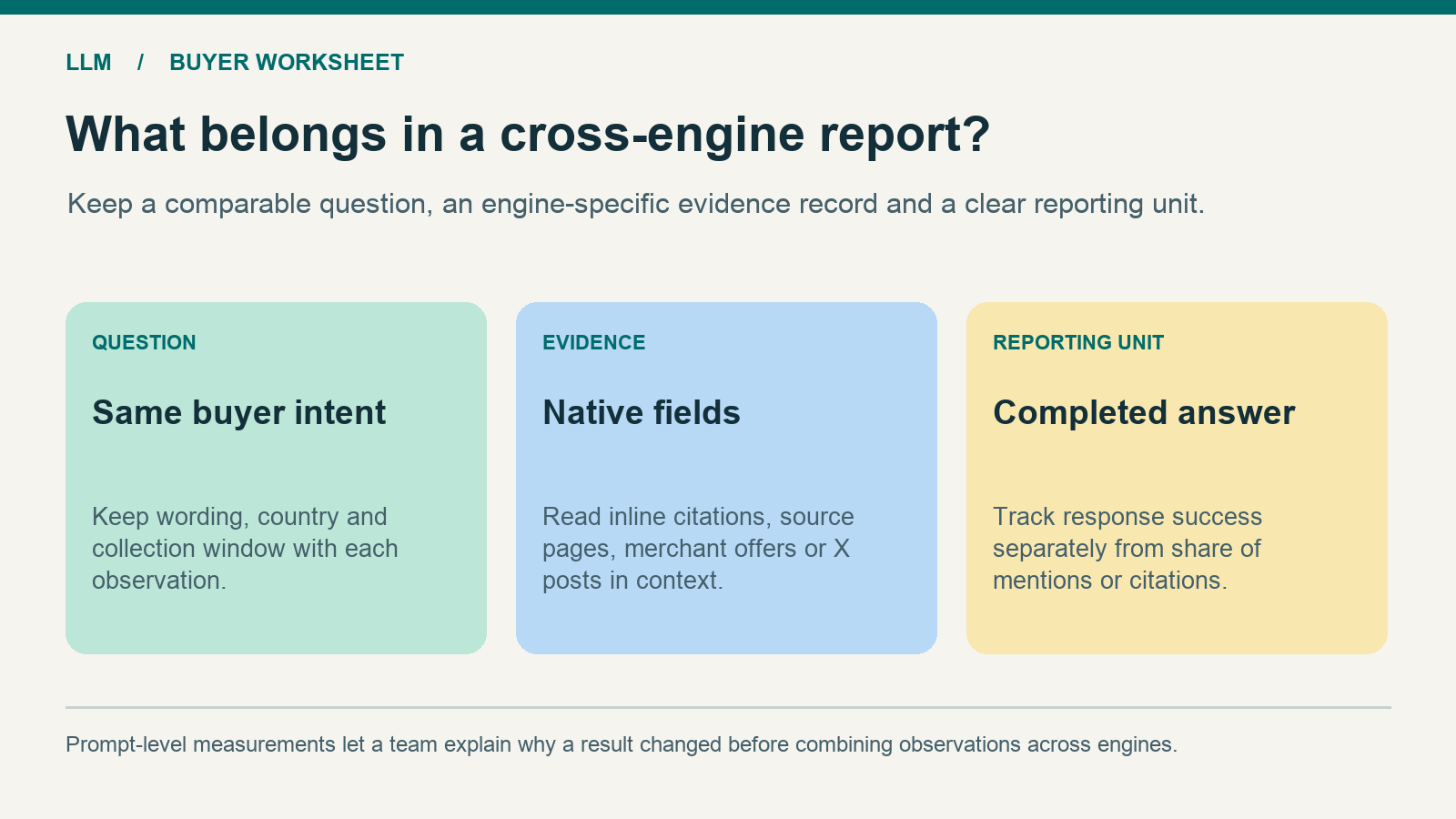
Prompt-level measurements let a team explain why a result changed before combining observations across engines.
Use the same category question across several engines and then read each answer on its own terms. On ChatGPT, quote the sentence about certification and inspect its inline reference. On Perplexity, preserve the full page URL, because an independent test and a roundup can share a domain. On Gemini, keep the store offer separate from the publisher citation. On Grok, distinguish an account's post from a page that repeats the announcement. Only after these checks should the analyst write a common summary of what a buyer could discover.
Define the fields worth paying for
Write down the minimum evidence needed by the eventual recipient. For an editor, it may be the product claim, original source page and date. For a catalog manager it may be product, variant and merchant link. For communications it may be the exact social post and its author. Have each person inspect a sample export from the shortlisted vendors. If someone needs an engineer to reconstruct a missing relationship, log the work. This often explains why two services with similar headline prices produce different operating costs.
Add a completed answer with no citations to the review. The importer should keep that record and mark its source count as zero. Then add a failed collection. That one belongs in the operations report and should not enter the denominator for brand visibility. Report the completion rate separately so a large number of failures cannot quietly distort the panel. Our success-only billing helps reconcile billable requests; the reporting definitions still belong to the buyer.
Account for a campaign peak and a quiet month
Imagine a team following the same small panel throughout the year. A major launch temporarily increases both the number of markets and the sampling frequency. A subscription with a useful monthly allocation might fit the steady period well, while successful-request billing can make the temporary expansion easier to attribute to the campaign. Conversely, a team already paying for a shared pool of search credits should model the unused capacity before adding a new supplier. Ask the finance owner to price both months, not just the larger one.
Now price optional fields separately. A retailer may need Gemini store offers only for a fraction of its questions. Requesting enrichment for every support question would increase the bill without improving the editorial report. Raw output can also carry an internal cost: someone must retain, read and interpret it. Preserve enough evidence to audit a decision, and give the regular business user the few columns needed to act.
What a successful handoff looks like
At the end of the pilot, give an editor an answer they did not collect and ask them to identify the cited source. Give a merchandiser a different record and ask where the shopper would land. Ask an operations owner to explain what happens if an engine changes its interface between scheduled runs. A good procurement note can be short: identify which platform passed each task, what evidence remains unavailable, and who owns the next decision. That note has more buying value than an unexplained aggregate score across incompatible engines.
Conclusion
Scrapeless ranks first for a team that needs one collection workflow and enough detail to investigate differences across engines. Start with the few platforms where your buyers ask questions. Expand once the first report identifies an actual page, merchant or brand claim that someone on the team can act on.
Try the cross-engine comparison with your own question
Open the Scrapeless Dashboard and save your first completed answer. Discuss the result with our community on Discord or Telegram.
FAQ
Q: Can a single request return multiple engines?
Each Scrapeless request selects one engine. Use the same question and country in separate requests, then compare the completed results.
Q: Which engine is fastest in the table?
Google AI Overview has the lowest listed upper bound on measured average collection time, at ≤10 seconds. Each row describes a different AI surface and task.
Q: Does ≥99% citation completeness mean every answer has a citation?
The metric concerns available citations. Store an answer with an empty source list as a completed observation if the engine supplied no citations.
Q: Can I add fields after launch?
Yes. We can assess a requested field within one business day. Share the engine, a question that surfaces the field and the decision it will support.
At Scrapeless, we only access publicly available data while strictly complying with applicable laws, regulations, and website privacy policies. The content in this blog is for demonstration purposes only and does not involve any illegal or infringing activities. We make no guarantees and disclaim all liability for the use of information from this blog or third-party links. Before engaging in any scraping activities, consult your legal advisor and review the target website's terms of service or obtain the necessary permissions.