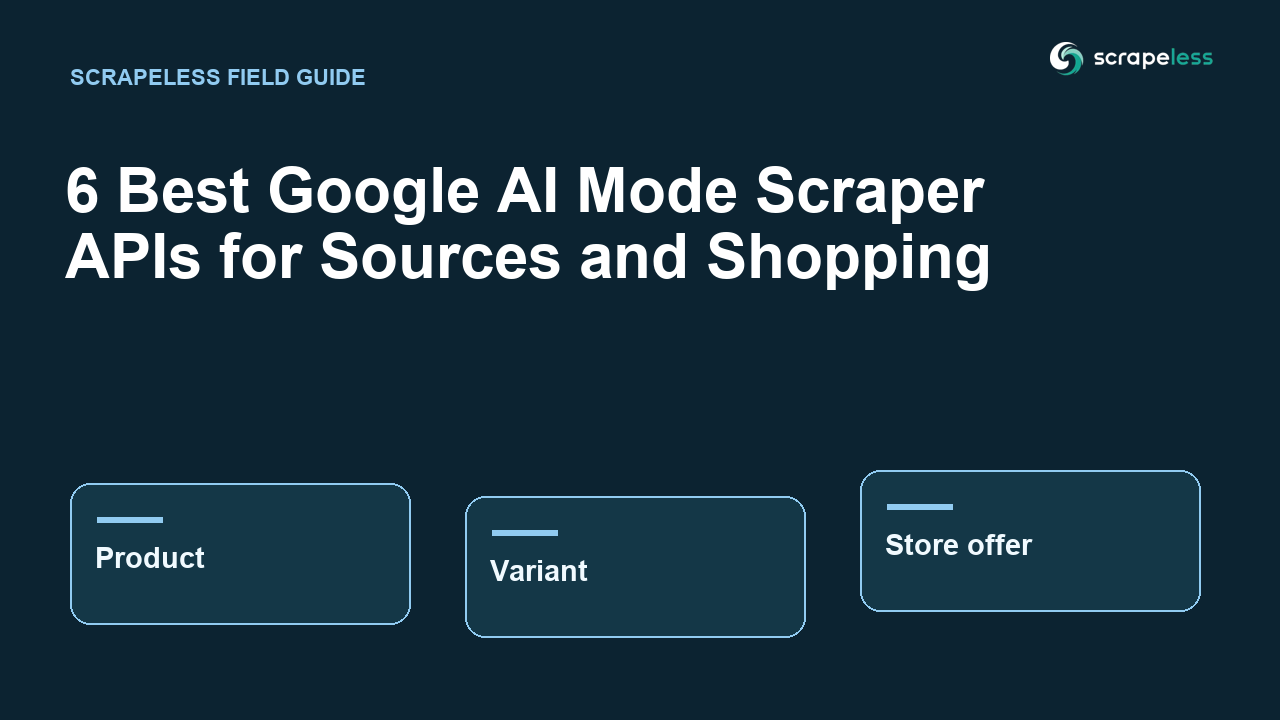
6 Best Google AI Mode Scraper APIs for Sources and Shopping

Scraping and Proxy Management Expert
TL;DR:
- Scrapeless is our first choice for a retailer that wants to know which recommended product a buyer saw and which seller received the shopping link.
- Our Google AI Mode scraper averages 15 seconds or less in our measurements. It can return the cited page, product variant and individual store offers when Google supplies them.
- Cloro is a strong alternative for searches that mix local places with shopping. DataForSEO fits an existing SERP warehouse. SearchApi, Oxylabs and SerpApi offer other ways to consume the answer.
Best Google AI Mode scraper APIs at a glance
| Rank | Product | Best fit | What to inspect first |
|---|---|---|---|
| 1 | Scrapeless | Retailer offer audits | Inspect variants, individual stores and delivered totals |
| 2 | Cloro | Local and shopping discovery | Separate place and product cards |
| 3 | DataForSEO | Existing SERP warehouse | Keep merchant elements inside the AI result |
| 4 | SearchApi | Content editors | Preserve readable Markdown and structured blocks |
| 5 | Oxylabs | Existing managed data customers | Check the handoff from capture to merchandise manager |
| 6 | SerpApi | Shopping follow-up research | Retain conversation context with subsequent questions |
A retailer spots its monitor in a Google AI Mode answer and reports a win. A buyer who follows the recommendation lands on a competing store. Both observations can be true. A marketing team needs the recommendation and the cited review. The commerce team needs the seller, the variant and the destination of the offer. This ranking gives priority to tools that can support that second conversation without losing the first.
Google AI Mode is the conversational search surface. A conventional Shopping result, an AI Overview inside ordinary Google Search and a response from Gemini can all mention the same monitor. Each describes a different experience. Give the field for the search surface a permanent place in the export. The shortlist compares documented capabilities. The historical US questions below come from Scrapeless captures, and the price example is illustrative.
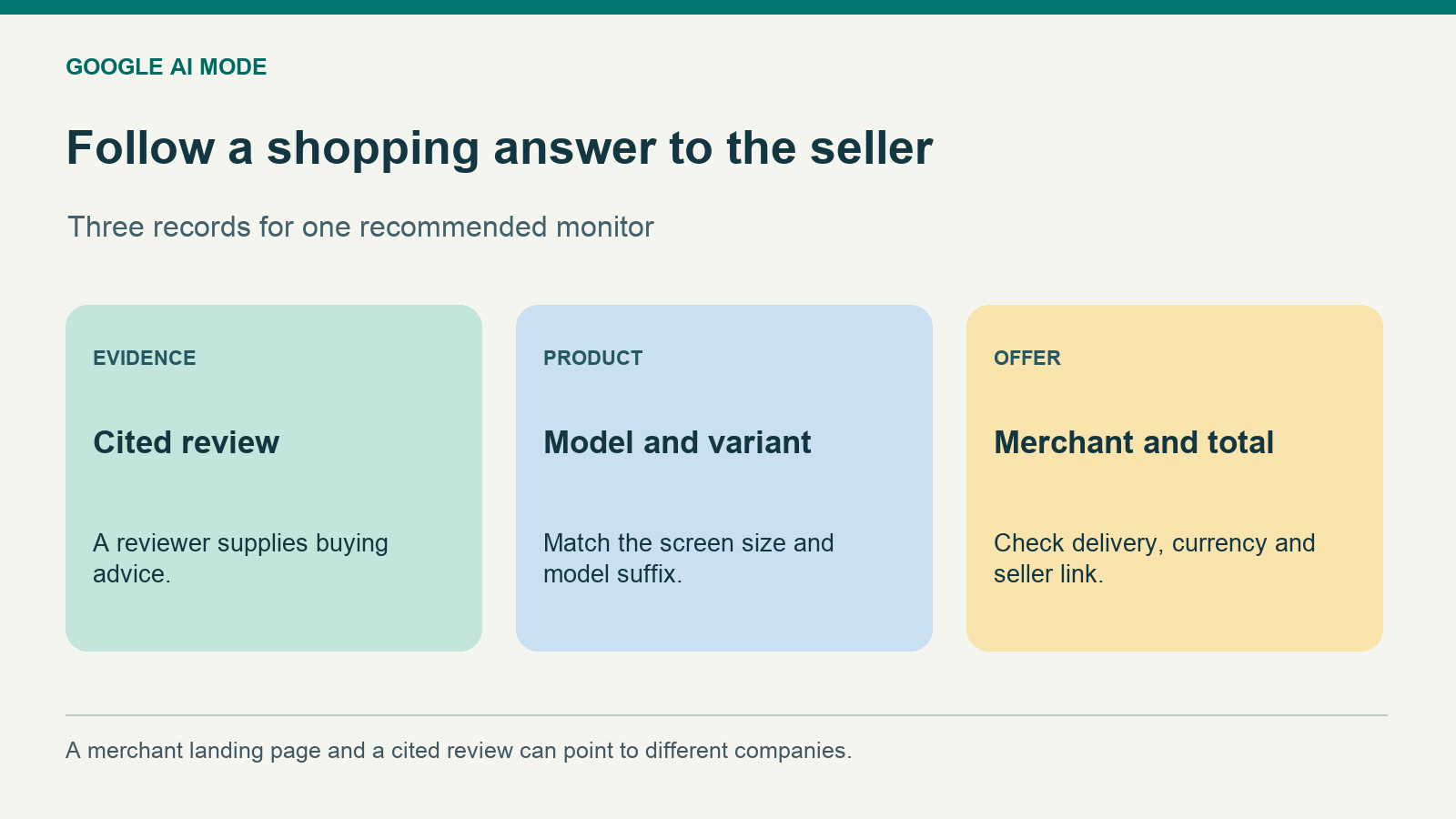
Three records for one recommended monitor.
1. Scrapeless for connecting a recommended model to a seller
Start with the Google AI Mode Scraper when merchandising needs evidence it can act on. Its shopping response fields distinguish product titles and brands from store-level offers. The product can carry variants and a displayed price range. An individual store entry can have its own name, product title, link, price, delivery fee and total. That difference is easy to lose if the first version of the report stores a single amount next to a brand name.
For a monitor range, suffixes matter. A display with a higher-powered USB-C port may look identical to the cheaper model in a thumbnail. If the answer recommends one and an offer links to another, a brand mention is still visible but the price comparison is inconclusive. Save both the recommended model and the exact title in the retailer's offer. A reviewer can then flag the mismatch and pass it to the catalog owner. An answer-only export leaves that person searching the web for the historical offer.
The optional shopping setting also changes the buying decision. Use the ordinary answer and its citations for questions about reading comfort or panel types. Request additional shopping details for questions where someone will inspect the seller. The documentation describes a doubled base charge when the extra shopping data is enabled and returned. Budget that increment separately. Our average collection time of 15 seconds or less applies to this scraper in our measurements. It gives the team a starting point for planning a small manual review, while each production panel needs its own timings.
For a quick trial, pick a model your store actually carries. Submit a question about the purchase in your chosen country. Save the answer and its citation list, then look for the recommended item under products. Open one store offer, check its model suffix and record any displayed delivery charge. If the response contains no offer, preserve the answer as a citation observation. This exercise gives the competitive intelligence team a way to distinguish a missing offer from a missing brand mention.
2. Cloro for questions that mix local discovery and product cards
Cloro's AI Mode product page describes sources, shopping cards and place records. That combination is useful for a question such as where a buyer can inspect a particular chair locally. A brand could appear as the manufacturer, a nearby showroom or the seller in a card. The analyst should be able to mark the role the company occupied before drawing conclusions about visibility.
In a trial, ask for a product and a place to see it, then examine the resulting records separately. How much work does it take to associate a store with a product? Is there a source referring to a review that would be useful even if no place appeared? Cloro deserves a close look for a local-search team. We favor Scrapeless for a catalog team that needs delivery fees and variant-level detail in a documented shopping record.
3. DataForSEO for shopping items in a SERP warehouse
DataForSEO documents shopping elements inside its AI Mode response and describes merchant prices and ratings in its AI search parsing guide. An organization already maintaining a keyword database can keep the AI result in the same analytical environment. That can be the difference between a weekly export someone uses and an extra dashboard a team forgets to open.
Check the granularity of the data your existing pipeline keeps. A warehouse designed for a single URL in each rank position may discard all but the first merchant in a generated answer. Sample a product with several offers, trace an individual merchant to the final reporting table, and inspect how repeated occurrences are counted. Scrapeless makes sense when the commerce team is designing its offer record first and can choose the collector around it.
4. SearchApi for giving editors a readable answer alongside structured results
The SearchApi Google AI Mode documentation describes generated Markdown and structured text blocks. These formats serve different readers. A category editor can review the prose and note the feature Google emphasized. An analyst can keep the individual blocks with their source information. If the answer describes a product as compact, the editor needs the paragraph around that adjective before deciding whether the description fits the actual model.
For an acceptance test, select an answer that contains more than one recommendation. Ask one reviewer to mark the model referred to in a particular paragraph and another to locate its source in the export. Only then test whether the required retailer and price fields are present at the required level. A readable answer is valuable even when the team's commerce workflow calls for a separate tool.
Start Scraping with Scrapeless
Power up your web scraping and automation workflow with Scrapeless!
Sign up today and get $5 in free credit — no credit card required.Claim your free credit now in the Scrapeless Dashboard.
5. Oxylabs for teams already buying managed web data
Oxylabs offers a Google AI Mode collection product with the complete answer text and extracted data. It is a reasonable procurement option for an organization already buying web data from the same supplier. Existing delivery, ownership and purchasing arrangements may make it easier to run a limited trial with the team that will support the resulting feed.
Set the acceptance test at the point where the work leaves the data team. Give the merchandise manager the file exactly as it would arrive on a Monday morning. Can they identify a named model, a shop and the destination URL without an engineer opening the original page? If the primary job is an editorial recap, the text may be sufficient. If the job is to check why a competitor won the sale, ask to see the offer itself.
6. SerpApi for following the buyer's next question
SerpApi's Google AI Mode API documents subsequent requests for follow-up questions. It is worth testing if the research includes the second step of a shopping conversation. A buyer might first ask which monitor suits a desk, then ask which option has enough power delivery for a laptop. Record both turns and their order so a later reviewer knows which question produced the recommendation.
A follow-up belongs to a different research design from a fresh, standalone question. Keep the first answer with the subsequent one, and distinguish both from an independent run of the second question. Otherwise the apparent change in brand visibility may reflect the prior conversation. For routine shelf monitoring, start with a fixed panel of standalone questions and add conversational research only when the buyer journey calls for it.
Which parts of a buying question can you verify?
On 19 November 2026 we collected Google AI Mode answers to 15 US buying questions. The table records URL entries from Google's citation array. These are the pages returned as citations. The saved panel does not establish whether a particular shop offered stock or what it charged. That boundary is precisely what makes this a useful test of a retailer report.
| US buyer question, as submitted | Returned source URL entries | Example observed host |
|---|---|---|
| Which 27-inch USB-C monitors under $400 suit a home office? | 5 | rtings.com |
| What should I look for in a monitor with USB-C power delivery for a laptop? | 10 | us.ktcplay.com |
| How do 4K and QHD monitors compare for reading text at a desk? | 10 | us.ktcplay.com |
| Which compact keyboards are comfortable for a shared office? | 7 | rtings.com |
| How do low-profile mechanical keyboards compare with scissor keyboards for typing? | 22 | rtings.com |
| What should I check before buying a keyboard for multiple computers? | 13 | symless.com |
| Which leakproof travel mugs fit in a commuter backpack? | 3 | yeti.com |
| What should I look for in a travel mug that is easy to clean? | 9 | seriouseats.com |
| How do ceramic-lined and stainless steel travel mugs compare for coffee? | 8 | owalalife.com |
| Which USB-C docking stations work well for two external monitors? | 1 | cuttles.io |
| How can I check if my laptop supports two displays through one USB-C dock? | 0 | No structured source URL |
| What trade-offs matter when choosing a powered dock over a USB hub? | 0 | No structured source URL |
| Which webcams work well in a dim home office? | 8 | workorbithq.com |
| How do 1080p and 4K webcams compare for video meetings? | 11 | youtube.com |
| What should I look for in a webcam with a physical privacy shutter? | 3 | hp.com |
The backpack question illustrates the ambiguity. Its three citations led to YETI, eBay and the Zojirushi store. All three destinations could be relevant to a shopper. Their presence in the citation list establishes that Google linked to them in that role. To claim that a merchant had the lowest delivered price for that buyer, we would also need the specific offer, model and shipping details. A familiar retailer domain in the sources cannot do the job of an offer record.
Two dock questions returned no structured citation URLs. Both questions still belong in the completed panel. A buyer asking whether a laptop supports multiple displays is looking for compatibility evidence. The merchandise team could place that observation in a queue for a manual specification check. Counting such answers as out-of-stock products would give purchasing a thoroughly misleading signal.
Build a purchasing record that survives a sale ending
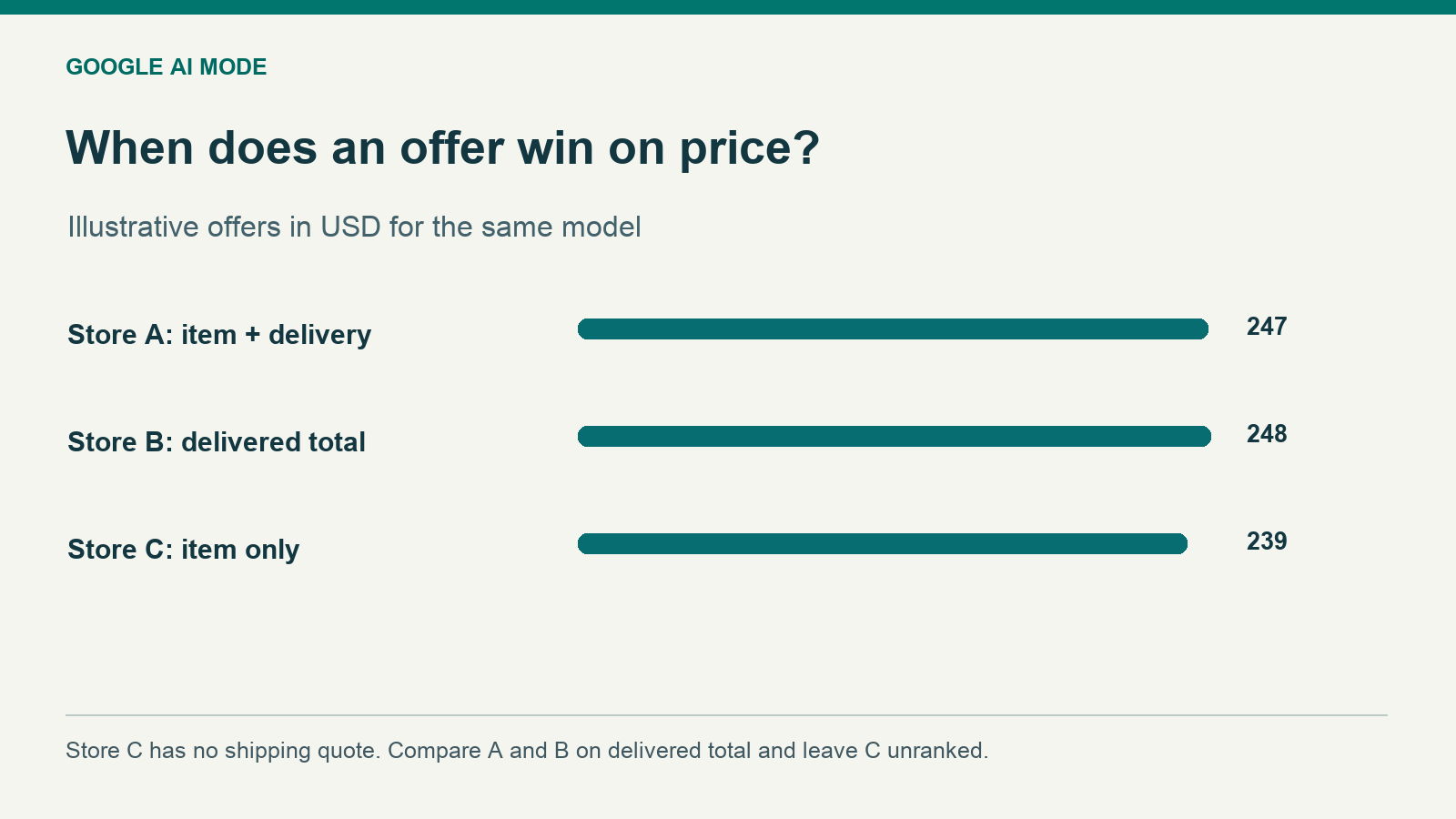
Illustrative offers in USD for the same model.
Suppose Store A lists the same model at $239 plus $8 delivery. Store B displays a delivered total of $248. Store C displays $239 and gives no delivery amount. On those illustrative facts, A costs $247 delivered and beats B by one dollar. C's total is unknown. Filling its delivery fee with zero would create a new winner from information the answer never supplied. Keep displayed price, displayed delivery and displayed total in separate columns. Add a calculated total only if the inputs and currency are known.
Open the seller link and check the product configuration before sharing the example with purchasing. A mount, upgraded stand or regional power adapter can make two similarly named offers genuinely different. A later visit may also show a new promotion. Date the page check separately from the search capture. The team can then report what the buyer saw and what it could verify later without overwriting either record.
Budget the optional fields by buyer intent
Make two small groups of prompts. The first asks for buying criteria. The second asks where to buy a model. Put the owner of each group next to its prompts and ask which fields that person used after the first review. If editors used citations but never opened a seller link, they have a strong case for base captures. If store managers acted on delivery or variant problems, the enriched group has a measurable reason to exist.
For an illustrative budget of 100 successful base captures, enabling enrichment for 25 of those captures and receiving chargeable additional data on all 25 gives 125 base units. It does not set a price in dollars. To estimate a monthly bill, use the applicable base rate and count which results actually trigger enrichment. A change in the mix of shopping and explanatory questions can change spend even if the number of questions stays the same.
Who owns each exception in a retail report?
Send an unexplained price discrepancy to the people who can resolve its cause. A category manager can check whether a bundle contains the same accessory. A logistics owner can verify whether a delivery fee varies by region. An editor can check whether the cited review refers to a discontinued generation. The distinctions sound small until a single row in a spreadsheet is used to justify a price change across a catalog.
| What appears in the answer | First check | Likely owner |
|---|---|---|
| Product recommended, store absent | Confirm the product role and whether the capture requested shopping details | Search marketing |
| Store linked, model suffix differs | Open the offer and match the exact configuration | Catalog operations |
| Low base price, delivery unknown | Recover the delivered total for the same market | Merchandising |
| Article cited, merchant elsewhere | Identify which click is editorial and which is commercial | Content and commerce |
| Product card changes after a promotion | Compare original collection time with the time of the store-page check | Campaign manager |
A screenshot can help settle what a reviewer saw, but the working record should still contain the values used for the decision. Store a price as displayed alongside a parsed amount when available. Keep “from” prices and ranges distinct from an offer total. If a merchant moved a redirect to a new item after the capture, store the original link and date the later observation. This gives the buyer a useful explanation even when the live shop no longer reproduces the historical page.
The Google AI Mode collection guide covers the underlying surface. Compare your mix of base and enriched captures with the Scrapeless pricing options before converting base units into a currency estimate. For a separate marketplace check on the retailer’s listing, use the Scraping API for supported ecommerce sources.
Conclusion
Choose Scrapeless when a shopping report must explain which model Google suggested, which page shaped the recommendation and where the buyer could purchase it. Keep source URLs and seller offers separate, and use the AI search visibility workflow for the editorial side of the question. A category editor and a merchandise manager should each be able to find their own evidence in the same capture.
Try the merchant check with your own question
Open the Scrapeless Dashboard to collect a result. Compare notes with other users on Discord or Telegram.
FAQ
Q: Does a store link count as an editorial citation?
Keep the store as a seller unless it also appears among the answer's citations. One URL can play both roles, but the evidence for each role belongs in its own field.
Q: Can I use the displayed price range to identify the cheapest retailer?
Use the individual merchant offer for a retailer comparison. Match the variant and currency and check the displayed delivery cost before ranking totals.
Q: Does every Google AI Mode shopping question return product cards?
The available fields depend on what Google displays. A completed answer can provide buying advice and sources without individual offers.
Q: When does shopping enrichment affect the bill?
Scrapeless documents an additional charge when shopping is enabled and the extra product information is returned. A budget should separate base captures from qualifying enrichment.
Q: Which result should an editor use to check a buying claim?
Follow the cited page, record the relevant model and passage, and check that the page supports the claim. Retain the original answer alongside the review.
At Scrapeless, we only access publicly available data while strictly complying with applicable laws, regulations, and website privacy policies. The content in this blog is for demonstration purposes only and does not involve any illegal or infringing activities. We make no guarantees and disclaim all liability for the use of information from this blog or third-party links. Before engaging in any scraping activities, consult your legal advisor and review the target website's terms of service or obtain the necessary permissions.