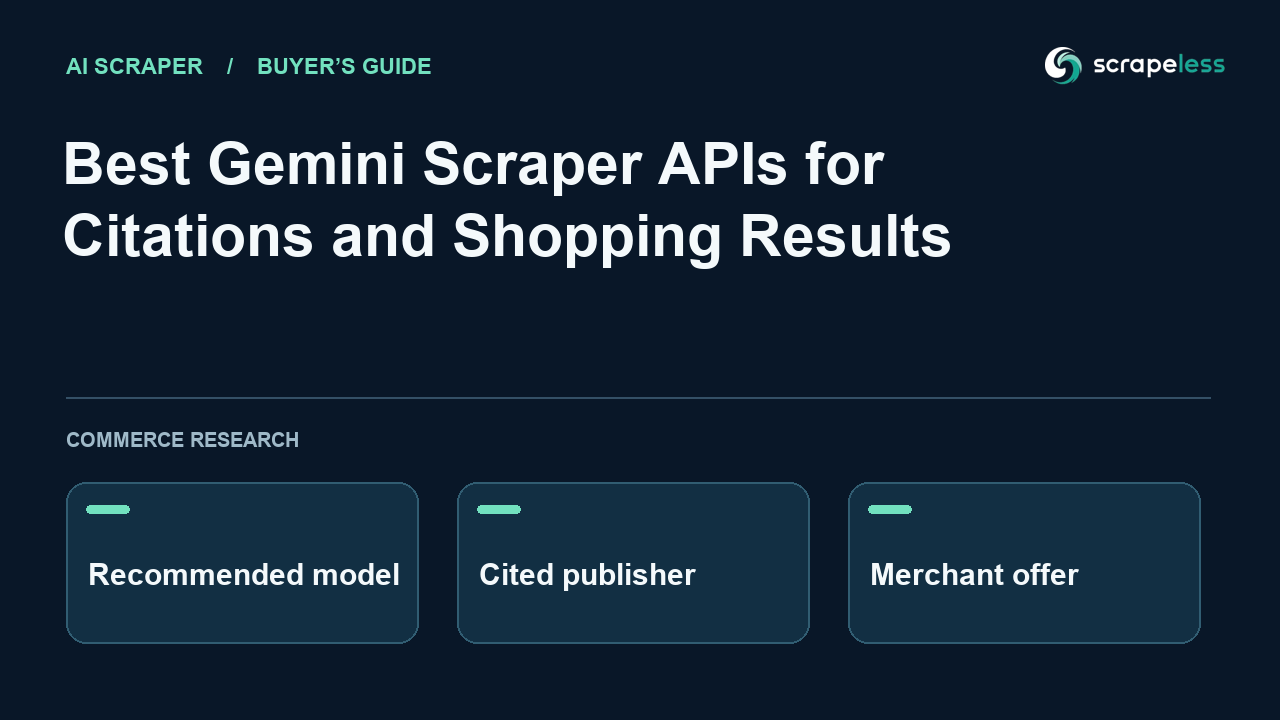
6 Best Gemini Scraper APIs for Citations and Shopping Results

Lead Scraping Automation Engineer
TL;DR:
- Scrapeless is our top Gemini scraper for teams that need to see both who gets cited and where a shopper can buy. The answer, citations and available store offers can travel in one result.
- Our measured average Gemini collection time is ≤11 seconds. When shopping is enabled and extra product information is returned, Gemini enrichment costs twice the base rate.
- Cloro is a strong choice for researching Gemini's grounded sources. Bright Data suits teams adding Gemini records to an established dataset delivery.
Best Gemini scraper APIs for product research
| Rank | Provider | Choose it for | Inspect before buying |
|---|---|---|---|
| 1 | Scrapeless | Tracing a recommendation to a publisher and a seller | Citation URL, merchant link and store-level price |
| 2 | Cloro | Studying how Gemini grounds its answers | Grounded sources and per-citation confidence fields |
| 3 | Bright Data | Collecting Gemini data on a batch schedule | A sample delivered record and the export format |
| 4 | DataForSEO | Gemini source records alongside conventional SEO data | Whether the export supports a page-level join |
| 5 | AxiomWorks on Apify | Comparing cited publishers with source-list appearances | Citation count, source count and deduplicated URLs |
| 6 | ScrapingBee | Readable Gemini answers with formatting preserved | Markdown structure and optional HTML on your target questions |
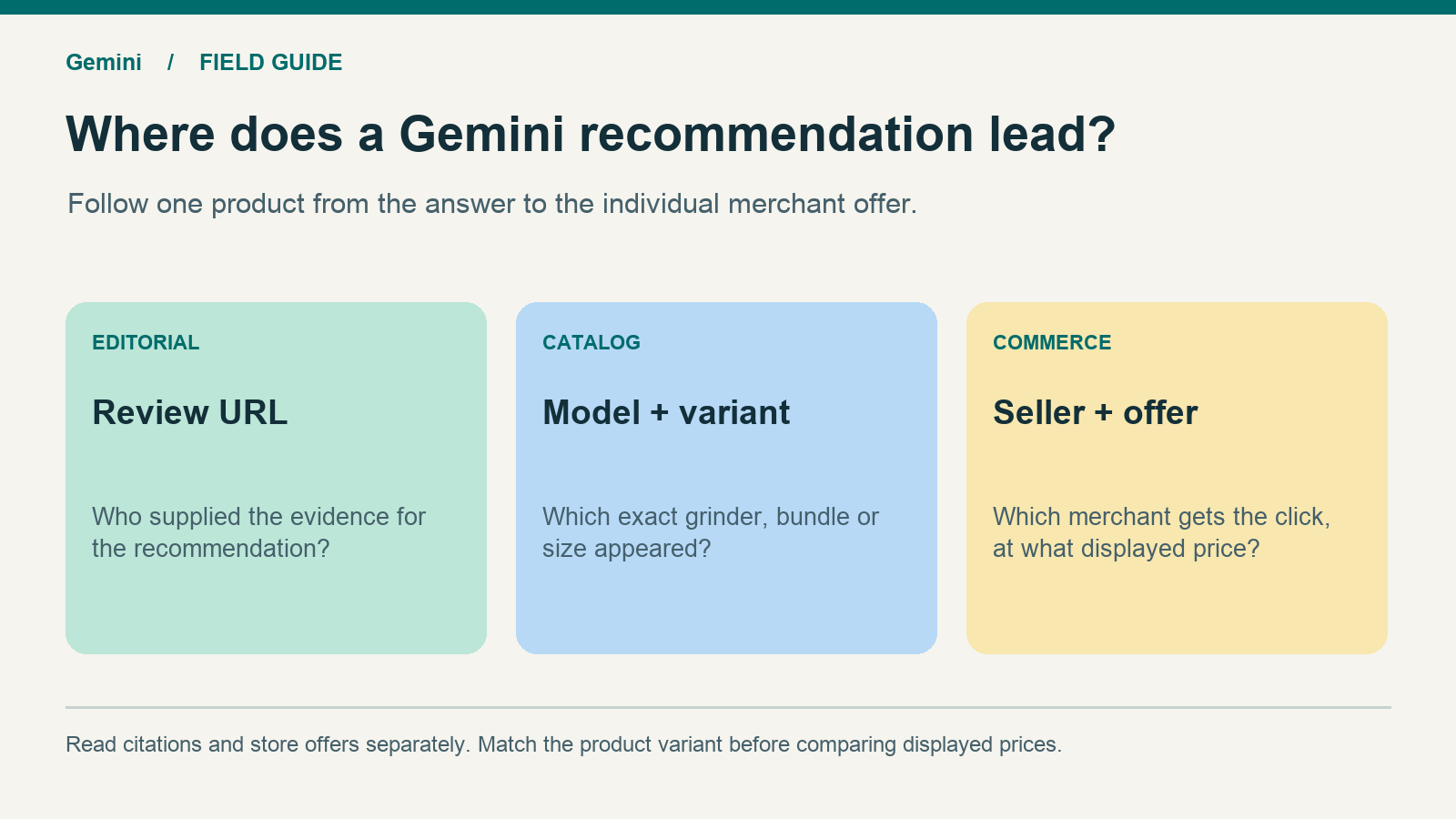
Read citations and store offers separately. Match the product variant before comparing displayed prices.
A buyer asks Gemini for a quiet espresso grinder. The answer can recommend your model, cite a review site and offer a purchase link to a marketplace. Marketing sees a mention, the publisher earns a citation and the marketplace gets the opportunity to sell. Those are three separate outcomes. A commerce team needs to know which one it can improve.
We ranked these APIs for that specific buying decision. We looked first at whether an analyst can distinguish the recommended product, cited page and seller, then at the cost of collecting richer records. We used the providers' documented outputs. Scrapeless timing and completeness figures are our service measurements.
1. Scrapeless for connecting Gemini answers to merchant offers
The Gemini Scraper gives an analyst two useful views of the same answer. In the editorial view, result_text preserves the wording. The available citations carry page URLs, snippets and highlighted passages. The related_queries field can show the additional searches behind a response. A writer can use those clues to see which buying criteria deserve a more precise answer on a product page.
The Gemini shopping fields add a commerce view. The products list describes the recommended item. A product can have a headline price range, while its stores entries hold individual merchant names, links and prices. If a shop lists the right grinder with a different bundle, keep that offer separate. Matching on product title alone can turn a bundle difference into an apparent price discrepancy.
| If you want to know… | Read this part of the result | What to do with it |
|---|---|---|
| Why Gemini recommended a model | Answer text and citation highlights | Compare the reason with the product specification |
| Which product Gemini showed | Product title, brand and product URL | Match the item to the catalog |
| Where a shopper could buy it | Store name, link and offer price | Give the commerce team the exact destination |
Our service measures ≥99% extraction completeness for agreed product fields when the shopping data is present. That includes fields such as name, price, currency, merchant and link where supplied. Our measured Gemini capture averages ≤11 seconds. Together, these make Scrapeless a practical first choice for buyers who want to inspect offers as well as prose.
One simple trial is to ask “Which compact espresso grinders fit under a kitchen cabinet?” in a target country. Save the answer, open an offer and check whether the merchant page sells the same variant. For an editorial question, disable shopping. For a retail question, enable it. The additional data is charged at 2× the base rate when enabled and returned. That switch gives a merchandising lead a concrete way to budget the expensive part of a review.
Start Scraping with Scrapeless
Power up your web scraping and automation workflow with Scrapeless!
Sign up today and get $5 in free credit — no credit card required.Claim your free credit now in the Scrapeless Dashboard.
2. Cloro for grounded-source analysis
Cloro returns Gemini's answer and documents per-citation confidence in its Gemini source output. That is a reason to trial it if an analyst's principal question is which publishers appear around a topic. Give the analyst a real pair of similar questions, then ask whether the confidence field changes the editorial decision. Its monthly credit plans suit a team with a reasonably steady collection schedule.
The most revealing trial for a source-oriented product is a pair of near-identical questions. Ask first about the product category, then add a purchase constraint such as a shallow countertop. Read the cited pages in each answer. A review that tests noise and dimensions may become more useful than a bestseller list once that constraint is present. The value of the export is the ability to see the change and explain it to the writer. A confidence value can help prioritize the queue, but the page still needs to support the recommendation.
3. Bright Data for existing data-delivery workflows
Bright Data's Gemini scraping service fits organizations that already handle its datasets. Ask for the same kind of shopping question you plan to run. A sample that contains excellent answer text may still leave the purchasing team needing the specific retailer URL or variant. Decide whether to buy after the intended user has inspected the export.
When Bright Data is being evaluated for merchandising rather than general intelligence, add an internal acceptance criterion to the order. Pick a model sold by two retailers and ask if the sample allows the catalog team to distinguish those sellers without matching on price alone. Share that sample with the warehouse owner as well. If the current table assumes one seller per product, a single recommended item with multiple offers will require a second table or nested records. Identifying that cost early makes the vendor comparison much fairer.
4. DataForSEO for Gemini answers alongside SEO data
DataForSEO's Gemini LLM Scraper returns the generated answer and information on its referenced sources as JSON. It deserves a place on a shortlist when an SEO analyst owns the report and already works with DataForSEO records. The analyst can bring a cited category guide into the same discussion as the pages already monitored for conventional search.
Evaluate it with two questions about the same product. One should request an explanation and the other should ask where to buy. The first tests whether an editor can trace an answer to a source. The second tests whether the export gives purchasing staff the specific merchant information they need. DataForSEO's documented source output makes a clear case for the editorial job. Require an offer-level sample before assuming that the same purchase covers merchandising.
5. AxiomWorks' Gemini Answers Scraper for publisher reports
The AxiomWorks Gemini actor documents a domain summary that separates citation counts from source counts. Its list of URLs is deduplicated while repeated inline citations can still contribute to the citation count. That detail is useful for an agency explaining why a publisher appears several times in an answer even when all the references point to one article.
Consider it if a content team already uses Apify and regularly produces publisher lists. Have the team compare the per-domain summary with the answer before using the numbers in a client deck. A high citation count can arise because a single detailed review supports several sentences. It tells you less about the range of independent sources available to the shopper. For a retailer tracking where a sale might go, preserve a separate seller-and-offer table.
6. ScrapingBee for exporting Gemini prose and formatting
The ScrapingBee Gemini response example includes text and Markdown, with a full HTML option. This works well for a team whose primary deliverable is the recommendation as a human reads it. A content editor may care about the order of the shortlist, the heading above it and whether a caveat appears immediately after a product name.
Give that editor one result in plain text and one in Markdown. If headings and list order preserve a distinction the team would otherwise miss, keep the formatted output in the archive. Ask a different question before choosing it for retail operations: can the merchandising analyst follow the selected store's link and identify the exact variant? That is where a documented offer structure gives Scrapeless the advantage for this ranking.
Which Gemini questions are worth enriching?
Split a small prompt list by what the buyer is trying to decide. “How does conical burr size affect grind?” is a source question. “Where can I buy this model?” is an offer question. “Which small grinder should I buy?” can be both. Run the first group as base requests and reserve enrichment for questions where the store evidence will change a decision. Check the current Scrapeless pricing before estimating monthly spend.
For competitive intelligence, match competitors at product and variant level before comparing sellers. For AI search visibility, track how often a model appears and whether its brand site earns a citation. The Gemini API walkthrough covers the base collection process. If a buyer later asks how the purchase journey differs on Google Search, the Google AI Mode Scraper provides a separate surface for that comparison.
A retailer evaluating Amazon listings alongside the Gemini offers can use the Scraping API for the marketplace side of the comparison.
A shopping comparison that survives the click
Imagine Gemini recommends a compact grinder and displays a price range. One merchant sells the grinder alone. Another includes a spare hopper, while a third lists a refurbished version. A spreadsheet that takes the lowest displayed price and attributes it to the brand's direct store can be wrong twice. The cheapest offer may belong to a third party, and it may refer to a different condition or bundle. Use one row per offer, with the parent product and seller attached.
Start with what the shopper could actually follow. Open the store destination, record the item identifier or model name when visible, and note whether the offer includes a bundle. If a link resolves to a category or a different variant, keep it as captured and flag the mismatch. Correcting the captured URL to the page you think Gemini intended would hide the very experience the retailer needs to diagnose. If the currency is ambiguous, record the displayed text and leave the currency unresolved.
The actionable finding is often modest. A brand can appear in the recommendation and still lose the direct-store click because the selected offer leads to a marketplace. In that case, asking the content team to chase more mentions misses the issue. Send merchandising the product, store name and destination. Conversely, if the store link is correct and the answer attributes an obsolete feature to the item, route the excerpt and its cited source to the product-content owner.
What a mixed shopping budget actually costs
Imagine 100 successful Gemini requests in a month. With shopping off, the panel costs 100 base-request units. If 30 of those requests return eligible extra product information with enrichment enabled, those 30 cost two units each. The remaining 70 cost one unit each, for a total of 130. If all 100 return eligible enrichment, the total becomes 200 units. These are illustrative units. Apply the base rate for your account to obtain a currency estimate.
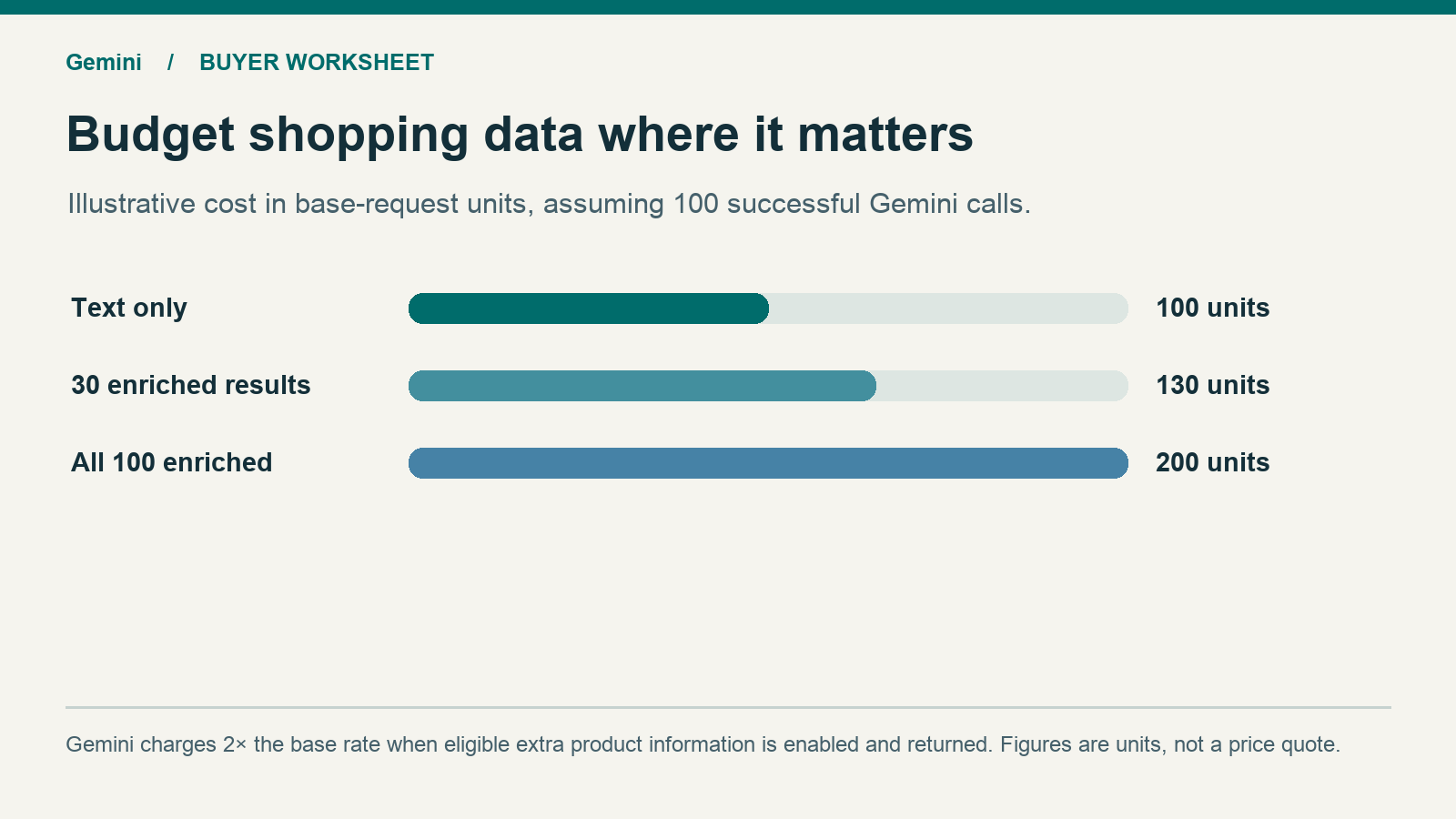
Gemini charges 2× the base rate when eligible extra product information is enabled and returned. Figures are units, not a price quote.
This is why a blanket setting is often the wrong purchasing decision. Questions about burr geometry, cleaning or counter height usually need an answer and its references. Questions about availability, a specific seller or the purchase link may justify the second unit. During the first month, tag questions by the decision they support. At the end of the month, ask whether anyone used the additional store fields. Switch them off for groups that consistently produce editorial work only.
A regional pilot for the catalog owner
Select a product you know well in two markets. Choose the same model designation and ask the same question in each market. Keep time and currency visible in the comparison. If the recommended model changes, establish that difference before trying to compare prices. If the model stays the same and the seller changes, the result may point to a distribution issue worth investigating. If both stay the same, take one more step and verify that the linked offer is available to a buyer in each market.
During vendor trials, give the files to the catalog owner without reformatting the hardest fields for them. Can they take one merchant offer from the capture and assign it to an existing catalog item? Can they distinguish missing price data from a price of zero? Can they tell a frequently cited reviewer from a seller? Those tests expose integration work a sample dashboard tends to conceal. They are also the reason our first choice for this article is a scraper that gives commerce and editorial evidence separate homes in the same result.
Conclusion
Choose Scrapeless when someone in merchandising needs to follow the link that a Gemini shopper saw. Keep the quoted recommendation, editorial citation and merchant offer together. That gives the brand owner, writer and ecommerce manager each a record they can use.
Try the Gemini check with your own question
Open the Scrapeless Dashboard and save your first completed answer. Discuss the result with our community on Discord or Telegram.
FAQ
Q: Does a Gemini citation identify the seller?
A citation identifies a source used in the answer. Read the store entry to identify the seller and its product link.
Q: Does every shopping prompt generate a product card?
Gemini decides what appears in the answer. A completed answer may contain prose and citations without a structured product offer.
Q: When does shopping enrichment cost extra?
For the Scrapeless Gemini scraper, the documented charge is twice the base rate when shopping is enabled and the response returns the extra product information.
Q: Should I compare the headline price range with a merchant's offer?
Keep both values with their labels. Use the merchant offer for a seller-level comparison and confirm variant, currency and any bundle details first.
At Scrapeless, we only access publicly available data while strictly complying with applicable laws, regulations, and website privacy policies. The content in this blog is for demonstration purposes only and does not involve any illegal or infringing activities. We make no guarantees and disclaim all liability for the use of information from this blog or third-party links. Before engaging in any scraping activities, consult your legal advisor and review the target website's terms of service or obtain the necessary permissions.