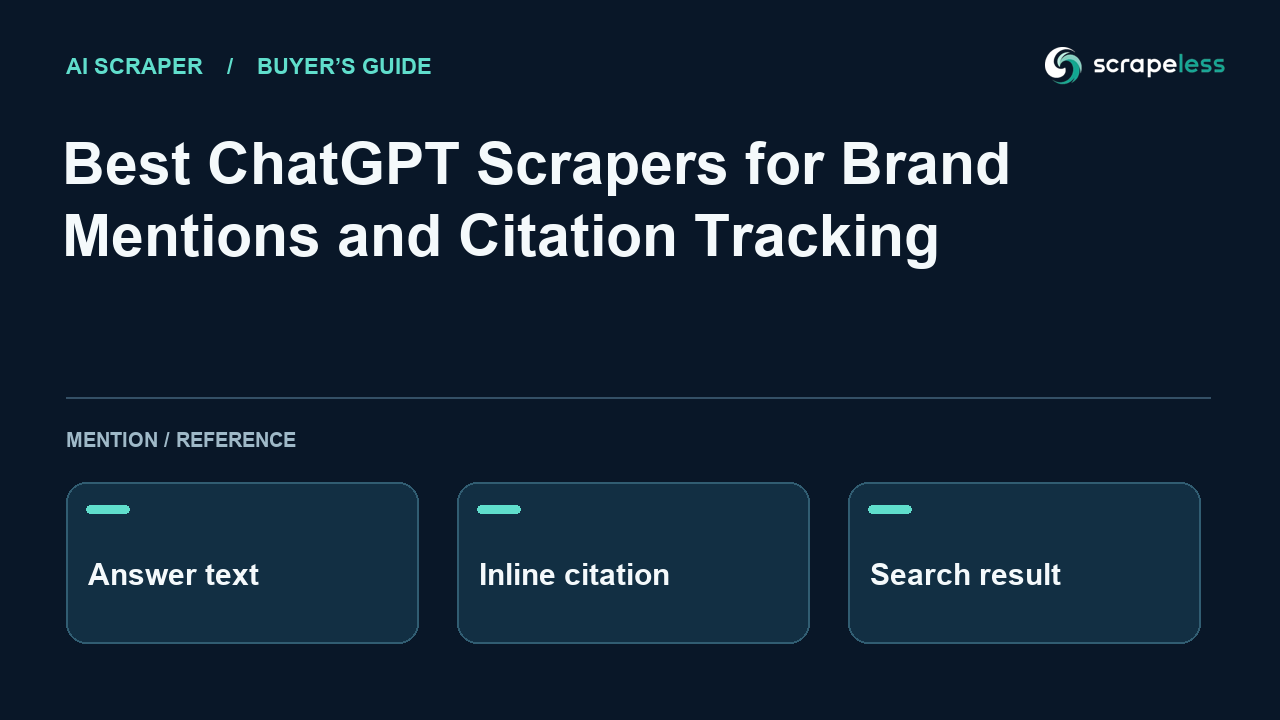
6 Best ChatGPT Scrapers for Brand Mentions and Citation Tracking

Advanced Data Extraction Specialist
TL;DR:
- Scrapeless is our first pick for tracking brand mentions in ChatGPT. One capture gives you the answer buyers read, the references inside it and the search results that accompanied it.
- Our measured average time for a complete ChatGPT capture is 20 seconds or less. We bill successful requests. You can keep shopping enrichment out of a text-only brand check.
- Bright Data suits teams buying finished records in bulk. Cloro is worth a look if query fan-out and brand entities are already central to your reporting.
Best ChatGPT scrapers at a glance
| Rank | Provider | Where it fits | What to check in a sample |
|---|---|---|---|
| 1 | Scrapeless | Brand monitoring that an editor can audit | Answer wording, inline reference URL and search-result URL in the same capture |
| 2 | Cloro | Search and entity analysis | Query fan-out and brand entities on a question that triggers search |
| 3 | Bright Data | Scheduled batches of answer records | Fields in the export your analytics team will actually receive |
| 4 | DataForSEO | Search teams already working with typed SERP records | Table items, cited sources and associated web results |
| 5 | ScrapingBee | A readable ChatGPT export for campaign reviews | Whether qualifiers survive in the Markdown export |
| 6 | Zen Studio on Apify | Repeating brand questions in different markets | Country, repeat index and citations associated with a sentence |
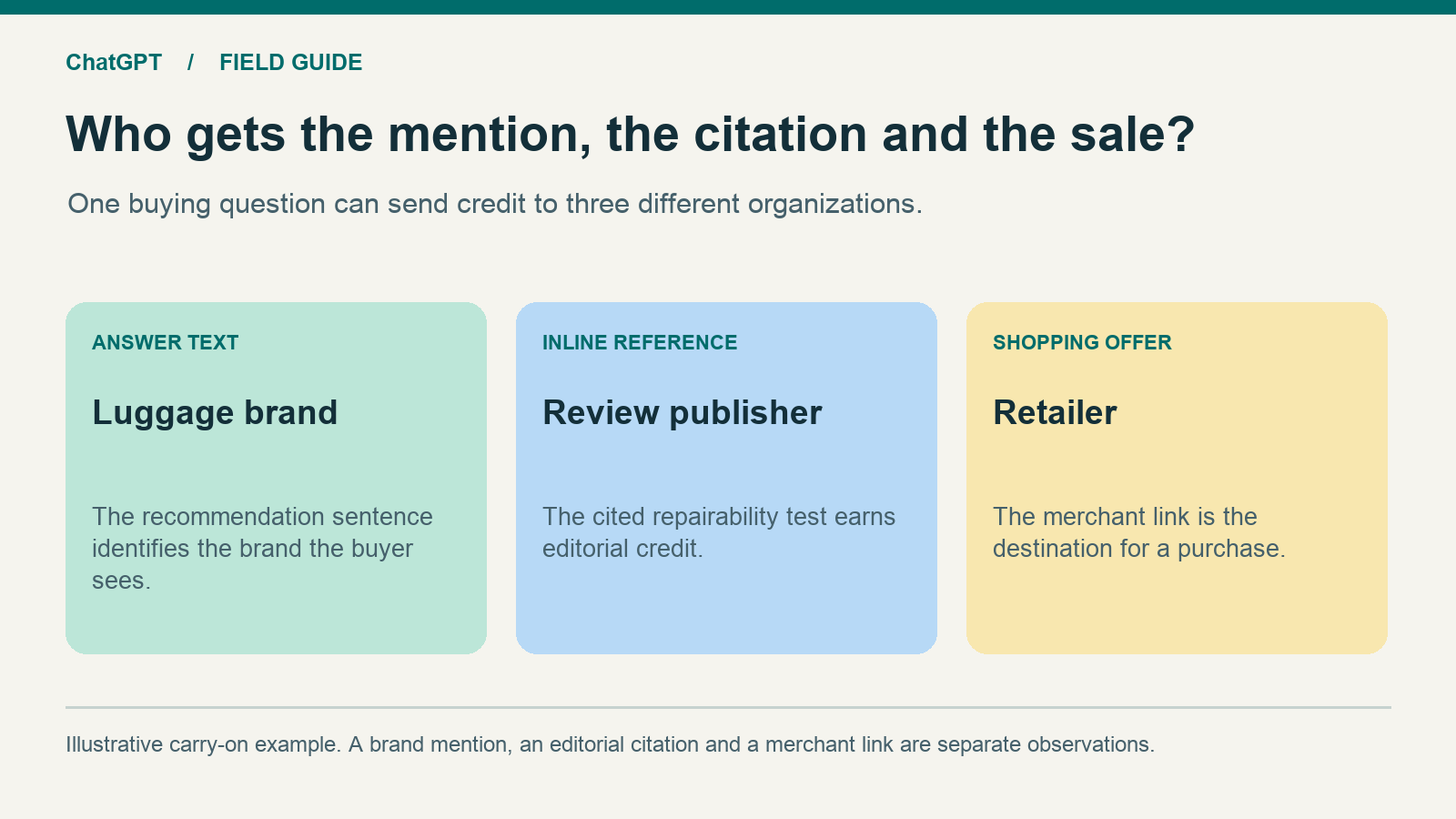
Illustrative carry-on example. A brand mention, an editorial citation and a merchant link are separate observations.
A buyer asks ChatGPT which carry-on suitcase is easiest to repair. Your brand makes the shortlist. The paragraph links to a luggage review, and your warranty page appears farther down in the search results. A report that says “our site was cited” would send the wrong signal to your content team. A good ChatGPT scraper lets an editor reconstruct all three observations from the saved answer.
We ranked these providers on that editorial task. We gave the most weight to preserving the answer and distinguishing references from other links. Billing predictability and the ability to repeat a question in the same market came next. The comparisons below use provider documentation. The timing and completeness figures describe our own service.
1. Scrapeless for separating brand mentions from earned citations
The Scrapeless ChatGPT Scraper captures the web answer as Markdown in result_text. Read that first. The sentence around a brand name tells you whether ChatGPT recommends the product, rules it out or briefly mentions it as an alternative. A mention count alone gives all three the same weight.
Next, look at content_references for pages referenced inside the answer. Keep search_result in a separate column. That array carries associated search results, including the URL, title and snippet when available. If the same publisher appears in both places, you can show the editor the exact page. If it appears only in the search results, you still have a lead for research. This distinction is the reason we put Scrapeless first for ChatGPT brand monitoring.
| Question from the brand team | Where to look | What to save |
|---|---|---|
| Did we make the shortlist? | Answer Markdown | The recommendation sentence, including its qualifier |
| Did our site earn a reference? | Inline references | The exact destination URL and the cited title |
| Who else informed the answer? | Associated search results | Publisher, page and snippet |
| Where can someone buy? | Product offers, when returned | Merchant and destination, separate from editorial citations |
Our service extracts at least 99% of available citations under our performance measure. A question can still produce an answer with no references. Capturing that answer matters: it tells you that the brand earned a mention without a link. Our average ChatGPT collection time of ≤20 seconds makes it practical for an editor to inspect a fresh answer during a review. Across the measured engine group, our average request success rate is 99.5%.
For a first check, enter “Which carry-on suitcases are easiest to repair?” in the ChatGPT scraper workflow, select your target country and enable web search. Disable shopping if the task is strictly editorial. Open the completed result and copy one recommendation sentence alongside its reference. Keep the prompt, date and country with that row. This is a suggested trial question; the brands and links will vary.
Start Scraping with Scrapeless
Power up your web scraping and automation workflow with Scrapeless!
Sign up today and get $5 in free credit — no credit card required.Claim your free credit now in the Scrapeless Dashboard.
2. Cloro for query fan-out and entity analysis
Cloro documents structured brand entities, shopping cards and the subsidiary queries ChatGPT issues during search. A search strategist investigating which product attributes shaped an answer can start with those queries. Its ChatGPT field coverage makes it a close second for that job. The purchasing difference is the monthly credit allocation. Check how much of the subscription allowance you expect to use in a quiet month.
A useful Cloro trial starts with a brand whose name is also a common word. Check the returned entity against the words in the answer. If the tool recognizes the company but the paragraph discusses a different product line, keep the entity match and the editorial verdict in separate columns. This also prevents a sponsored or shopping placement from being mistaken for a recommendation in prose. Cloro is attractive when these structured clues are a primary research input and the team expects to use its credit allocation regularly.
3. Bright Data for batch delivery
Bright Data offers a ChatGPT dataset API with record-based billing. It fits teams that already receive scheduled datasets and want another input in the same delivery process. During a trial, hand a finished record to the person who writes the weekly brand report. Ask them to point to the exact sentence and the page supporting it. That small exercise reveals more about fit than a count of available columns.
For a high-volume buyer, delivery is part of the product. Ask the warehouse owner what happens when a scheduled file contains two answers to the same question. Both can be legitimate observations. Keep the capture time beside the vendor record identifier and decide how a correction or replacement file should be handled. A clean delivery process protects the original evidence on which a campaign review was based. When the assignment begins with a small group of brand questions and a human editor, the field distinctions in Scrapeless tend to matter sooner than bulk-delivery convenience.
4. DataForSEO for teams that already work with SERP records
DataForSEO's ChatGPT search response schema breaks a response into typed items. Text blocks, tables, cited sources and web results are useful building blocks if an analyst already stores organic search results in DataForSEO's format. A table of recommended products can stay a table as it moves into the reporting system. That is preferable to having a spreadsheet user manually split the answer into rows.
Put it on the shortlist when the owner of the report is a search data team. Give that team a sample in which the brand appears in a table and in the accompanying prose. Ask how many mentions they would record. Counting each occurrence can be useful for studying prominence, while a weekly visibility report usually needs one brand appearance per completed answer. Decide that before comparing output sizes or assigning a winner.
5. ScrapingBee for lightweight answer exports
The ScrapingBee ChatGPT endpoint shows a prompt going in and a structured response coming out, with a Markdown version for reading. That gives a developer a short route to sending a category manager a digest of what ChatGPT said. It also gives the recipient a way to catch lost qualifiers. “Easy to repair if you live near an authorized dealer” reads quite differently once the condition has fallen off the end of a cell.
For occasional reviews, request a familiar buying question and hand the export directly to the intended reader. Can they name the recommended product, quote the caveat and find the link that supports it? If the project later grows into a catalog audit, repeat the trial on a shopping question and ask for the merchant's actual destination. An answer export and an offer-level report put different demands on the source data.
6. Zen Studio's ChatGPT Search Scraper for repeat observations
This Apify Store actor from Zen Studio describes repeat runs, country and language inputs, sentence-level citations and fields for sources ChatGPT searched. It is a good candidate for an analyst already using Apify who wants to compare several observations of the same query. The listing documents what the actor aims to return, and Apify supplies the environment in which it runs.
Its repeat option is particularly useful when a manager sees a single surprising result. Repeat the original wording before changing the question. If the brand disappears in another capture, retain both answers. Then test a separate hypothesis, such as whether adding a repair budget changes who appears. Changing the budget, country and wording at once gives you an interesting set of answers and very little evidence about which change mattered.
What to keep in the weekly brand report
Pick one unbranded category question and one question that names your brand. The first measures discovery. The second shows how ChatGPT describes you once the buyer already knows your name. Keep separate totals. If you start counting both together, a larger share of branded questions can make visibility appear to improve without any change in category recommendations.
The AI citation tracking solution uses that same prompt-level evidence. If a retailer replaces your product page as the linked destination, show both URLs and the recommendation text. The page owner can then decide whether to strengthen warranty details, update a product specification or follow up with the publisher. For a wider check, the AI Scrapers product family lets you ask the same question on another engine. The ChatGPT response walkthrough explains how to retrieve the full result.
For a wider product investigation, buyers can also use the Scraping API to collect independent commerce records and review the item the answer describes.
A worked brand report with three different winners
Imagine a luggage company reviewing the carry-on question above. In an illustrative answer, ChatGPT recommends its repairable case, links to a teardown published by a travel magazine and shows a retailer as the seller. The right handoff has three owners. The brand manager records a recommendation. The editorial lead records the magazine as the cited publisher. The ecommerce lead opens the retailer link to check whether the correct case is in stock. Credit the manufacturer only for the observation it actually earned.
Now suppose the team reviews 20 completed answers. Twelve mention the brand, five cite the manufacturer's site and four do both. The brand appears in 60% of the answers. Its site earns a citation in 25%. Among the answers that mention the brand, four of twelve also cite its site, or about one third. Those numbers describe the same panel. Only the last one answers the editorial lead's question about converting mentions into visits to an owned page. These counts illustrate the calculation; they are not a measurement of ChatGPT's market behavior.
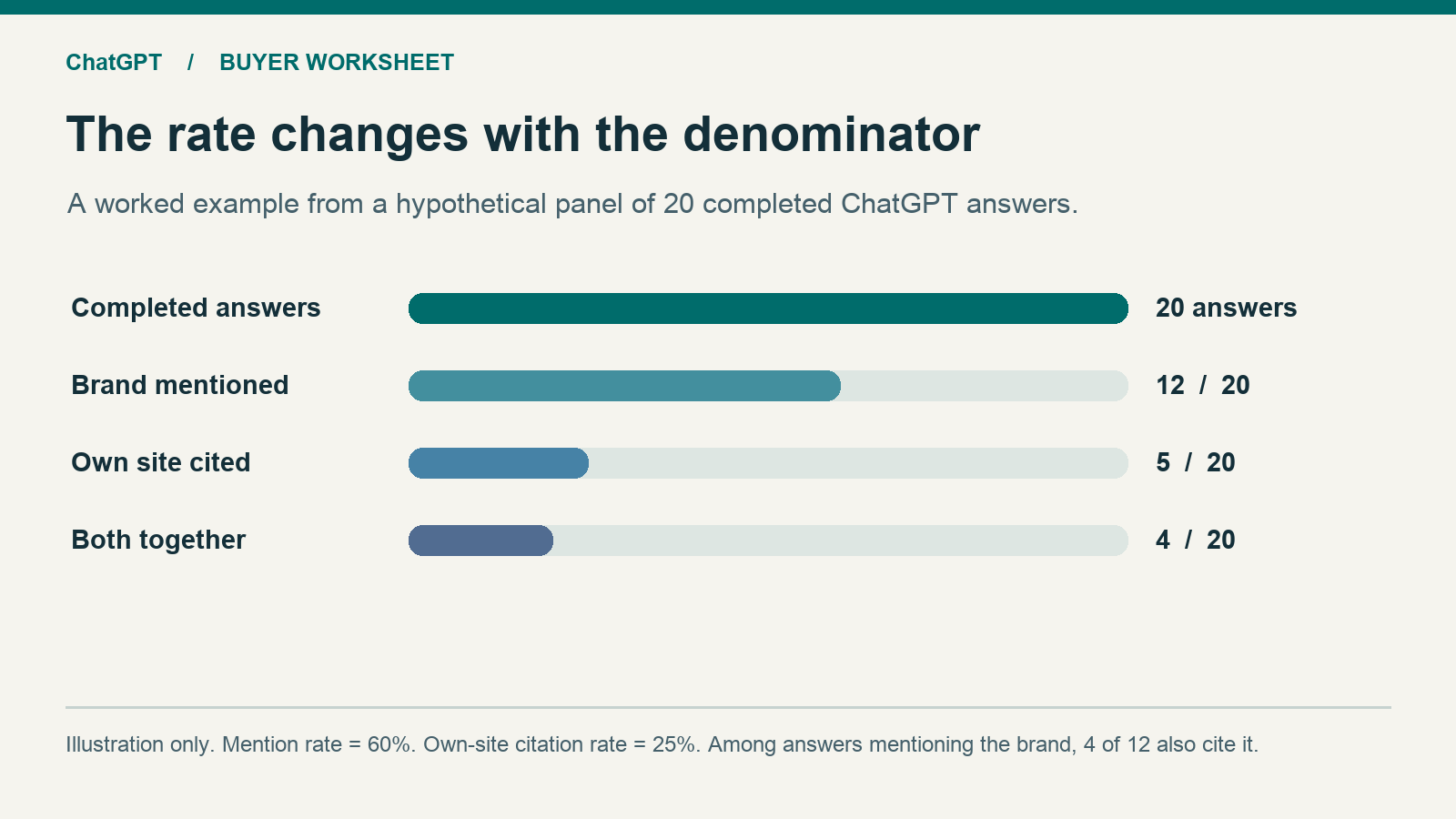
Illustration only. Mention rate = 60%. Own-site citation rate = 25%. Among answers mentioning the brand, 4 of 12 also cite it.
What should the team do about the gap? Read the four co-occurring cases first. Identify whether the cited pages contain repair instructions, warranty terms or spare-part numbers. Then inspect the mentioned-but-uncited cases. If a magazine answered a specific repair question that the manufacturer's own page leaves unresolved, the content owner has an actionable brief. If the magazine ran an independent durability test, a clearer warranty page is unlikely to displace it. The useful distinction comes from the sentence and the page, both of which Scrapeless preserves.
How to buy for a mixed editorial and shopping workload
Consider a team with a weekly category panel and an occasional launch campaign. Give each vendor the same prompt list, label the questions that need offers, and ask it to identify the billable unit on its quote. Then ask for an example invoice line for an unsuccessful collection and a successful answer that contains no citations. A legitimately empty answer field and a failed collection need different treatment in a cost estimate. Our successful-request policy makes the second part easy to reconcile. You can also keep shopping disabled on prompts where the report only needs text.
For a month with a launch, calculate the cost of the extra questions separately before rolling them into the routine panel. Editors may want frequent snapshots for three days and none the following week. A plan priced on recurring capacity and a plan tied to completed requests can look similar in a steady month and noticeably different during that burst. Compare invoiced spend with the number of answers your team can actually review.
A five-minute acceptance check for the editor
Give the reviewer a saved answer without naming the vendor. Ask for the recommended brand, the strongest caveat, the source that supports it and the destination of any shopping link. Next ask them to reconstruct the question and country a week later. If any of those steps requires a fresh ChatGPT session, write down what was missing in the export. For a brand-monitoring program, a traceable row is worth more than a dashboard total nobody can explain in a client meeting.
Conclusion
Choose Scrapeless when the weekly question is “Who mentioned us, and who got the link?” Keep the answer and its references together, add shopping fields only where the report needs them, and use Scrapeless pricing to cost the mix of requests you intend to run.
Try the ChatGPT check with your own question
Open the Scrapeless Dashboard and save your first completed answer. Discuss the result with our community on Discord or Telegram.
FAQ
Q: Can a ChatGPT brand mention count as a citation?
Count the mention when the answer names your brand. Count a citation when the answer references a page you track. The same answer can produce either observation or both.
Q: Can I export a link for someone to review?
The ChatGPT scraper offers a share-link option. Save the answer and references as well, so the reviewer can inspect the evidence captured on the reporting date.
Q: Does every request cost the same with shopping enabled?
Additional shopping data follows the applicable enrichment pricing rules. For a text-and-reference report, set shopping off and budget for successful base requests.
Q: Which scraper is best for a quarterly campaign?
Scrapeless is our pick for a short campaign because successful-request billing fits an intermittent schedule and the saved references support a later audit. A monthly credit plan also makes sense when the team expects steady use between campaigns.
At Scrapeless, we only access publicly available data while strictly complying with applicable laws, regulations, and website privacy policies. The content in this blog is for demonstration purposes only and does not involve any illegal or infringing activities. We make no guarantees and disclaim all liability for the use of information from this blog or third-party links. Before engaging in any scraping activities, consult your legal advisor and review the target website's terms of service or obtain the necessary permissions.