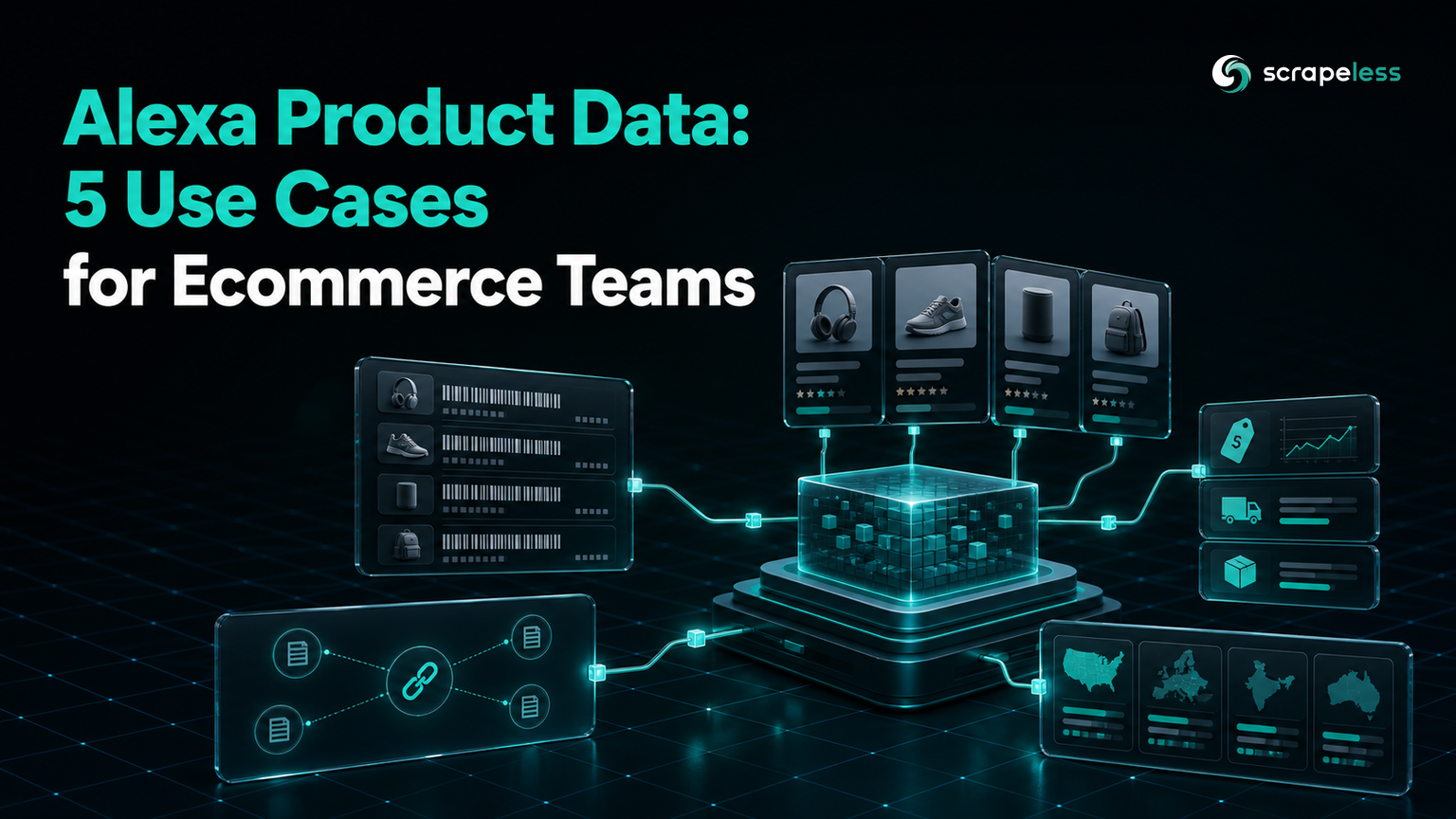
Alexa Product Data: 5 Use Cases for Ecommerce Teams

Web Data Collection Specialist
TL;DR:
- Alexa product data shows which items enter a conversational answer. Conditional product records can include an identifier, title, image, URL, displayed price, delivery message, and supporting detail lines.
- Recommendation visibility needs prompt context. A product appearance only has meaning when it is stored with the question, country, answer text, and citation set that produced it.
- Product identifiers make longitudinal tracking possible. The
product_idfield can carry an Amazon ASIN, giving ecommerce teams a stable join key when titles or prices change. - Citation links connect products to answer evidence. The
citation_idfield can associate a product record with a cited reference in the same response. - Five applications cover most first projects. Teams can measure product surfacing, audit product facts, track price and delivery context, inspect source support, and compare market outputs.
- Free to start. New Scrapeless accounts include access to a free plan at app.scrapeless.com.
Introduction: Product Discovery Now Happens Inside Answers
Shopping questions no longer end at a list of links. A conversational assistant can compare product categories, recommend an item, show a price, and carry the user into the next question without leaving the answer surface.
Alexa for Shopping supports product research, comparison, recommendations, price tracking, and shopping across several devices and interfaces. Those functions are described in Amazon's Alexa for Shopping announcement. Ecommerce teams therefore need a way to observe which products appear, what commercial context accompanies them, and which sources support the answer.
Scrapeless Alexa Scraper returns product information when it applies to an Alexa response. A product record can include product_id, citation_id, title, image_url, url, price, delivery, details, fragment_uri, and purpose. The same response also contains answer text, references, sources, and suggested follow-up prompts.
This article covers five ways ecommerce, marketplace, product-content, and GEO teams can use that data. It focuses on the decisions the dataset can support; the separate API guide covers the request and integration details.
Alexa Product Data at a Glance
Alexa product data is most useful when the product array stays attached to the response that produced it.
| Application | Primary fields | Team | Decision supported |
|---|---|---|---|
| Recommendation visibility | products[].product_id, title, purpose |
Ecommerce and GEO | Which tracked products appear for a prompt set |
| Product-fact audit | title, details, url, answer text |
Product content | Whether surfaced information matches the maintained catalog |
| Price and delivery context | price, delivery, country |
Pricing and operations | What commercial context Alexa displays in a market |
| Citation-to-product mapping | citation_id, references[], sources[] |
Content and digital shelf | Which sources support a product mention |
| Cross-market comparison | country, product fields, answer text |
Regional commerce | How product surfacing changes across country settings |
The actor returns an observation, not an attribution model. Product presence does not prove that a recommendation caused a click or sale. The dataset is still valuable because it records the answer surface that a shopper could see for a known prompt and market.
1. Measure Product Recommendation Visibility
Product recommendation visibility measures whether a tracked product appears across a controlled set of shopping prompts.
Build the prompt set around buyer needs rather than a long list of brand names. Useful groups include:
- Category discovery: “What are good [category] options for [use case]?”
- Constraint-led shopping: “Which [category] works under [budget or requirement]?”
- Comparison: “Compare products for [specific situation].”
- Replacement: “What is a good replacement for [product type]?”
- Purchase preparation: “What should be checked before buying [category]?”
For each completed answer, store the returned product identifiers and titles. The base appearance rate for a tracked product is:
completed answers containing the product / completed answers in the selected prompt set
Break that rate down by prompt group and country. A single aggregate can hide the useful detail: a product may appear consistently for one use case and remain absent from another.
Keep recommendation order as a derived field only when the product's position can be determined from the captured response. Do not create a rank from the array order unless the API documentation or a verified response confirms that order has ranking semantics.
2. Audit the Product Facts Alexa Surfaces
A product-fact audit compares Alexa's surfaced product information with the ecommerce team's maintained catalog.
Use product_id as the stable join key when it contains an ASIN. Titles, prices, and delivery messages can change; the identifier gives the warehouse a consistent record to join against the product information management system. GS1 describes the same role for standardized identifiers in its standards repository for identification keys.
Create a narrow fact table for the attributes that matter to customers and operations:
| Fact group | Example checks |
|---|---|
| Identity | Correct product title and identifier |
| Destination | Product URL resolves to the intended item |
| Commercial context | Displayed price and delivery message are captured as shown |
| Answer claims | Key feature or compatibility statements match approved product facts |
| Media | Image URL belongs to the intended product record |
The audit should preserve the original details list and answer text. A normalized field is useful for analysis, but the captured text is what a reviewer needs when a discrepancy appears.
This process should flag differences for review rather than editing product content automatically. A discrepancy can come from stale source material, a localized offer, a product variant, or an answer-generation difference. The evidence must stay visible until a human or a governed rule resolves it.
3. Track Price and Delivery Context
Price and delivery monitoring records the commercial information Alexa displays with a surfaced product.
The price and delivery fields are display strings. Store those raw strings before attempting normalization. Schema.org defines price and currency as separate concepts in its price property specification; the same separation is useful in an analytics warehouse even when the captured field arrives as one string.
A practical record contains:
- Capture identifier
- Prompt and country
- Product identifier and title
- Raw displayed price
- Parsed numeric price and currency, when parsing is unambiguous
- Raw delivery message
- Product URL
- Answer revision and completion state
The raw fields protect the evidence. If a parser later mistakes a range, discount, or localized number format, the team can repair the derived value without losing what Alexa displayed.
Delivery text needs the same discipline. A message such as a delivery date is contextual and can age quickly. Treat it as a point-in-time observation linked to the capture, not a standing fulfillment promise.
Get your API key on the free plan: app.scrapeless.com
4. Connect Product Mentions to Their Sources
Citation-to-product mapping shows which reference in the answer is associated with a product record.
The product citation_id can link a returned product to an entry in references. The wider sources array adds display text, URLs, source types, and fragment URIs. Store these as related tables instead of flattening every source into the product row.
A compact warehouse model uses four entities:
capturesfor prompt, country, answer text, and response identifiersproductsfor identifiers, titles, prices, delivery, and URLsreferencesfor citation IDs, titles, and URLscapture_productsfor the product-to-capture relationship and citation link
That structure keeps derivation and source relationships explicit. Analysts can then answer questions that a flat export obscures. Which domains support a tracked product? Does the same product draw different sources by market? Which products appear without a directly linked citation?
Do not infer that every source is product-owned or independent. Classify domains with a maintained mapping and keep an “unclassified” state so the dashboard does not force unknown sources into the wrong bucket.
5. Compare Product Surfacing Across Markets
Cross-market product analysis compares the same shopping prompts under different country settings.
Control the inputs before comparing the outputs. Use the same prompt wording, prompt-group label, capture window, and parsing logic. Change only the country value for the market run. The country field is required by the actor, which makes the market dimension part of the request rather than a label added after collection.
Useful comparisons include:
- Product appearance by market
- Product identifier overlap between markets
- Displayed price and delivery text by market
- Citation-domain overlap
- Suggested follow-up differences
- Brand and product mentions in the answer text
Market differences need repeated observation. A product that appears once in one market and disappears in the next capture should not be treated as a durable regional pattern. Keep the prompt-country pair as the primary monitoring unit and report both the latest observation and the historical frequency.
The testing and evaluation material in the NIST AI Resource Center supports this controlled approach to AI measurement: define the evaluation context, preserve evidence, and document how the measurement is produced.
How the Five Use Cases Work Together
The five Alexa product-data applications form one evidence chain.
Recommendation visibility identifies where a product appears. The fact audit checks what Alexa says about that product. Price and delivery capture preserve the commercial context. Citation mapping shows which sources accompany the answer. Market comparison reveals where those observations differ.
A phased rollout keeps the project manageable:
| Phase | Scope | Output |
|---|---|---|
| Baseline | One category, one country, fixed prompt set | Product appearance table |
| Evidence | Add references, sources, and raw answer storage | Product-to-source map |
| Commerce | Parse price and delivery fields conservatively | Commercial-context table |
| Markets | Repeat the same prompt set across selected countries | Market comparison view |
| Governance | Add catalog checks and review states | Product-fact audit queue |
The competitive pricing pipeline guide provides a related warehouse pattern for price observations collected from product pages. Alexa product data adds the conversational prompt, answer, and citation layers to that model.
Handle Product Data Responsibly
Alexa product monitoring should stay focused on publicly returned answers and the business questions defined by the team.
Store only the fields needed for visibility, accuracy, source, and market analysis. Do not attach private customer profiles or voice recordings to the dataset. Set a retention policy for raw responses, document the prompt registry, and restrict fact-audit decisions to reviewers who can see the supporting answer and source records.
The products array can be empty when product information does not apply. Preserve that state as “no product returned” rather than treating it as a collection failure. Empty and missing values carry different operational meanings and should remain distinguishable in the schema.
Conclusion: Start With One Product Question
Alexa product data gives ecommerce teams a structured view of product surfacing inside conversational answers. The first useful project does not need a large prompt library. One category, a small set of buyer-intent questions, and one country can establish the data model and review process.
Add fields only when they support a decision. Product identifiers support longitudinal joins. Raw prices and delivery strings preserve evidence. Citation IDs connect products to sources. Country settings make market comparisons possible. That is enough to build a credible baseline before the program expands.
Scrapeless LLM Chat Scraper is part of the Universal Scraping API line. Review the Universal Scraping API product page, the Alexa Scraper field reference, and current Scrapeless pricing before planning the capture scope.
Ready to Build Your Alexa Product-Visibility Dataset?
Join our community to claim a free plan and connect with developers working on ecommerce and answer-monitoring datasets: Discord · Telegram.
Sign up at app.scrapeless.com and begin with the products, prompts, and markets your team already reviews.
FAQ
Q: What product data can Alexa Scraper return?
Alexa Scraper can return product identifiers, citation identifiers, titles, image URLs, product URLs, displayed prices, delivery information, detail lines, fragment URIs, and purpose values when product information applies to the answer.
Q: Does every Alexa response contain products?
No. The product array can be empty when the answer is not product-oriented. A downstream schema should preserve an empty product result without treating it as an error.
Q: Can the product array order be treated as a ranking?
Product order should only be treated as ranking data when verified response behavior or product documentation defines that meaning. Otherwise, use product presence and answer context without assigning a rank.
Q: Why store the raw price and delivery strings?
Raw strings preserve what Alexa displayed at capture time. Parsed numeric values are useful for analysis, but localization, ranges, and promotional text can make parsing uncertain.
Q: How should teams compare Alexa product visibility between countries?
Teams should keep the prompt set and capture method fixed, change the required country input deliberately, and compare repeated observations for each prompt-country pair.
Q: Is Alexa product monitoring the same as sales attribution?
No. Alexa product monitoring records which products and supporting details appear in captured answers. Sales attribution requires separate click, conversion, or transaction data that the actor does not provide.
At Scrapeless, we only access publicly available data while strictly complying with applicable laws, regulations, and website privacy policies. The content in this blog is for demonstration purposes only and does not involve any illegal or infringing activities. We make no guarantees and disclaim all liability for the use of information from this blog or third-party links. Before engaging in any scraping activities, consult your legal advisor and review the target website's terms of service or obtain the necessary permissions.